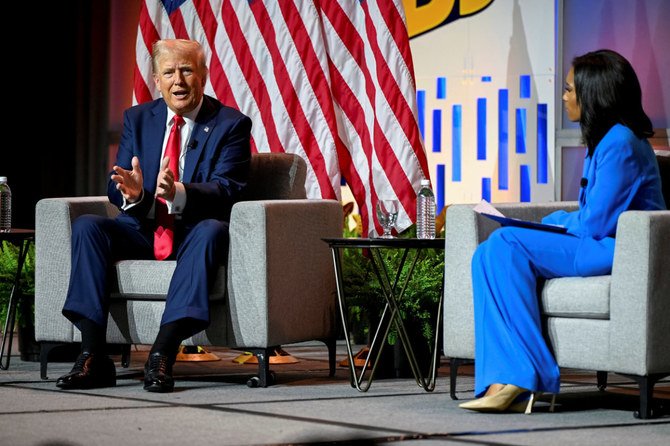

CHICAGO: Donald Trump falsely suggested Kamala Harris had misled voters about her race as the former president appeared before the National Association of Black Journalists in Chicago Wednesday in an interview that quickly turned hostile.
The Republican former president wrongly claimed that Harris, the first Black woman and Asian American to serve as vice president, had in the past only promoted her Indian heritage.
“I didn’t know she was Black until a number of years ago when she happened to turn Black and now she wants to be known as Black. So, I don’t know, is she Indian or is she Black?” Trump said while addressing the group’s annual convention.
Harris is the daughter of a Jamaican father and an Indian mother, both immigrants to the US As an undergraduate, Harris attended Howard University, one of the nation’s most prominent historically Black colleges and universities, where she also pledged the historically Black sorority Alpha Kappa Alpha. As a US senator, Harris was a member of the Congressional Black Caucus, supporting her colleagues’ legislation to strengthen voting rights and reforming policing.
Trump has leveled a wide range of criticism at Harris since she replaced President Joe Biden atop the likely Democratic ticket last week. Throughout his political career, the former president has repeatedly questioned the backgrounds of opponents who are racial minorities.
Michael Tyler, the communications director for Harris’ campaign, said in a statement that “the hostility Donald Trump showed on stage today is the same hostility he has shown throughout his life, throughout his term in office, and throughout his campaign for president as he seeks to regain power.”
“Trump lobbed personal attacks and insults at Black journalists the same way he did throughout his presidency — while he failed Black families and left the entire country digging out of the ditch he left us in,” Tyler said. “Donald Trump has already proven he cannot unite America, so he attempts to divide us.
White House press secretary Karine Jean-Pierre was asked during her briefing with reporters on Wednesday about Trump’s remarks and responded with disbelief, initially murmuring, “Wow.”
Jean-Pierre, who is Black, called what Trump said “repulsive” and said, “It’s insulting and no one has any right to tell someone who they are how they identify.”
Trump has repeatedly attacked his opponents and critics on the basis of race. He rose to prominence in Republican politics by propagating false theories that President Barack Obama, the nation’s first Black president, was not born in the United States. “Birtherism,” as it became known, was just the start of Trump’s history of questioning the credentials and qualifications of Black politicians.
He has denied allegations of racism. And after Biden picked Harris as his running mate four years ago, a Trump campaign spokesperson then pointed to a previous Trump political donation to Harris as proof that he wasn’t racist.
“The president, as a private businessman, donated to candidates across all aisles,” the spokesperson, Katrina Pierson, told reporters. “And I’ll note that Kamala Harris is a Black woman and he donated to her campaign, so I hope we can squash this racism argument now,” Pierson said.
During this year’s Republican primary, he once referred to former UN Ambassador Nikki Haley, the daughter of Indian immigrants, as “Nimbra.”
Trump’s appearance Wednesday at the annual gathering of Black journalists immediately became heated, with the former president sparring with interviewer Rachel Scott of ABC News and accusing her of giving him a “very rude introduction” with a tough first question about his past criticism of Black people and Black journalists, his attack on Black prosecutors who have pursued cases against him and the dinner he had at his Florida club with a white supremacist.
“I think it’s disgraceful,” Trump said. “I came here in good spirit. I love the Black population of this country. I’ve done so much for the Black population of this country.”
Trump continued his attacks on Scott’s network, ABC News, which he has been arguing should not host the next presidential debate, despite his earlier agreement with the Biden campaign. He also several times described her tone and questions as “nasty,” a word he used in the past when describing women, including Hillary Clinton and Meghan the Duchess of Sussex.
The Republican also repeated his false claim that immigrants in the country illegally are “taking Black jobs.” When pushed by Scott on what constituted a “Black job,” Trump responded by saying “a Black job is anybody that has a job,” drawing groans from the room.
At one point, he said, “I have been the best president for the Black population since Abraham Lincoln.”
The audience responded with a mix of boos and some applause.
Scott asked Trump about his pledge to pardon people convicted for their roles in the Jan. 6, 2021, riot at the US Capitol and specifically whether he would pardon those who assaulted police officers.
Trump said, “Oh, absolutely I would,” and said, “If they’re innocent, I would pardon them.”
Scott pointed out they have been convicted and therefore are not innocent.
“Well, they were convicted by a very, very tough system,” he said.
At one point, when he was defending his supporters who entered the Capitol on Jan. 6, he said, “Nothing is perfect in life.”
He compared the 2021 insurrection to the protests in Minneapolis and other cities in 2020 following the death of George Floyd by Minneapolis police and to more recent protests at the Capitol last week by demonstrators opposed to the war in Gaza. Trump falsely claimed that no one was arrested in those other demonstrations and that only his supporters were targeted.
As Trump made the comparison, a man in the back of the room shouted out, “Sir, have you no shame?”
The former president’s invitation to address the organization sparked an intense internal debate among NABJ that spilled online. Organizations for journalists of color typically invite presidential candidates to speak at their summer gatherings in election years.
As he campaigns for the White House a third time, Trump has sought to appear outside his traditional strongholds of support and his campaign has touted his efforts to try to win over Black Americans, who have been Democrats’ most committed voting bloc.
His campaign has emphasized his messages on the economy and immigration as part of his appeal, but some of his outreach has played on racial stereotypes, including the suggestion that African Americans would empathize with the criminal charges he has faced and his promotion of branded sneakers.
Trump and NABJ also have a tense history over his treatment of Black women journalists. In 2018, NABJ condemned Trump for repeatedly using words such as “stupid,” “loser” and “nasty” to describe Black women journalists.
The vice president is not scheduled to appear at the convention, but NABJ said in a statement posted on X that it was in conversation with her campaign to have her appear either virtually or in person for a conversation in September.
Trump posted on his social media network that he was told he could not do the event virtually.
“She declined, and I am getting ready to land in Chicago in order to be there,” Trump wrote. “Now I am told that she is doing the Event on ZOOM. WHAT’S GOING ON HERE?”
Trump hosted a campaign rally in Harrisburg, Pennsylvania, later Wednesday in which he repeatedly mispronounced Harris’ name.
Before he took the stage, Trump’s team displayed what appeared to be years-old news headlines describing Harris as the “first Indian-American senator” on the big screen in the arena.