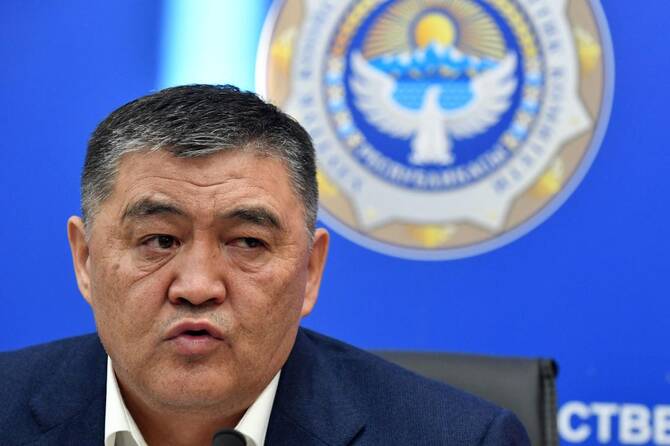
BISHKEK: Kyrgyzstan’s parliament speaker said Thursday he would step down, two days after President Sadyr Japarov dismissed the Central Asian country’s powerful secret service chief and arrested political figures who called for early elections.
In a surprise move, Japarov had sacked his one-time close ally — spy chief Kamchybek Tashiev — in a decision Bishkek said was meant to “prevent division in society.”
Japarov is seeking re-election next year in a country that was once a regional leader in terms of openness, though marked by political volatility.
Rights groups have accused him of authoritarian tendencies, as he seeks to assert his control and cast himself as a bringer of stability.
Speaker Nurlanbek Turgunbek uulu — close to the sacked security boss — told MPs he would step down, insisting that he was not resigning under pressure.
“Reforms initiated by the president must be carried out. Political stability is indispensable,” he said.
Kyrgyzstan has in recent years been de-facto governed by the Japarov-Tashiev tandem.
Both came to power in the wake of the 2020 revolution — the third since Bishkek gained independence from the Soviet Union in 1991.
Several NGOs have in recent months denounced the deterioration of freedom of expression in Kyrgyzstan.
Japarov had unexpectedly sacked Tashiev and three of his deputies on Tuesday, also weakening the powers of the secret services.
Japarov rarely speaks publicly. His spokesman had said the decision was taken “in the interests of the state, with the aim of preventing divisions within society, including between government structures, and to strengthen unity.”
Tashiev was in Germany for health treatment when the sacking was announced and had said it was a “total surprise” to him.
The decision came the day after the publication of an open letter from 75 political figures and ex-officials calling to bring forward presidential elections — scheduled for January 2027.
Five of those who signed the letter — which criticized the economic situation in the country — were arrested Wednesday on charges of organizing mass riots.

Kyrgyzstan parliament speaker resigns after spy chief sacking
https://arab.news/m5h2z
Kyrgyzstan parliament speaker resigns after spy chief sacking
- Japarov is seeking re-election next year in a country that was once a regional leader in terms of openness
Single ‘digital nation-state’ is not a far-fetched notion, Melania Trump tells UN Security Council
- US first lady argues that AI and global connectivity could reshape education, help reduce conflict and empower children worldwide
- Societies rooted in knowledge foster innovation, tolerance and moral reasoning, while those shaped by ignorance risk disorder and conflict, she says
NEW YORK CITY: The idea of a single digital nation-state is “not so far-fetched,” US First Lady Melania Trump told the UN Security Council on Monday.
She argued that artificial intelligence and global connectivity could reshape education, help reduce conflict and empower children worldwide.
The US holds the rotating presidency of the council for March, and as she presided over its first meeting of the month Trump said technology was erasing borders and creating what she described as a shared intellectual future.
“Perhaps this idea isn’t so far-fetched,” she said, pointing to the rise of digital currencies, blockchain-based payment systems, and AI-driven databases she argued were already transforming media and financial markets.
Trump thanked the US’s fellow council members — the UK, France, Russia, China, Greece, the Democratic Republic of Congo, Denmark, Panama, Liberia, Somalia, Colombia, Pakistan, Bahrain and Latvia — for their role in efforts to maintain international security.
The responsibility for preventing conflict “must be applied evenly and should never be carried out lightly,” she said. Her remarks focused in particular on the role of education as the foundation of peace and stability.
“A nation that makes learning sacred protects its books, its language, its science and its mathematics. It protects its future,” Trump said, arguing that societies rooted in knowledge foster innovation, tolerance and moral reasoning, while those shaped by ignorance risk disorder and conflict.
Education is widely recognized as a fundamental human right, she added, yet many children and young adults around the world remain barred from the chance to attend high school or university. The losses arising from this squandered potential, from potential medical breakthroughs to possible advances in food security and technology, are borne not only by the individual countries involved but by humanity as a whole, she said.
Trump called for the expansion of global access to technology to help bridge the digital divide, noting that about 6 billion people, 70 percent of the world’s population, now use mobile devices and the internet.
“If our nations band together, we can close the technological divide,” she said, describing a world in which a farmer on a remote Greek island, a student in Somalia and a resident of New York City can all tap into centuries of accumulated human knowledge.
AI was democratizing access to information once confined to university libraries, she added, and redefining participation in the global “economy of ideas.”
She continued: “Conflict arises from ignorance. Knowledge creates understanding, replacing fear with peace and unity.”
Trump called on council members to safeguard learning and promote access to higher education, urging them to “build a future generation of leaders who embrace peace through education.”
She added: “The path to peace depends on us taking responsibility to empower our children through education and technology.”


