

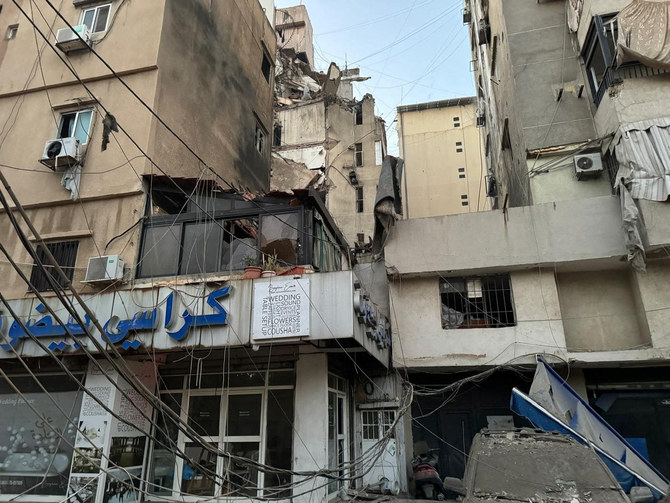


BEIRUT: The Lebanese militant group Hezbollah said Wednesday they were still searching for the body of a top commander targeted in an Israeli strike in Beirut.
The Iran-backed group’s first comment after the strike targeting Fouad Shukur came hours after his death Tuesday and followed an overnight strike in Tehran that killed Hamas leader Ismail Haniyeh. Hezbollah did not comment about the Hamas leader’s death.
Israel claimed late Tuesday that they had killed Shukur, who they said was behind a rocket attack on Majdal Shams in the Israeli-occupied Golan Heights that killed 12 youths.
An Israeli drone strike in Beirut’s southern suburb of Haret Hreik has targeted Fuad Shukr, head of Iran-backed Hezbollah’s military operations room, who is considered the No. 2 in the group.
The attack left the targeted residential building damaged.
Hezbollah said civil defense workers were still searching for his body and others under the rubble of the building Israel struck.
Like most of Hezbollah’s military officials, little is known about Shukur, who was also known as Sayed Mohsen. Washington blames him for planning and staging the truck bombing of a Marine Corps barracks in Beirut that killed 241 American service members in 1983. US Treasury Department had offered a $5 million reward for information about him.
The Lebanese Health Ministry said that at least two children and a woman were killed in the attack, while 74 others were wounded.
The attack, which took place shortly before 8 p.m. local time, came against the backdrop of Israeli threats to deal Hezbollah “a painful blow” after Israeli officials held the group responsible for the bombing of a football stadium in the town of Majdal Shams in the occupied Golan Heights on Saturday, which left 12 children and young adults dead and dozens injured.
Hezbollah strongly denied any role in the attack.
The Israeli drone fired three missiles at the targeted building, which is located near a former office of Hezbollah’s Shoura Council and a few meters from Bahman Hospital.
Dozens of ambulances and fire engines rushed to the scene amid the thick dust, broken glass and debris in the surrounding streets, while Hezbollah set up a security cordon around the area.
Residents took to the streets, some in a state of panic believing that the area was being bombed, while hundreds of young Hezbollah supporters chanted slogans in support of the group, threatening Israel with a response.
The Israeli military said 15 projectiles had been fired across the Lebanese border, with impacts in parts of the Upper Galilee region. No injuries were reported.

A photo shows the destroyed top floors of an eight storey building following an Israeli military strike on Beirut’s southern suburbs on July 30, 2024. (AFP)
Israel’s Channel 13 was quick to confirm the attack on the southern suburb of Beirut and said that it was carried out by a drone that had fired three missiles.
Israeli media published a photo of Shukr and said that “the Israeli army has set a reward of up to $5 million for information on Fuad Shukr.”
Officials, including the UN’s chief coordinator in Lebanon, have stepped up their efforts to prevent a deterioration in the situation.
Israel’s Channel 12 quoted an Israeli official as saying that “Israel has no intention of starting a regional war, and the ball is in Hezbollah’s court. If it does not respond to the attack, we will not be dragged into a war.”
The Israel Broadcasting Authority said: “The decision on the target of the attack on the southern suburb of Beirut was made last Sunday after Benjamin Netanyahu’s return from the US.”


