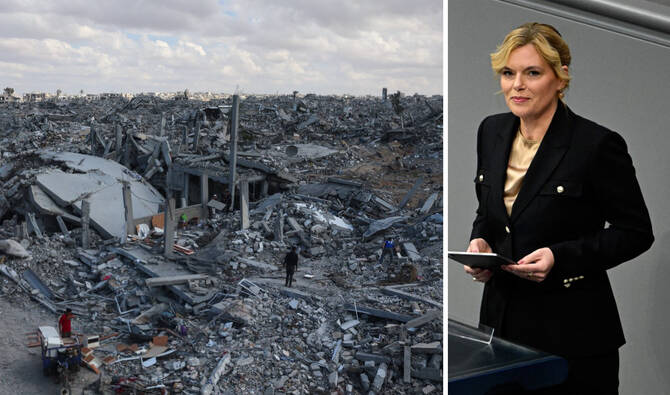
BERLIN: The speaker of Germany’s lower house of parliament briefly visited the Israeli-controlled part of the Gaza Strip on Thursday, the body told AFP.
Julia Kloeckner spent “about an hour in the part of Gaza controlled by Israeli army forces,” parliament said, becoming the first German official to visit the territory since Hamas’s attack on Israel in October 2023 that sparked the devastating war.
Since the start of the conflict, Israel has drastically restricted access to the densely populated coastal strip.
In a statement shared by her office, Kloeckner said it was essential for politicians to have access to “reliable assessments of the situation” in Gaza.
“I expressly welcome the fact that Israel has now, for the first time, granted me, a parliamentary observer, access to the Gaza Strip,” she said.
However, she was only able to gain a “limited insight” into the situation on the ground during her trip, she said.
Kloeckner appealed to Israel to “continue on this path of openness” and emphasized that the so-called yellow line, which designates Israeli military zones inside the Gaza Strip, must “not become a permanent barrier.”
The German foreign ministry did not immediately respond to a request for comment from AFP.
Germany has been one of Israel’s staunchest supporters as the European power seeks to atone for the legacy of the Holocaust.
But in recent months, Chancellor Friedrich Merz has occasionally delivered sharp critiques of Israeli policy as German public opinion turns against Israel’s actions in Gaza.
In August, Germany imposed a partial arms embargo on Israel, which was lifted in November after the announcement of what has proved to be a fragile ceasefire for Gaza.
Merz visited Israel in December and reaffirmed Germany’s support.
But in a sign of lingering tension, Germany’s foreign ministry on Wednesday criticized Israeli plans to tighten control over the occupied West Bank as a step toward “de facto annexation.”

German parliament speaker visits Gaza
Short Url
https://arab.news/447ta
German parliament speaker visits Gaza
- Germany has been one of Israel’s staunchest supporters as the European power seeks to atone for the legacy of the Holocaust
WHO says Dubai global emergency logistics hub ‘resuming operations’
- Hanan Balkhy, WHO’s Eastern Mediterranean regional chief, says more than 50 emergency supply requests across 25 countries are affected by the pause
- The hub stopped work this week after Iran launched waves of missile and drone attacks across the Gulf
GENEVA: The World Health Organization said its global health emergencies logistics hub in Dubai was resuming operations on Friday after a pause caused by the war in the Middle East.
“One of our most immediate concerns is the disruption of humanitarian health supply chains,” Hanan Balkhy, the UN health agency’s Eastern Mediterranean regional chief, told a press conference in Geneva.
“After a temporary pause, WHO’s Hub for Global Health Emergencies Logistics is today resuming operations,” she said, speaking from Cairo.
She said the UAE, in coordination with the UN’s World Food Programme, had confirmed that it stood ready to facilitate urgent humanitarian shipments.
“More than 50 emergency supply requests across 25 countries are currently affected,” said Balkhy.
“These pending requests — which will benefit more than 1.5 million people — include WHO supplies for Lebanon, Gaza, Yemen, and Somalia, as well as polio laboratory supplies for global detection and eradication activities across a number of countries.”
She said the WHO would be working in the coming days to process urgent new shipments and clear priority backlogs.
Balkhy noted that even before the escalation of hostilities in the Middle East, health systems in many countries were already operating at full capacity.
“WHO has pre-positioned trauma supplies and essential medicines at our warehouse in Tehran and is closely monitoring the situation — including potential mass casualty needs, disruptions to essential health services, and possible displacement,” she said.
“One of our most immediate concerns is the disruption of humanitarian health supply chains,” Hanan Balkhy, the UN health agency’s Eastern Mediterranean regional chief, told a press conference in Geneva.
“After a temporary pause, WHO’s Hub for Global Health Emergencies Logistics is today resuming operations,” she said, speaking from Cairo.
She said the UAE, in coordination with the UN’s World Food Programme, had confirmed that it stood ready to facilitate urgent humanitarian shipments.
“More than 50 emergency supply requests across 25 countries are currently affected,” said Balkhy.
“These pending requests — which will benefit more than 1.5 million people — include WHO supplies for Lebanon, Gaza, Yemen, and Somalia, as well as polio laboratory supplies for global detection and eradication activities across a number of countries.”
She said the WHO would be working in the coming days to process urgent new shipments and clear priority backlogs.
Balkhy noted that even before the escalation of hostilities in the Middle East, health systems in many countries were already operating at full capacity.
“WHO has pre-positioned trauma supplies and essential medicines at our warehouse in Tehran and is closely monitoring the situation — including potential mass casualty needs, disruptions to essential health services, and possible displacement,” she said.
© 2026 SAUDI RESEARCH & PUBLISHING COMPANY, All Rights Reserved And subject to Terms of Use Agreement.


