Who is the Hezbollah commander targeted by Israel in Beirut?

1 / 2
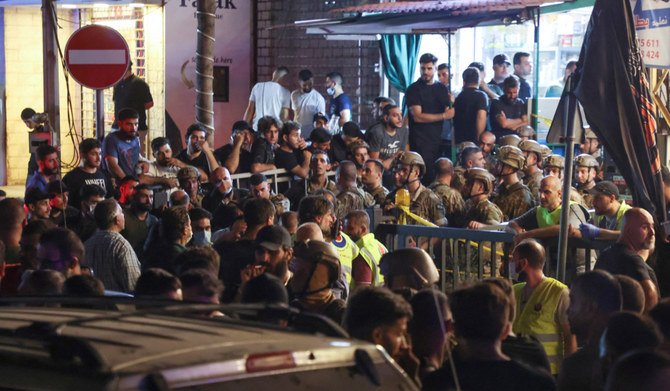
Members of the Lebanese army and people gather near a damaged site after what security sources said was a strike on Beirut's southern suburbs, Lebanon July 30, 2024. (REUTERS)
2 / 2
A man inspects a destroyed building that was hit by an Israeli airstrike in the southern suburbs of Beirut, Lebanon, Tuesday, July 30, 2024. (AP)
Short Url
Updated 31 July 2024
Follow

Who is the Hezbollah commander targeted by Israel in Beirut?

  • Two security sources in Lebanon earlier named the target as Shukr, describing him as head of Hezbollah’s operations center

BEIRUT: Fuad Shukr, a Hezbollah commander whom Israel believes it killed in an airstrike in Beirut on Tuesday, has been one of the group’s leading military figures since it was established by Iran’s Revolutionary Guards more than four decades ago.
Part of the generation of Lebanese Shiites who founded Hezbollah during the Israeli invasion of Lebanon in 1982, Shukr was a friend of the group’s late military commander Imad Mughniyeh, who was assassinated in Damascus in 2008, Hezbollah sources said.
The United States says Shukr, believed to be in his 60s, played a central role in the 1983 bombing of the US Marine barracks in Beirut, which killed 241 US military personnel, and had put a bounty of up to $5 million on his head, according to the US government’s Rewards for Justice website.
He was hit in what the Israeli army has said was a targeted strike against the Hezbollah commander responsible for an attack in the Israeli-occupied Golan Heights that killed 12 children and teenagers at the weekend. Hezbollah denied any role.
An Israel broadcast report said the commander was killed.
Two security sources in Lebanon earlier named the target as Shukr, describing him as head of Hezbollah’s operations center. They said he was critically injured in the attack around Hezbollah’s Shoura Council in the Haret Hreik neighborhood.
Also known as Al-Hajj Mohsin, Hezbollah sources said Shukr is a special adviser to Hezbollah leader Sayyed Hassan Nasrallah and a member of the Shoura Council, a decision-making body.
The sources said he became more prominent in Hezbollah after the assassination of Mughniyeh — a shadowy figure remembered in Hezbollah as a military mastermind who was on the US list of most wanted terrorists, accused of plotting attacks on Western interests including the Marines barracks.
Referring to those attacks and hostage-taking in Lebanon in the 1980s, Hezbollah leader Nasrallah said in a 2022 interview with an Arabic broadcaster they were carried out by small groups not linked to Hezbollah.
The Hezbollah sources said Shukr fought Israeli troops during Israel’s 1982 invasion alongside both Mughniyeh and Mustafa Badreddine, another of Hezbollah’s veteran commanders who was killed in Syria in 2016.
Announcing the bounty on his head in 2017, the US Rewards for Justice program said he was a senior Hezbollah military commander of the group’s forces in southern Lebanon and a member of Hezbollah’s highest military body, the Jihad Council.
It also said he played a key role in its military operations in Syria, where Hezbollah deployed fighters in support of President Bashar Assad in the early years of the Syrian civil war.
Hezbollah at the time dismissed the accusations against Shukr and another Hezbollah operative for whom a bounty was offered, Talal Hamiyah, saying they were “rejected and void.”


Deaths mount in Gaza as ceasefire frays and key agreements stall

Updated 9 sec ago
Follow

Deaths mount in Gaza as ceasefire frays and key agreements stall

JERUSALEM: As the bodies of two dozen Palestinians killed in Israeli strikes arrived at hospitals in Gaza on Wednesday, the director of one asked a question that has echoed across the war-ravaged territory for months.
“Where is the ceasefire? Where are the mediators?” Shifa Hospital’s Mohamed Abu Selmiya wrote on Facebook.
At least 556 Palestinians have been killed in Israeli strikes since a US-brokered truce came into effect in October, including 24 on Wednesday and 30 on Saturday, according to Gaza’s Health Ministry. Four Israeli soldiers have been killed in Gaza in the same period, with more injured, including a soldier whom the military said was severely wounded when militants opened fire near the ceasefire line in northern Gaza overnight.
Other aspects of the agreement have stalled, including the deployment of an international security force, Hamas’ disarmament and the start of Gaza’s reconstruction. The opening of the Rafah border crossing between Gaza and Egypt raised hope of further progress, but fewer than 50 people were allowed to cross on Monday.
Hostages freed as other issues languish
In October, after months of stalled negotiations, Israel and Hamas accepted a 20-point plan proposed by US President Donald Trump aimed at ending the war unleashed by Hamas’ Oct. 7, 2023, attack into Israel.
At the time, Trump said it would lead to a “Strong, Durable, and Everlasting Peace.”
Hamas freed all the living hostages it still held at the outset of the deal in exchange for thousands of Palestinian prisoners held by Israel and the remains of others.
But the larger issues the agreement sought to address, including the future governance of the strip, were met with reservations, and the US offered no firm timeline.
The return of the remains of hostages meanwhile stretched far beyond the 72-hour timeline outlined in the agreement. Israel recovered the body of the last hostage only last week, after accusing Hamas and other militant groups of violating the ceasefire by failing to return all of the bodies. The militants said they were unable to immediately locate all the remains because of the massive destruction caused by the war — a claim Israel rejected.
The ceasefire also called for an immediate influx of humanitarian aid, including equipment to clear rubble and rehabilitate infrastructure. The United Nations and humanitarian groups say aid deliveries to Gaza’s 2 million Palestinians have fallen short due to customs clearance problems and other delays. COGAT, the Israeli military body overseeing aid to Gaza, has called the UN’s claims “simply a lie.”
Ceasefire holds despite accusations
Violence has sharply declined since the ceasefire paused a war in which more than 71,800 Palestinians have been killed, according to the Gaza Health Ministry. The ministry is part of the Hamas-led government and maintains detailed records seen as generally reliable by UN agencies and independent experts.
Hamas-led militants killed some 1,200 people in the initial October 2023 attack and took around 250 hostage.
Both sides say the agreement is still in effect and use the word “ceasefire” in their communications. But Israel accuses Hamas fighters of operating beyond the truce line splitting Gaza in half, threatening its troops and occasionally opening fire, while Hamas accuses Israeli forces of gunfire and strikes on residential areas far from the line.
Palestinians have called on US and Arab mediators to get Israel to stop carrying out deadly strikes, which often kill civilians. Among those killed on Wednesday were five children, including two babies. Hamas, which accuses Israel of hundreds of violations, called it a “grave circumvention of the ceasefire agreement.”
In a joint statement on Sunday, eight Arab and Muslim countries condemned Israel’s actions since the agreement took effect and urged restraint from all sides “to preserve and sustain the ceasefire.”
Israel says it is responding to daily violations committed by Hamas and acting to protect its troops. “While Hamas’ actions undermine the ceasefire, Israel remains fully committed to upholding it,” the military said in a statement on Wednesday.
“One of the scenarios the (military) has to be ready for is Hamas is using a deception tactic like they did before October 7 and rearming and preparing for an attack when it’s comfortable for them,” said Lt. Col. Nadav Shoshani, a military spokesperson.
Some signs of progress
The return of the remains of the last hostage, the limited opening of the Rafah crossing, and the naming of a Palestinian committee to govern Gaza and oversee its reconstruction showed a willingness to advance the agreement despite the violence.
Last month, US envoy Steve Witkoff, who played a key role in brokering the truce, said it was time for “transitioning from ceasefire to demilitarization, technocratic governance, and reconstruction.”
That will require Israel and Hamas to grapple with major issues on which they have been sharply divided, including whether Israel will fully withdraw from Gaza and Hamas will lay down its arms.
Though political leaders are holding onto the term “ceasefire” and have yet to withdraw from the process, there is growing despair in Gaza.
On Saturday, Atallah Abu Hadaiyed heard explosions in Gaza City during his morning prayers and ran outside to find his cousins lying on the ground as flames curled around them.
“We don’t know if we’re at war or at peace,” he said from a displacement camp, as tarpaulin strips blew off the tent behind him.