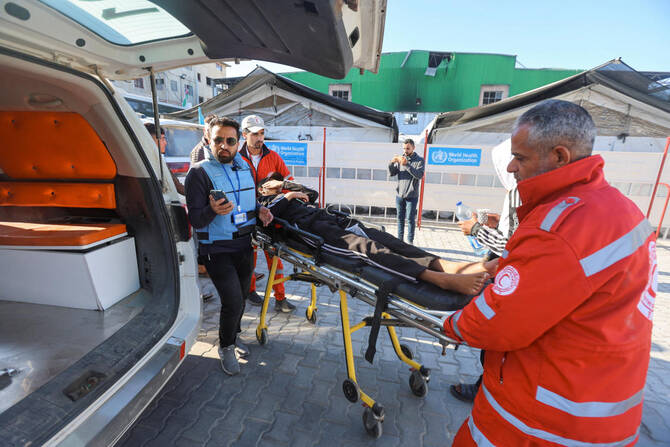
JERUSALEM: As the bodies of two dozen Palestinians killed in Israeli strikes arrived at hospitals in Gaza on Wednesday, the director of one asked a question that has echoed across the war-ravaged territory for months.
“Where is the ceasefire? Where are the mediators?” Shifa Hospital’s Mohamed Abu Selmiya wrote on Facebook.
At least 556 Palestinians have been killed in Israeli strikes since a US-brokered truce came into effect in October, including 24 on Wednesday and 30 on Saturday, according to Gaza’s Health Ministry. Four Israeli soldiers have been killed in Gaza in the same period, with more injured, including a soldier whom the military said was severely wounded when militants opened fire near the ceasefire line in northern Gaza overnight.
Other aspects of the agreement have stalled, including the deployment of an international security force, Hamas’ disarmament and the start of Gaza’s reconstruction. The opening of the Rafah border crossing between Gaza and Egypt raised hope of further progress, but fewer than 50 people were allowed to cross on Monday.
Hostages freed as other issues languish
In October, after months of stalled negotiations, Israel and Hamas accepted a 20-point plan proposed by US President Donald Trump aimed at ending the war unleashed by Hamas’ Oct. 7, 2023, attack into Israel.
At the time, Trump said it would lead to a “Strong, Durable, and Everlasting Peace.”
Hamas freed all the living hostages it still held at the outset of the deal in exchange for thousands of Palestinian prisoners held by Israel and the remains of others.
But the larger issues the agreement sought to address, including the future governance of the strip, were met with reservations, and the US offered no firm timeline.
The return of the remains of hostages meanwhile stretched far beyond the 72-hour timeline outlined in the agreement. Israel recovered the body of the last hostage only last week, after accusing Hamas and other militant groups of violating the ceasefire by failing to return all of the bodies. The militants said they were unable to immediately locate all the remains because of the massive destruction caused by the war — a claim Israel rejected.
The ceasefire also called for an immediate influx of humanitarian aid, including equipment to clear rubble and rehabilitate infrastructure. The United Nations and humanitarian groups say aid deliveries to Gaza’s 2 million Palestinians have fallen short due to customs clearance problems and other delays. COGAT, the Israeli military body overseeing aid to Gaza, has called the UN’s claims “simply a lie.”
Ceasefire holds despite accusations
Violence has sharply declined since the ceasefire paused a war in which more than 71,800 Palestinians have been killed, according to the Gaza Health Ministry. The ministry is part of the Hamas-led government and maintains detailed records seen as generally reliable by UN agencies and independent experts.
Hamas-led militants killed some 1,200 people in the initial October 2023 attack and took around 250 hostage.
Both sides say the agreement is still in effect and use the word “ceasefire” in their communications. But Israel accuses Hamas fighters of operating beyond the truce line splitting Gaza in half, threatening its troops and occasionally opening fire, while Hamas accuses Israeli forces of gunfire and strikes on residential areas far from the line.
Palestinians have called on US and Arab mediators to get Israel to stop carrying out deadly strikes, which often kill civilians. Among those killed on Wednesday were five children, including two babies. Hamas, which accuses Israel of hundreds of violations, called it a “grave circumvention of the ceasefire agreement.”
In a joint statement on Sunday, eight Arab and Muslim countries condemned Israel’s actions since the agreement took effect and urged restraint from all sides “to preserve and sustain the ceasefire.”
Israel says it is responding to daily violations committed by Hamas and acting to protect its troops. “While Hamas’ actions undermine the ceasefire, Israel remains fully committed to upholding it,” the military said in a statement on Wednesday.
“One of the scenarios the (military) has to be ready for is Hamas is using a deception tactic like they did before October 7 and rearming and preparing for an attack when it’s comfortable for them,” said Lt. Col. Nadav Shoshani, a military spokesperson.
Some signs of progress
The return of the remains of the last hostage, the limited opening of the Rafah crossing, and the naming of a Palestinian committee to govern Gaza and oversee its reconstruction showed a willingness to advance the agreement despite the violence.
Last month, US envoy Steve Witkoff, who played a key role in brokering the truce, said it was time for “transitioning from ceasefire to demilitarization, technocratic governance, and reconstruction.”
That will require Israel and Hamas to grapple with major issues on which they have been sharply divided, including whether Israel will fully withdraw from Gaza and Hamas will lay down its arms.
Though political leaders are holding onto the term “ceasefire” and have yet to withdraw from the process, there is growing despair in Gaza.
On Saturday, Atallah Abu Hadaiyed heard explosions in Gaza City during his morning prayers and ran outside to find his cousins lying on the ground as flames curled around them.
“We don’t know if we’re at war or at peace,” he said from a displacement camp, as tarpaulin strips blew off the tent behind him.


Deaths mount in Gaza as ceasefire frays and key agreements stall
https://arab.news/zxb3b
Deaths mount in Gaza as ceasefire frays and key agreements stall

- At least 556 Palestinians have been killed in Israeli strikes since a US-brokered truce came into effect in October


Washington presses Syria to shift from Chinese telecom systems
- Syria is exploring the possibility of procuring Chinese technology
- It was unclear whether the United States pledged financial or logistical support to Syria to do so
DAMASCUS: The United States has warned Syria against relying on Chinese technology in its telecommunications sector, arguing it conflicts with US interests and threatens US national security, according to three sources familiar with the matter.
The message was conveyed during an unreported meeting between a US State Department team and Syrian Communications Minister Abdulsalam Haykal in San Francisco on Tuesday. Washington has been coordinating closely with Damascus since 2024, when Syria’s now President Ahmed Al-Sharaa ousted longtime leader Bashar Assad, who had a strategic partnership with China.
Syria is exploring the possibility of procuring Chinese technology to support its telecommunications towers and the infrastructure of local Internet service providers, according to a Syrian businessman involved in the procurement talks.
“The US side asked for clarity on the ministry’s plans regarding Chinese telecom equipment,” said another source briefed on the talks.
But Syrian officials said infrastructure development projects were time-critical and that Damascus was seeking greater vendor diversity, the source added.
SYRIAN OFFICIALS CITE US EXPORT CONTROLS AS TELECOMS BARRIER
Syria is open to partnering with US firms but the matter was urgent and export controls and “over-compliance” remained an issue, according to person familiar with the meeting in San Francisco.
A US diplomat familiar with the discussions told Reuters that the US State Department “clearly urged Syrians to use American technology or technology from allied countries in the telecoms sector.”
It was unclear whether the United States pledged financial or logistical support to Syria to do so.
Responding to Reuters questions, a US State Department spokesperson said: “We urge countries to prioritize national security and privacy over lower-priced equipment and services in all critical infrastructure procurement. If it seems too good to be true, it probably is.”
The spokesperson added that Chinese intelligence and security services “can legally compel Chinese citizens and companies to share sensitive data or grant unauthorized access to their customers’ systems” and promises by Chinese companies to protect customers’ privacy were “entirely inconsistent with China’s own laws and well-established practices.”
China has repeatedly rejected allegations of it using technology for spying purposes.
The Syrian Ministry of telecommunications told Reuters any decisions related to equipment and infrastructure are made “in accordance with national technical and security standards, ensuring data protection and service continuity.”
The ministry said it is also prioritizing the diversification of partnerships and technology sources to serve the national interest.
Syria’s telecom infrastructure has relied heavily on Chinese technology due to US sanctions imposed on successive Assad governments over the civil war that grew from a crackdown on anti-government protests in 2011.
Huawei technology accounts for more than 50 percent of the infrastructure of Syriatel and MTN, the country’s only telecom operators, according to a senior source at one of the companies and documents reviewed by Reuters. Huawei did not immediately respond to a request for comment.
Syria is seeking to develop its private telecommunications sector, devastated by 14 years of war, by attracting foreign investment.
In early February, Saudi Arabia’s largest telecom operator, STC, announced it would invest $800 million to “strengthen telecommunications infrastructure and connect Syria regionally and internationally through a fiber-optic network extending over 4,500 kilometers.”
The ministry of telecommunications says that US restrictions “hinder the availability of many American technologies and services in the Syrian market,” emphasizing that it welcomes expanding cooperation with US companies when these restrictions are lifted.
Syria has inadequate telecommunications infrastructure, with network coverage weak outside city centers and connection speeds in many areas barely exceeding a few kilobits per second.