Israel’s targeted killings in Lebanon since Gaza war began

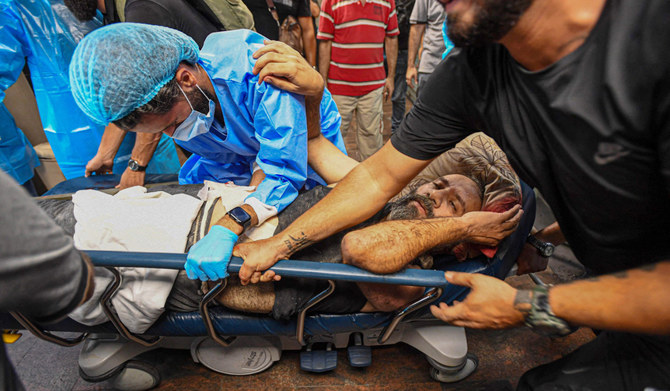
A photo taken on July 30, 2024, shows medical staff carrying on an injured man on a stretcher at the Bahman hospital following an Israeli military strike on a building in Beirut's southern suburb. (AFP)
Short Url
Updated 31 July 2024
Follow

Israel’s targeted killings in Lebanon since Gaza war began

  • Israeli strikes have killed around 350 Hezbollah fighters in total since

BEIRUT: An Israeli strike on the southern suburbs of Lebanon’s capital on Tuesday killed Fuad Shukr, identified by the Israeli military as Lebanese armed group Hezbollah’s most senior commander.
It was the latest in a string of targeted Israeli killings in Lebanon since October, when hostilities broke out between Hezbollah and Israel’s military in parallel with the Gaza war.
Israeli strikes have killed around 350 Hezbollah fighters in total since. The following is a list of the senior figures among those targeted.

FUAD SHUKR
Shukr has been one of Hezbollah’s leading military figures since it was established by Iran’s Revolutionary Guards more than four decades ago.
The United States accused Shukr of playing a central role in the 1983 bombing of the US Marine barracks in Beirut, which killed 241 US military personnel, and had put a bounty of up to $5 million on his head, according to the US government’s Rewards for Justice website.
He was sanctioned by the US in 2015 over Hezbollah’s role in helping Syria’s army. Israel said he was the right-hand man of Hezbollah chief Sayyed Hassan Nasrallah, and that he was responsible for an attack in the Israeli-occupied Golan Heights that killed 12 youths. Hezbollah denied any role.

MOHAMMED NASSER
Nasser, a senior commander in Hezbollah, was responsible for a section of Hezbollah’s operations at the frontier, according to senior security sources in Lebanon.
He was killed in an Israeli airstrike on July 3. Israel claimed responsibility, saying he headed a unit responsible for firing from southwestern Lebanon at Israel.

TALEB ABDALLAH
Senior Hezbollah field commander Abdallah was killed on June 12 in a strike claimed by Israel, which said it had hit a command and control center in southern Lebanon.
Security sources in Lebanon said he was Hezbollah’s commander for the central region of the southern border strip and was of the same rank as Nasser.
His killing prompted the group to fire a massive barrage of rockets across the border at Israel.

WISSAM TAWIL
Tawil, a commander in Hezbollah’s elite Radwan forces, was the first senior Hezbollah officer to be killed by Israel in the latest round of fighting.
He had been deployed with Hezbollah in Syria and Iraq, according to a senior source, and played a leading role in directing the group’s operations in the south since October.
Tawil and another Hezbollah fighter were killed on Jan. 8 when the car they were in was struck in a southern village. Israel later took responsibility for the strike.

SALEH AROURI
Arouri, the deputy chief of Palestinian armed group Hamas, was killed in a targeted strike on a Hamas office in the southern suburb of Beirut on Jan. 2.
It was the only other targeted killing on the edges of the capital since the exchanges of fire began in October.
While Lebanon’s prime minister, Hezbollah and other officials accused Israel, the Israeli military neither confirmed nor denied its involvement in his killing.


Palestinian citizens in Israel demand more security from violence

Updated 4 sec ago
Follow

Palestinian citizens in Israel demand more security from violence

  • Protests and strikes are sweeping Israel over record levels of violence targeting the country’s Palestinian citizens
  • At least 26 people were killed in January alone, adding to a record-breaking toll of more than 250 last year
KAFR YASIF, Israel: Nabil Safiya had taken a break from studying for a biology exam to meet a cousin at a pizza parlor when a gunman on a motorcycle rode past and fired, killing the 15-year-old as he sat in a black Renault.
The shooting — which police later said was a case of mistaken identity — stunned his hometown of Kafr Yasif, long besieged, like many Palestinian towns in Israel, by a wave of gang violence and family feuds.
“There is no set time for the gunfire anymore,” said Nabil’s father, Ashraf Safiya. “They can kill you in school, they can kill you in the street, they can kill you in the football stadium.”
The violence plaguing Israel’s Arab minority has become an inescapable part of daily life. Activists have long accused authorities of failing to address the issue and say that sense has deepened under Israel’s current far-right government.
One out of every five citizens in Israel is Palestinian. The rate of crime-related killings among them is more than 22 times higher than that for Jewish Israelis, while arrest and indictment rates for those crimes are far lower. Critics cite the disparities as evidence of entrenched discrimination and neglect.
A growing number of demonstrations are sweeping Israel. Thousands marched in Tel Aviv late Saturday to demand action, while Arab communities have gone on strike, closing shops and schools.
In November, after Nabil was gunned down, residents marched through the streets, students boycotted their classes and the Safiya family turned their home into a shrine with pictures and posters of Nabil.
The outrage had as much to do with what happened as with how often it keeps happening.
“There’s a law for the Jewish society and a different law for Palestinian society,” Ghassan Munayyer, a political activist from Lod, a mixed city with a large Palestinian population, said at a recent protest.
An epidemic of violence
Some Palestinian citizens have reached the highest echelons of business and politics in Israel. Yet many feel forsaken by authorities, with their communities marked by underinvestment and high unemployment that fuels frustration and distrust toward the state.
Nabil was one of a record 252 Palestinian citizens to be killed in Israel last year, according to data from Abraham Initiatives, an Israeli nongovernmental organization that promotes coexistence and safer communities. The toll continues to climb, with at least 26 additional crime-related killings in January.
Walid Haddad, a criminologist who teaches at Ono Academic College and who previously worked in Israel’s national security ministry, said that organized crime thrives off weapons trafficking and loan‑sharking in places where people lack access to credit. Gangs also extort residents and business owners for “protection,” he said.
Based on interviews with gang members in prisons and courts, he said they can earn anywhere from thousands to hundreds of thousands of dollars, depending on whether the job is torching cars, shooting at buildings or assassinating rival leaders.
“If they fire at homes or people once or twice a month, they can buy cars, go on trips. It’s easy money,” Haddad said, noting a widespread sense of impunity.
The violence has stifled the rhythm of life in many Palestinian communities. In Kafr Yasif, a northern Israel town of 10,000, streets empty by nightfall, and it’s not uncommon for those trying to sleep to hear gunshots ringing through their neighborhoods.
Prosecutions lag
Last year, only 8 percent of killings of Palestinian citizens led to charges filed against suspects, compared with 55 percent in Jewish communities, according to Abraham Initiatives.
Lama Yassin, the Abraham Initiatives’ director of shared cities and regions, said strained relations with police long discouraged Palestinian citizens from calling for new police stations or more police officers in their communities.
Not anymore.
“In recent years, because people are so depressed and feel like they’re not able to practice day-to-day life ... Arabs are saying, ‘Do whatever it takes, even if it means more police in our towns,’” Yassin said.
The killings have become a rallying cry for Palestinian-led political parties after successive governments pledged to curb the bloodshed with little results. Politicians and activists see the spate of violence as a reflection of selective enforcement and police apathy.
“We’ve been talking about this for 10 years,” said Knesset member Aida Touma-Suleiman.
She labeled policing in Palestinian communities “collective punishment,” noting that when Jews are victims of violence, police often set up roadblocks in neighboring Palestinian towns, flood areas with officers and arrest suspects en masse.
“The only side that can be able to smash a mafia is the state and the state is doing nothing except letting (organized crime) understand that they are free to do whatever they want,” Touma-Suleiman said.
Many communities feel impunity has gotten worse, she added, under National Security Minister Itamar Ben-Gvir, who with authority over the police has launched aggressive and visible campaigns against other crimes, targeting protests and pushing for tougher operations in east Jerusalem and the occupied West Bank.
Israeli police reject allegations of skewed priorities, saying that killings in these communities are a top priority. Police also have said investigations are challenging because witnesses don’t always cooperate.
“Investigative decisions are guided by evidence, operational considerations, and due process, not by indifference or lack of prioritization,” police said in a statement.
Unanswered demands
In Kafr Yasif, Ashraf Safiya vowed his son wouldn’t become just another statistic.
He had just gotten home from his work as a dentist and off the phone with Nabil when he learned about the shooting. He raced to the scene to find the car window shattered as Nabil was being rushed to the hospital. Doctors there pronounced him dead.
“The idea was that the blood of this boy would not be wasted,” Safiya said of protests he helped organize. “If people stop caring about these cases, we’re going to just have another case and another case.”
Authorities said last month they were preparing to file an indictment against a 23-year-old arrested in a neighboring town in connection with the shooting. They said the intended target was a relative, referring to the cousin with Nabil that night.
And they described Nabil as a victim of what they called “blood feuds within Arab society.”
At a late January demonstration in Kafr Yasif, marchers carried portraits of Nabil and Nidal Mosaedah, another local boy killed in the violence. Police broke up the protest, saying it lasted longer than authorized, and arrested its leaders, including the former head of the town council.
The show of force, residents said, may have quashed one protest, but did nothing to halt the killings.