

Gaza’s ancient Christian monastery gets ‘danger listing’ at UNESCO session in India

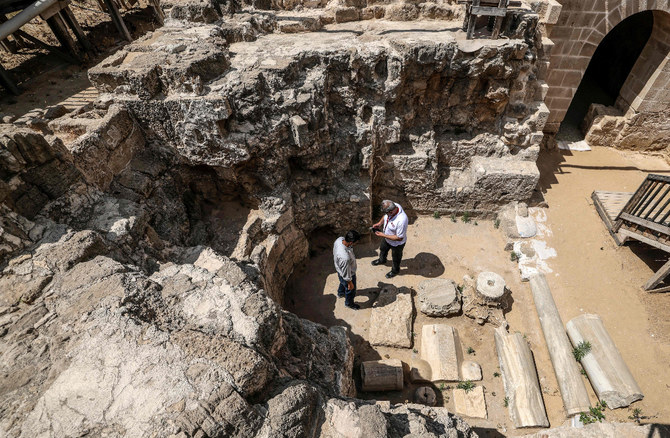
A picture shows a view of the archaeological site of Saint Hilarion in the center of the Gaza Strip, on June 8, 2022. (AFP)
Short Url
Updated 26 July 2024
Follow

Gaza’s ancient Christian monastery gets ‘danger listing’ at UNESCO session in India

  • Founded in 340, Saint Hilarion’s monastery is one of oldest in Middle East
  • UNESCO inscription processed in wake of Israel’s destruction of Palestinian heritage sites

NEW DELHI: An ancient Christian monastery in Gaza was recognized as a World Heritage in Danger site during a UNESCO session in New Delhi on Friday.

Founded in about 340 by Saint Hilarion, the monastery is part of Tell Umm Amer, an archaeological site located in the Nuseirat refugee camp of Gaza’s Deir Al-Balah governorate.

Submitted for inscription by the Permanent Delegation of Palestine to UNESCO in 2012, its nomination was processed on an emergency basis during the World Heritage Committee’s ongoing annual session.

Ambassador Mounir Anastas, Palestine’s permanent delegate to the UN cultural agency, welcomed the inscription as giving hope to the people of Gaza in the wake of the ongoing Israeli attacks, which since October have killed at least 40,000 people and destroyed most of the Palestinian enclave’s infrastructure.


“It constitutes a message of hope to our people in Gaza who are fleeing bombing, who have no shelter, no water, no food. Nevertheless, they are committed to protect their heritage because this heritage is part of our people’s memory and history,” Anastas told Arab News on the sidelines of the UNESCO session.

The move was submitted by Belgium and sponsored by 18 other members of the World Heritage Committee, who resorted to the emergency procedure provided for in the World Heritage Convention and agreed to inscribe the Saint Hilarion monastery complex on both the World Heritage and World Heritage in Danger lists.

Under the terms of the convention, its 195 states parties — including Israel — are barred from directly or indirectly damaging the site and are committed to providing their cooperation for its protection.

“Once the site is enshrined on the World Heritage in Danger list, this means that all state parties to the convention are responsible for the protection and promotion of the site,” Mounir said.

“And this is also another strong message from the international community to our people in Gaza, saying that the international community did not forget you.”

Saint Hilarion was a native of the Gaza region and is considered the father of Palestinian monasticism. His monastery used to be an important station on the crossroads between Egypt, Palestine, Syria and Mesopotamia, and is associated with the phenomenon of monastic desert centers during the Byzantine period. It also bears testimony to Christianity in Gaza.

One of the oldest monasteries in the Middle East, the complex consists of two churches, a burial site, a baptism hall, a public cemetery, an audience hall and dining rooms.

At least 207 archaeological sites and buildings of cultural and historical significance, out of a total of 320, have been reduced to rubble or severely damaged by Israel’s bombardment of the Gaza Strip over the past 10 months.

These include the Orthodox Church of Saint Porphyrios — the world’s third oldest church — the 12th century Great Omari Mosque and nearby Al-Qissariya medieval Old City market, Gaza’s ancient seaport dating to 800 B.C. and a Philistine cemetery dating to the Late Bronze period, 1550-1200 B.C.

The destruction of many of the archeological sites was detailed in South Africa’s case against Israel for the crime of genocide at the International Court. of Justice. The case argues that the mass killings and destruction of cultural heritage in Gaza demonstrate the Israeli leadership’s intent to destroy the Palestinian people and their cultural identity.


Last Christians gather in ruins of Turkiye’s quake-hit Antakya

Updated 5 sec ago
Follow

Last Christians gather in ruins of Turkiye’s quake-hit Antakya

  • Saint Peter’s, one of the world’s oldest rock churches, is a sacred rallying point for the isolated Christians still left in quake-hit Antakya in southeastern Turkiye
ANTAKYA: Saint Peter’s, one of the world’s oldest rock churches, is a sacred rallying point for the isolated Christians still left in quake-hit Antakya in southeastern Turkiye, the city known in ancient times as Antioch.
“Since the earthquake, our community has scattered,” said worshipper Mari Ibri.
“Those who remain are trying to regroup. We each had our own church but, like mine, they have been destroyed.”
The landscape around the cave remains scarred by the disaster nearly three years ago, when two earthquakes devastated Hatay province on February 6, 2023 and its jewel, Antakya, the gateway to Syria.
Sad fields of rubble and the silhouettes of cracked, abandoned buildings still scar the city — all enveloped in the ever-present grey dust.
Since the earthquakes, Antakya city has emptied and the Christian community has shrunk from 350 families to fewer than 90, Father Dimitri Dogum told AFP.
“Before, Christmas at our house was grandiose,” Ibri recalled.
“Our churches were full. People came from everywhere.”
Ibri’s own church in the city center was rendered inaccessible by the earthquakes.
Now she and other worshippers gather at the cave on December 24 — Christmas Eve in some Christian calendars.
It is here, they believe, that Peter, the disciple Jesus assigned to found the Christian church, held his first religious service in the 1st century.
The rock church was later enlarged and 11th-century crusaders added a pale stone facade.
It is now a museum, opened to the faithful only on rare occasions.
Christmas Eve is one.
The morning sun was still glowing red in the sky when Fadi Hurigil, leader of Antakya’s Orthodox Christian community, and his assistants prepared the service.
They draped the stone altar and unpacked candles, holy oil, chalices and plastic chairs.
Out in front they placed figurines of Christ and three saints near a bottle of rough red wine, bread baskets and presents for the children.
The sound system played a recording of the bells of Saint Peter and Paul church, which now stands empty in Antakya city center.
“That was my church,” said Ibri, crossing herself. “They recorded the peals.”
Around one hundred worshippers soon squeezed into the incense-filled cave and at least as many congregated outside.
A large police contingent looked on. Sniffer dogs had already inspected the cave and esplanade.
“It’s normal,” said Iliye, a 72-year-old from Iskenderun, 60 kilometers (40 miles) further north. “We’re a minority. It’s to protect us.”
The slow chanting of Orthodox hymns heralded the start of the two-hour service, conducted entirely in chants sung in Arabic and Turkish by Dogum and another cleric.
“It’s very moving for us to be here in the world’s first cave church, where the first disciples gathered,” the priest said.
“There used to be crowds here,” he added.
“In 2022, there were at least 750 people outside, Christians and non-Christians alike.”
Since the earthquakes, the gathering has been much smaller, although it is now starting to grow again.
At the end of the service, when Christmas carols fill the air, Dogum and Hurigil cut a huge rectangular cake.
The Nativity scene at its center — Mary, baby Jesus, the ox and the ass — was edged with whipped cream.
“There’s the religious dimension but it’s also important that people can gather here again,” a worshipper said.
“After February 6, our fellow citizens scattered. But they’re starting to come back. We’re happy about that.”