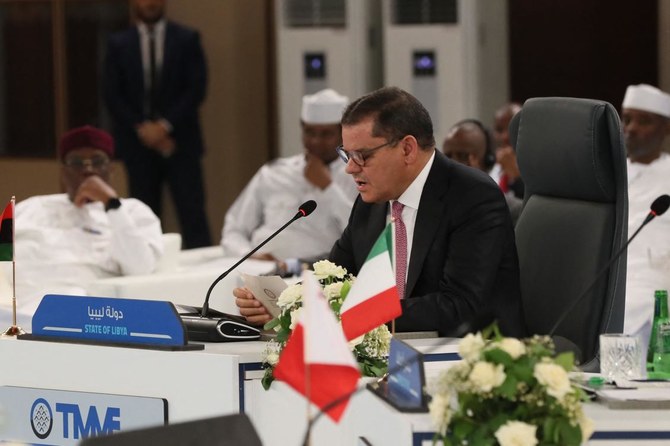
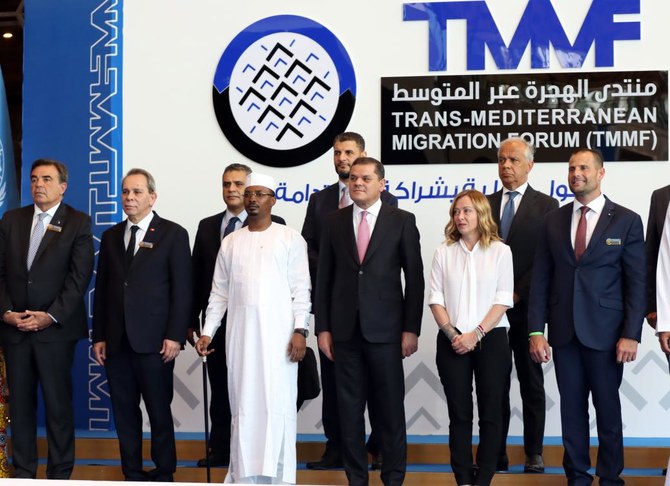
TRIPOLI: Libya held Wednesday a conference on irregular migration that saw the attendance of representatives from 28 European and African countries hoping to establish a “strategic” cooperation to resolve the issue.
“We have a moral responsibility” toward the mainly sub-Saharan migrants “who cross the desert and the sea” hoping to reach Europe, Libyan Prime Minister Abdelhamid Dbeibah said at the opening of the Trans-Mediterranean Migration Forum.
Libya, about 300 kilometers (186 miles) from Italy, is a key departure point for migrants, primarily from sub-Saharan African countries, risking perilous Mediterranean Sea journeys to seek better lives in Europe.
But with mounting efforts by the European Union to curb irregular migration, many have found themselves stranded in Libya and other North African countries.
“Libya found itself caught in pressure between (Europe’s) turning back of migrants and (their) desire to migrate,” said Dbeibah.
He called for development projects in departure countries.
“We can only resolve the migration crisis at the root, in the countries of departure,” he said.
Last week, authorities in Libya said that up to four in five foreigners in the North African country are undocumented, and hosting migrants hoping to reach Europe has become “unacceptable.”
“It’s time to resolve this problem,” Interior Minister Imad Trabelsi had said, because “Libya cannot continue to pay its price.”
Libya is still struggling to recover from years of war and chaos after the 2011 NATO-backed overthrow of longtime dictator Muammar Qaddafi.
Smugglers and human traffickers have taken advantage of the climate of instability that has dominated the vast country since.
The country has been criticized over the treatment of migrant and refugees, with accusations from rights groups ranging from extortion to slavery.
Italian Prime Minister Giorgia Meloni at Wednesday’s forum called for an end to “human trafficking... (which) is nowadays one of world’s most powerful criminal networks.”
The far-right minister denounced “criminal organizations” who “decide who has the right or not to live in our countries,” adding that “illegal migration is the enemy of legal migration.”
Italy recorded 30,348 migrant arrivals from North Africa between January 1 and July 16 — a 61-percent decrease in a year — with 17,659 people leaving from Libya and 11,001 from Tunisia, according to official figures.


![]()
![]()

Libya, EU seek ‘strategic’ cooperation to end irregular migration
Short Url
https://arab.news/6v3t7
Libya, EU seek ‘strategic’ cooperation to end irregular migration
- Libya is a key departure point for migrants, primarily from sub-Saharan African countries, risking Mediterranean Sea journeys to seek better lives in Europe


Latest updates


© 2026 SAUDI RESEARCH & PUBLISHING COMPANY, All Rights Reserved And subject to Terms of Use Agreement.