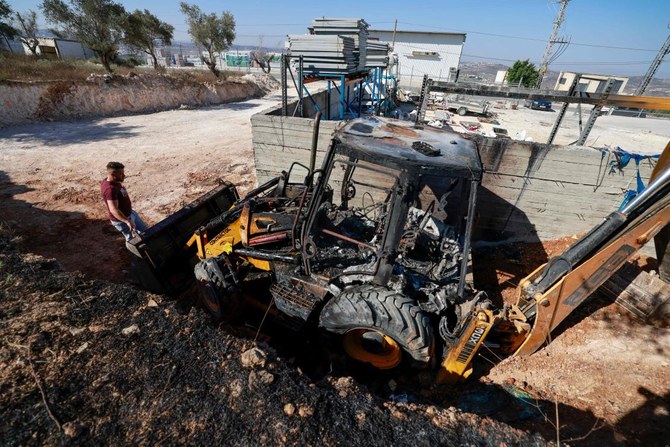
BRUSSELS: The European Union on Monday announced sanctions on five Israelis — including those termed “extremist settlers” — and three organizations for abuses against Palestinians in the West Bank and blocking humanitarian aid to Gaza.
The asset freezes and visa bans are the second round of sanctions from the 27-nation bloc targeting violent Israeli settlers, taking the total number of listings to 14.
Prominent settlers blacklisted by the European Union included Moshe Sharvit, Zvi Bar Yosef, Baruch Marzel, and Isaschar Manne.
“The listed individuals and entities are responsible for serious and systematic human rights abuses against Palestinians in the West Bank,” the EU said in a statement.
Israeli organization Tsav 9 was also sanctioned for “regularly blocking humanitarian aid trucks delivering food, water and fuel to Gaza” through violent protests.
The West Bank, which Israel has occupied since 1967, has seen a surge in violence in the past year, particularly since the Israel-Hamas war erupted in Gaza.
According to Palestinian figures, at least 565 Palestinians have died in the West Bank in military raids and in violence with Israeli settlers since the Hamas attacks on Israel on October 7.
The United States, Britain and Canada have also blacklisted Israeli settlers.
The latest EU moves against Israeli settlers follow measures targeting funders of the Palestinian militant group Hamas.
The bloc — which has struggled to settle on a unified position on the war in Gaza — has agreed to sequence sanctions against Hamas with those targeting settlers.


EU imposes fresh sanctions on ‘extremist’ Israeli settlers
https://arab.news/4gbaj
EU imposes fresh sanctions on ‘extremist’ Israeli settlers

- The West Bank, which Israel has occupied since 1967, has seen a surge in violence in the past year


Israeli Druze leader seeks US security guarantees for Syrian minority
- Washington needed to fulfill its “duty” to safeguard the rights of Syria’s minorities in order to encourage stability, said Tarif
- He stressed the need for self-determination, as well as rights and safety for all minorities
GENEVA: Israeli Druze leader Sheikh Mowafaq Tarif urged the United States to guarantee the security of the Druze community in Syria to prevent a recurrence of intense violence earlier this year in Sweida, a Druze-majority province.
Washington needed to fulfill its “duty” to safeguard the rights of Syria’s minorities in order to encourage stability, Tarif told Reuters on Tuesday during an official visit to the UN in Geneva, adding that US support would also remove the need for Israeli intervention in Syria’s south.
“We hope that the United States, President Trump, and America as a great power, we want it to guarantee the rights of all minorities in Syria ... preventing any further massacres,” he said.
US President Donald Trump vowed in November to do everything he can to make Syria successful after landmark talks with Syrian President Ahmed Al-Sharaa.
BLOODY CLASHES IN JULY
The Druze are a minority group whose faith is an offshoot of Islam and have followers in Israel, Syria and Lebanon.
In July, clashes between Druze and Bedouin residents broke out in Sweida after tit-for-tat kidnappings, leading to a week of bloodletting that shattered generations of fragile coexistence.
The violence worsened when government forces dispatched to restore order clashed with Druze militiamen, with widespread reports of looting, summary killings and other abuses.
Israel entered the fray with encouragement from its Druze minority, attacking government forces with the stated aims of protecting Syrian Druze and keeping its borders free from militants.
Tens of thousands of people from both communities were uprooted, with the unrest all but ending the Bedouins’ presence across much of Sweida. In the aftermath, Druze leaders called for a humanitarian corridor from the Israeli-occupied Golan to Sweida and demanded self-determination, which the government rejects. ‘NEED TO REBUILD TRUST’
Asked about proposals by influential Druze Sheikh Hikmat Al-Hajjari to separate Sweida from Syria, Tarif stressed the need for self-determination, as well as rights and safety for all minorities.
It was inconceivable to ask the Druze to surrender their weapons, he said. Talks to bring Sweida’s former police force onto Damascus’ payroll — while allowing the Druze to retain wide local autonomy — had been making steady progress until July’s bloodshed derailed them.
Al-Sharaa, who led rebel factions that ousted former long-time leader Bashar Assad last December, has vowed to protect the Druze. However, Hajjari insists he poses an existential threat to his community and in September rejected a 13-point, US-brokered roadmap to resolve the conflict.
Asked if talks should be revived, Tarif said trust had to be rebuilt by allowing residents to return to their homes, and permitting full humanitarian access to Sweida.
“There is no trust today ... Trust must be rebuilt,” he said.


