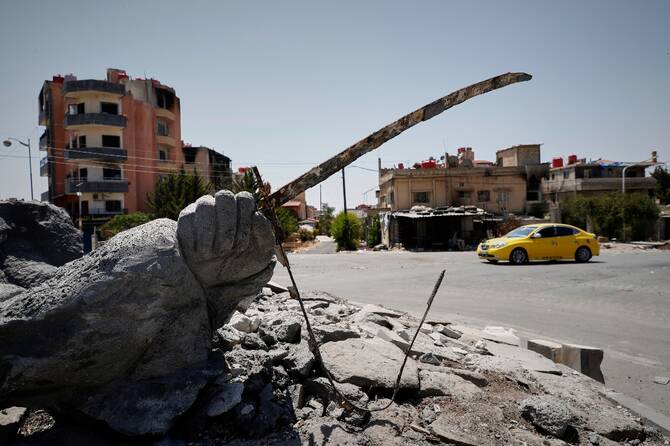
DAMASCUS: A new round of clashes between Druze armed groups and government forces in the province of Sweida in southern Syrian had subsided Friday but left fears of another escalation.
Clashes on Thursday led to both sides blaming each other for violating a ceasefire that ended several days of violent fighting in July. There were reports of people wounded on both sides, but no deaths reported.
The National Guard, the de facto military in Sweida, accused government forces of launching an attack on the town of Al-Majdal Thursday, “employing heavy and medium weapons and attack drones, in an aggressive attempt to breach our defense lines and target vital locations.”
“Our forces bravely and with high combat efficiency repelled this attack, inflicting heavy losses on the attacking forces in terms of equipment and personnel,” it said in a statement.
The government in Damascus accused the Sweida factions of violating the ceasefire first.
Mustafa Al-Bakour, the Damascus-appointed governor of Sweida province, said “some factions and the so-called National Guard” launched “attacks on de-escalation points.” The attacks, he added, “constitute a clear violation of international agreements and obstruct efforts to rebuild and prepare for the return of residents to their villages.”
Saber Abou Ras, a political analyst who lives in Sweida city, said Thursday’s clashes “were very intense and violent” and included attacks with drones, anti-aircraft machine guns and mortar shells. He said Israeli warplanes could be heard over the city of Sweida, but it was not clear if they launched any strikes.
Abou Ras said he believes the government forces had launched “a retaliatory attack” after the police chief of the local governmental body in Sweida, along with a “large group of officers” took over a checkpoint formerly controlled by Syrian government security forces in the northern countryside of the province.
On Thursday, Syrian Foreign Minister Asaad Al-Shibani, speaking at an event held by the Chatham House international affairs think tank during a visit to London said there had been “mistakes made by all sides” in Sweida.
“There are many problems, but we are not dealing with them as if we are the other party,” he said. “We are dealing with this as a Syrian wound, and that there is an internal problem within the same house.”
Sweida was the site of violent clashes in July that began as fighting between Druze groups and local Bedouin tribes after a series of tit-for-tat kidnappings.
The violence escalated after government security forces intervened, ostensibly to break up the fighting but ended up siding with the Bedouins. Hundreds of civilians, mostly Druze, were killed, many by government fighters.
Israel intervened on the side of the Druze, who also represent a significant minority in Israel, launching strikes on government forces and on the defense ministry building in central Damascus. A US-brokered ceasefire led to government forces withdrawing from Sweida.
Since then, Druze groups have set up a de facto military and governmental body in Sweida, similar to the Kurdish-led authorities in the country’s northeast, and have largely refused to deal with the government in Damascus.
Tens of thousands of people remain displaced after the July fighting, including Druze internally displaced within Sweida province and Bedouins who were evacuated from the province to other areas.


![]()

Druze groups and Syrian forces exchange ceasefire violation claims as clashes in Sweida resume
Short Url
https://arab.news/pn9fs
Druze groups and Syrian forces exchange ceasefire violation claims as clashes in Sweida resume
- The National Guard, the de facto military in Sweida, accused government forces of launching an attack on the town of Al-Majdal
- The government in Damascus accused the Sweida factions of violating the ceasefire first


Latest updates







© 2026 SAUDI RESEARCH & PUBLISHING COMPANY, All Rights Reserved And subject to Terms of Use Agreement.