




LONDON: In one of his first statements since winning the runoff election earlier this month, Iran’s President-elect Masoud Pezeshkian indicated that militant groups across the Middle East would not allow Israel’s “criminal policies” toward the Palestinians to continue.
In a message on July 8 to Hassan Nasrallah, leader of the Iran-backed Lebanese Hezbollah group, he said: “The Islamic Republic has always supported the resistance of the people of the region against the illegitimate Zionist regime.”
So far, however, Iran’s losses appear to outweigh greatly the cost it has been able to impose on the country suspected of inflicting them.

A handout picture provided by the office of Iran's Supreme Leader Ayatollah Ali Khamenei shows him (R) and Iran's newly elected President Masoud Pezeshkian attending a mourning ritual in Tehran late on July 12, 2024. (AFP)
Two months after Israel and Iran appeared to be on the brink of all-out war, a suspected Israeli airstrike near Syria’s northern city of Aleppo in June dealt another blow to Iran’s Islamic Revolutionary Guard Corps.
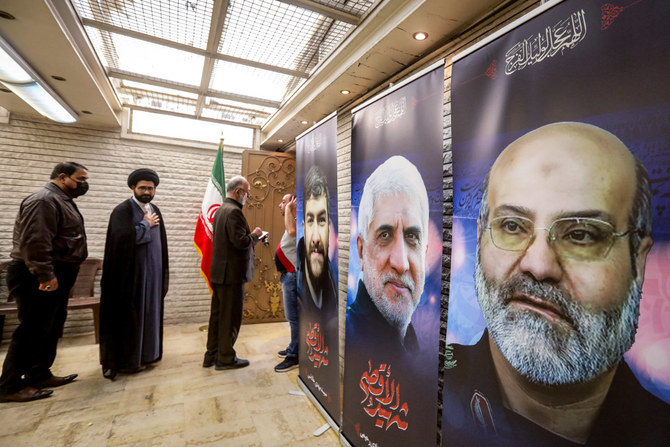
Saeed Abyar, who was in Syria on an “advisory mission,” according to a statement issued by the IRGC, died in an attack on June 3, bringing the total number of key IRGC figures killed in suspected Israeli strikes since Oct. 7 last year to 19.
Damascus accused Israel of orchestrating the strikes from the southeast of Aleppo. Israel, however, rarely comments on individual attacks.
It came just days after Israel launched air attacks on Syria’s central region as well as the coastal city of Baniyas on May 29, killing a child and injuring 10 civilians, according to Syrian state media.
“A closer look at the June 3 incident reveals that Israel targeted a copper factory and a weapons warehouse on the outskirts of Aleppo, attacking multiple times,” Francesco Schiavi, an Italy-based geopolitical analyst, told Arab News.
“In these confusing conditions, General Abyar was among several individuals near the impact site, making his death more likely an indirect consequence of an operation against Iranian infrastructure in Syria rather than an intended target of the Israeli attack, generally conducted with high-precision weapons.”
INNUMBERS
19 Officers of IRGC’s Quds Force branch killed in suspected Israeli strikes since Oct. 7, 2023.
8 IRGC officers killed in single strike on Iran’s embassy annex in Damascus on April 1.
Although Israel is accused of targeting numerous Iranian commanders and cadres on Syrian soil in the past nine months, the June 3 attack was the first to kill an IRGC commander since the April 1 strike on Iran’s embassy annex in Damascus.
That suspected Israeli strike eliminated eight IRGC officers, including Mohammad Reza Zahedi, the highest-ranking commander of the extraterritorial Quds Force to be killed since Qassem Soleimani died in a US drone strike in 2020.

Rescue workers search in the rubble of a building annexed to the Iranian embassy a day after an air strike in Damascus on April 2, 2024. (AFP)
Iran launched a massive retaliatory attack against Israel on April 13 — its first direct assault on Israeli territory, stoking fears of an all-out, region-wide conflict. The following day, IRGC chief Hossein Salami said his country “decided to create a new equation.”
“From now on, if Israel attacks Iranian interests, figures, and citizens anywhere, we will retaliate from Iran,” he said.
Observers, unsure how Iran might respond this time, remain on edge, especially as tensions mount in southern Lebanon, the stronghold of the Iran-backed Hezbollah militia, which has been trading cross-border fire with Israel since Oct. 8 last year.
“Tehran warned that a ‘new equation’ had been established whereby Iran would retaliate against any Israeli attacks on its interests in the region,” said Schiavi.

Smoke from Israeli bombardment billows in Kfarkila in southern Lebanon on July 12, 2024 amid ongoing cross-border tensions between Israel and Hezbollah. (AFP)
“The lack of precedents makes it challenging to predict what this renewed Iranian approach might entail in practical terms.”
As it has officially accused Israel of killing Abyar, Eva J. Koulouriotis, a political analyst specializing in the Middle East, believes the IRGC will now be “forced to respond” to the June 3 attack in order to bolster its deterrence — potentially setting off a new round of escalation.
“I understand that by this announcement and the threat to respond, Iran does not want the Israel Defense Forces to return to the equation before targeting the Iranian consulate in Syria,” when similar attacks had gone “unpunished,” Koulouriotis told Arab News.
Eldar Mamedov, a Brussels-based expert on the Middle East and Iran, believes the Israeli strike on the Iranian embassy annex in Damascus had “changed the deterrence equation to Tehran’s detriment.”

An Iranian ballistic missile lies on the shores of the Dead Sea after Iran launched drones and missiles toward Israel on April 13, 2024. (Reuters/File)
“Tehran was compelled to retaliate, but even then did so with caution — by forewarning Israel and the US through neighboring countries,” he told Arab News. “The aim was to send a message that Iran would not hesitate to strike Israel directly if it kept killing senior Iranian figures, in order to re-establish the deterrence.”
Mamedov added: “To understand what scenarios could prompt Iran to retaliate against Israel for the elimination of IRGC officers in Syria and Lebanon, we need to take into account the overall context of Iranian presence there.
“It is primarily about the ‘forward defense’ strategy through allies such as Hezbollah in Lebanon and proxy groups in Syria, the aim of which is to deter Israel from attacking Iran and its nuclear installations directly.”

Mourners join a funeral procession on July 10, 2024, in the southern suburbs of Beirut, Lebanon, for senior Hezbollah commander Yasser Nemr Qranbish, who was killed a day earlier in an Israeli airstrike that hit his car in Syria near the border with Lebanon. Qranbish was a former personal bodyguard of Hezbollah leader Nasrallah, an official with the Lebanese militant group said. (AP)
Nevertheless, Mamedov believes Iran “is willing to avoid an all-out war with Israel and/or the US.”
The death of Iran’s President Ebrahim Raisi in a helicopter crash on May 19, along with the foreign minister and other senior officials, forced Tehran to bring forward its presidential elections, which had not been due until 2025.
“As Iran is immersed in preparing the ground for an inevitable leadership transition, it is wary of further regional destabilization,” said Mamedov. “I do not think that this fundamental calculus has changed.”
Schiavi concurred, saying that Iran’s current “domestic leadership crisis” means the government is now preoccupied with the leadership transition, making a fresh round of retaliatory action unlikely.
He noted Iran’s “longstanding blend of pragmatism and assertiveness in responding to regional developments,” citing “the carefully measured direct attack on Israel on April 13, which was intended to avoid plunging the two countries into open confrontation.”
Schiavi added: “Despite Tehran’s continued adherence to its strategy of supporting the pro-Iranian axis and maintaining continuity in its regional policy despite sudden political upheaval, the current circumstances make a new wave of attacks on Israel highly unlikely.”

For his part, Mamedov believes Iran will likely “be forced to abandon its caution if tensions between Israel and Hezbollah were to escalate into an open war.”
“Hezbollah is considered by Iran the most capable and effective of its allies in the Levant, with a degree of operational cooperation and ideological alignment that is not met in Tehran’s relations with other allies/proxies,” he said.
“A severely weakened Hezbollah would undermine a vital pillar of Tehran’s ‘forward defense’ strategy, and it is to be expected that it will give its support to the Lebanese group in case of an open war with Israel. However, that depends on how Hezbollah will perform in such a war.”
ALSO READ: Iran and Israel: From allies to deadly enemies
The past month has been particularly tense on the Lebanese border, intensifying fears of an all-out war that would send shockwaves throughout the wider region.
On June 11, an Israeli airstrike on the Lebanese village of Jouya killed a senior Hezbollah commander, Taleb Abdullah, and three fighters. A week later, Iran’s mission to the UN warned Israel about the consequences of going to war with its ally in Lebanon.

A Hezbollah leader speaks in Beirut's southern suburbs on June 12, 2024, during the funeral of Taleb Abdallah, known as Abu Taleb, a senior field commander of Hezbollah who was killed in an Israel strike, on June 1 at a location near the border in southern Lebanon. (AFP)
A little over two weeks later, on June 27, Hezbollah fired dozens of Katyusha rockets at a military base in northern Israel. The group’s leadership said the attack came “in response to the enemy attacks that targeted the city of Nabatieh and the village of Sohmor.”
Until Israel and Hamas reach a deal on a ceasefire in Gaza, Koulouriotis said, “the dangerous escalation on the Lebanese-Israeli border” is an indicator that “we are closer than ever to war.”
“Tehran is directly concerned in light of any escalation that Hezbollah faces in Lebanon,” she said. “That is why I believe that Iran wants to keep the response card to the killing of its officer in Aleppo to be used during any Israeli military operation in southern Lebanon.”
Opinion
This section contains relevant reference points, placed in (Opinion field)
Noting that officials in Iran are well aware of the US and Europe’s “great fear” of a large-scale escalation in the Middle East, she said “any Iranian military move will put greater pressure on the West, pushing them to restrain Benjamin Netanyahu’s government” in Israel.
Charles Q. Brown, chairman of the US joint chiefs of staff, recently warned Israel that any offensive in Lebanon could spark a regional war involving Iran and its allies.
Considering current developments on the Lebanon-Israel border, Koulouriotis expects Iran’s response to Israel’s latest attack to be similar to its reaction to the embassy annex attack — “through swarms of drones and cruise missiles.”
“However, if Western diplomatic moves lead to reducing tension on the Lebanese-Israeli border, Iran may resort to a less severe response, and Iraqi Kurdistan may be a suitable place for an Iranian response,” she said

Israel's Prime Minister Benjamin Netanyahu. (Pool/AFP)
Schiavi, however, dismisses the idea that Iran “intended to retaliate against every attack on an Iranian target in Syria (or elsewhere) with a direct attack on Israel, especially given the potential accidental nature of General Abyar’s death.”
“The ramifications of the Gaza war highlight the centrality of Syria in Tehran’s Middle East strategy, and this means that Iran will remain committed to maintaining considerable influence in the country for the foreseeable future,” he said.
“Should the conflict escalate further, or should Israel launch a broader assault on other Iranian assets or personnel in Syria, Tehran may feel compelled to respond forcefully, risking the very conflict it seeks to avoid.”
For now, the general consensus is that the actions of the IRGC will be more important than the harsh words of President-elect Pezeshkian or any other regime official in judging Iran’s willingness or ability to challenge Israel militarily.


