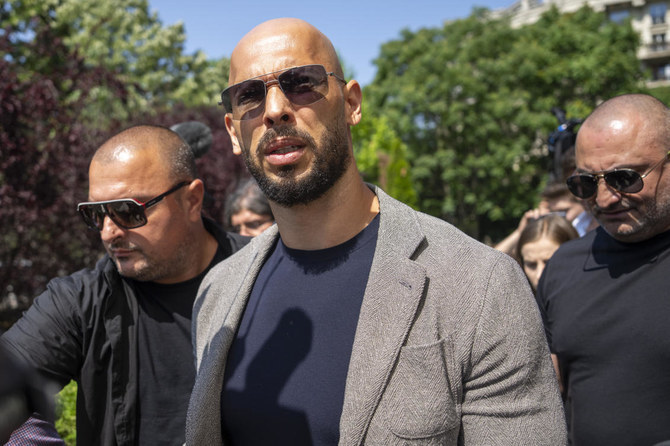
BUCHAREST: A Romanian court ruled on Friday that Internet personality Andrew Tate can travel within the European Union without restrictions while he awaits trial on human trafficking charges, his lawyer said.
Tate was indicted in mid-2023 along with his brother, Tristan, and two Romanian women on charges of human trafficking, rape and forming a criminal gang to sexually exploit women, accusations they have denied.
In April this year, the Bucharest court ruled their trial can start, a decision Tate has appealed.
Pending a ruling on his appeal, the four suspects had been banned from leaving Romania, but Friday’s court decision lifted the restriction for the European Union.
“My judges decided ... I’m allowed to leave Romania, so do we take the (Ferrari) SF90 to Italy, the (Maserati) MC20 to Cannes, the (Ferrari) 812 Competition to Paris, where do I go?” Tate said in a video posted on social media platform X.
The Tate brothers, both former kickboxers with dual US and British citizenship, are the highest-profile suspects facing trial for human trafficking in Romania and their case will be a test for Romania’s anti-organized crime prosecuting unit DIICOT.
The brothers were held in police custody during the criminal investigation from late December 2022 until April 2023 to prevent them from fleeing the country or tampering with evidence.
They were then placed under house arrest until August, when courts put them under judicial control, a lighter preventative measure.
“Andrew and Tristan are still determined to clear their name and reputation; however, they are grateful to the courts for placing this trust in them,” the brothers’ lead defense lawyer Eugen Vidineac said in a statement.
Romanian prosecutors have said the Tate brothers recruited their victims by seducing them and falsely claiming to want a relationship or marriage.
They said the victims were then taken to properties outside the capital Bucharest, and through physical violence and mental intimidation were sexually exploited by being forced to produce pornographic content for social media sites that generated large financial gain.
Tate, a self-described misogynist, has gained millions of fans by promoting an ultra-masculine lifestyle that critics say denigrates women.

Romanian court eases travel restrictions on influencer Andrew Tate
https://arab.news/g9gza
Romanian court eases travel restrictions on influencer Andrew Tate
- The Tate brothers, both former kickboxers with dual US and British citizenship, are the highest-profile suspects facing trial for human trafficking in Romania
- “Andrew and Tristan are still determined to clear their name and reputation,” the brothers’ lead defense lawyer Eugen Vidineac said
Tug of war: how US presidents battle Congress for military powers
- The last official declaration of war by Congress was as far back as World War II
WASHINGTON, United States: Donald Trump’s unleashing of operation “Epic Fury” against Iran has once more underscored the long and bitter struggle between US presidents and Congress over who has the power to decide on foreign military action.
In his video address announcing “major combat” with the Islamic republic, Trump didn’t once mention any authorization or consultation with the US House of Representatives or Senate.
In doing so he sidelined not only Democrats, who called for an urgent war powers vote, but also his own Republican party as he asserts his dominance over a largely cowed legislature.
A US official said Secretary of State Marco Rubio had called top congressional leaders known as the “Gang of Eight” to give them a heads up on the Iran attack — adding that one was unreachable.
Rubio also “laid out the situation” and consulted with the same leaders on Tuesday in an hour-long briefing, the US official said.
According to the US Constitution, only Congress can declare war.
But at the same time the founding document of the United States first signed in 1787 says that the president is the “commander in chief” of the military, a definition that US leaders have in recent years taken very broadly.
The last official declaration of war by Congress was as far back as World War II.
There was no such proclamation during the unpopular Vietnam War, and it was then that Congress sought to reassert its powers.
In 1973 it adopted the War Powers Resolution, passed over Richard Nixon’s veto, to become the only lasting limit on unilateral presidential military action abroad.
The act allows the president to carry out a limited military intervention to respond to an urgent situation created by an attack against the United States.
In his video address on Saturday, Trump evoked an “imminent” threat to justify strikes against Iran.
- Sixty days -
Yet under this law, the president must still inform Congress within 48 hours.
It also says that if the president deploys US troops for a military action for more than 60 days, the head of state must then obtain the authorization of Congress for continued action.
That falls short of an official declaration of war.
The US Congress notably authorized the use of force in such a way after the September 11, 2011 attacks on the United States by Al-Qaeda. Presidents have used it over the past two decades for not only the 2001 invasion of Afghanistan but a series of operations in several countries linked to the “War on Terror.”
Trump is far from the first US president to launch military operations without going through Congress.
Democrat Bill Clinton launched US air strikes against Kosovo in 1999 as part of a NATO campaign, despite the lack of a green light from skeptical lawmakers.
Barack Obama did the same for airstrikes in Libya in 2011.
Trump followed their example in his first term in 2018 when he launched airstrikes in Syria along with Britain and France.
But since his return to power the 79-year-old has sought to push presidential power to its limits, and that includes in the military sphere.
Trump has ordered strikes on alleged drug trafficking boats in Latin America without consulting Congress, and in June 2025 struck Iran’s nuclear facilities.
Perhaps the most controversial act was when he ordered the capture of Venezuelan president Nicolas Maduro in a lightning military raid on January 3.
Republicans however managed to knock down moves by Democrats for a rare war powers resolution that would have curbed his authority over Venezuela operations.
Trump has meanwhile sought to extend his powers over the home front. Democrats have slammed the Republican for deploying the National Guard in several US cities in what he calls a crackdown on crime and immigration.


