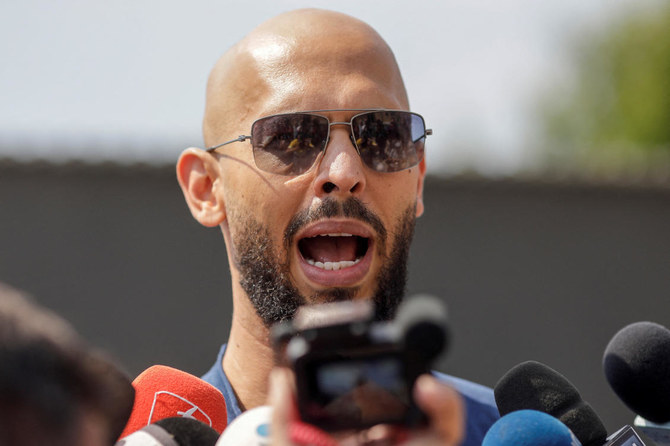
BUCHAREST: A court in Romania’s capital on Friday denied a request by online influencer Andrew Tate to return assets that were seized during investigations into the case in which he is charged with human trafficking, rape and forming a criminal gang to sexually exploit women.
The Bucharest Tribunal ruled that all assets seized will remain in possession of Romania’s anti-organized crime agency, DIICOT, Tate’s spokesperson said, adding that the decision will be appealed. Tate, 37, won an appeal in January challenging the asset seizures, which triggered a retrial.
The former professional kickboxer was arrested in December 2022 near Bucharest along with his brother Tristan Tate and two Romanian women. Romanian prosecutors formally indicted all four in June last year. They have denied the allegations.
After the Tates were detained, Romanian authorities seized 15 luxury cars, 14 designer watches and cash in several currencies. The fleet of automobiles included a Rolls-Royce, a Ferrari, a Porsche, a BMW, an Aston Martin and a Mercedes-Benz. The total value of the goods, authorities said at the time, was estimated at 3.6 million euros ($3.9 million).
DIICOT also said it had identified more than 10 properties and land owned by companies registered to the Tate brothers, and that their assets could be used to fund investigations and compensate victims if the authorities could prove they were gained through illicit activities.
Andrew Tate, who has amassed 9 million followers on the social media platform X, has repeatedly claimed that prosecutors have no evidence against him and that there is a political conspiracy to silence him. He was previously banned from various prominent social media platforms for expressing misogynistic views and for hate speech.
The decision on Friday came a week after the Tate brothers appeared at the Bucharest Court of Appeal in a separate case. British authorities issued arrest warrants over allegations of sexual aggression in a UK case dating back to 2012-2015, according to the brothers’ spokesperson.
The court granted the British authorities their request to extradite the Tates, but only after legal proceedings against them have been concluded in Romania.
The Romanian case is still being discussed in the preliminary chamber stages, when defendants can challenge prosecutors’ evidence. No trial date has been set.
Last week, the Bucharest Tribunal, the court of first instance, extended by 60 days geographical restrictions against the Tates, which stipulate they may not leave the country.

A Romanian court rejects Andrew Tate’s bid to get his confiscated assets returned
Short Url
https://arab.news/b4q5w
A Romanian court rejects Andrew Tate’s bid to get his confiscated assets returned
- The Bucharest Tribunal ruled that all assets seized will remain in possession of Romania’s anti-organized crime agency
- After the Tates were detained, Romanian authorities seized 15 luxury cars, 14 designer watches and cash in several currencies
US allies, foes alarmed by capture of Venezuela’s Maduro
- Countries such as Russia and China, which had ties with Maduro’s government, were quick to condemn the operation but alarm also shared by France and EU
Paris — FRA
Paris, France, Jan 3, 2026 : The US military operation that led to the seizure of Venezuelan President Nicolas Maduro on Saturday sparked alarm across the international community, with allies and foes of Washington and Caracas expressing disquiet.
US President Donald Trump said Maduro and his wife would be taken to New York to face federal charges after military strikes and an operation which he described as looking like a “television show.”
The Venezuelan government decried what it termed a “extremely serious military aggression” by Washington and declared a state of emergency.
Countries such as Russia and Iran, which had longstanding ties with Maduro’s government, were quick to condemn the operation but their alarm was also shared by Washington’s allies including France and the EU.
Here is a rundown of the main reaction.
- Russia -
Russia demanded the US leadership “reconsider its position and release the legally elected president of the sovereign country and his wife.”
- China -
Beijing said “China is deeply shocked and strongly condemns the US’s blatant use of force against a sovereign state and its action against its president.”
- Iran -
Iran, which Trump bombed last year, said it “strongly condemns the US military attack on Venezuela and a flagrant violation of the country’s national sovereignty and territorial integrity.”
- Mexico -
Mexico, which Trump has also threatened with military force over drug trafficking, strongly condemned the US military action in Venezuela, saying it “seriously jeopardizes regional stability.”
- Colombia -
Colombian President Gustavo Petro — whose country neighbors Venezuela — called the US action an “assault on the sovereignty” of Latin America which would lead to a humanitarian crisis.
- Brazil -
Brazilian President Luiz Inacio Lula da Silva slammed the US attacks as a “serious affront” to Venezuela’s sovereignty.
- Cuba -
Cuba, a strong ally of Venezuela, denounced “state terrorism against the brave Venezuelan people.”
- Spain -
Spain offered to mediate in the crisis to find a way to a peaceful solution, while calling for “de-escalation and restraint.”
- France -
France condemned the US operation, saying it undermined international law and no solution to Venezuela’s crisis can be imposed from the outside.
- EU -
The EU more generally expressed concern at the developments and urged respect for international law, even as it noted that Maduro “lacks legitimacy.”
EU candidate country North Macedonia, along with fellow Balkan nations Albania and Kosovo, backed Washington, however.
“We stand with the United States and the Venezuelan people for freedom and democracy,” North Macedonia FM Timco Mucunski said on X.
- Britain -
British Prime Minister Keir Starmer said all countries should “uphold international law” and added that “the UK was not involved in any way in this operation” as he urged patience in order to “establish the facts.”
- Italy -
In a rare expression of support for the US operation by a major European country, far-right Italian Prime Minister Giorgia Meloni — a Trump ally — argued the US military action in Venezuela was “legitimate” and “defensive.”
- Israel -
Israel also hailed the operation, saying Washington acted as the “leader of the free world.”
- Ukraine -
Ukraine — dependent on US support in its war against invading Russia — did not address the legality of a big country like America using military force against a much smaller one like Venezuela.
Foreign minister Andriy Sybiga instead focused on Maduro’s lack of legitimacy and the Venezuelan government’s repression, while backing “democracy, human rights, and the interests of Venezuelans.”
- South Africa -
South Africa, which Trump accuses of alleged discrimination — and even “genocide” — of minority white Afrikaners, said: “Unlawful, unilateral force of this nature undermines the stability of the international order and the principle of equality among nations.”
- UN -
UN Secretary-General Antonio Guterres was “deeply alarmed” by the US strikes, with his spokesman quoting him as saying it could “constitute a dangerous precedent.”
Paris, France, Jan 3, 2026 : The US military operation that led to the seizure of Venezuelan President Nicolas Maduro on Saturday sparked alarm across the international community, with allies and foes of Washington and Caracas expressing disquiet.
US President Donald Trump said Maduro and his wife would be taken to New York to face federal charges after military strikes and an operation which he described as looking like a “television show.”
The Venezuelan government decried what it termed a “extremely serious military aggression” by Washington and declared a state of emergency.
Countries such as Russia and Iran, which had longstanding ties with Maduro’s government, were quick to condemn the operation but their alarm was also shared by Washington’s allies including France and the EU.
Here is a rundown of the main reaction.
- Russia -
Russia demanded the US leadership “reconsider its position and release the legally elected president of the sovereign country and his wife.”
- China -
Beijing said “China is deeply shocked and strongly condemns the US’s blatant use of force against a sovereign state and its action against its president.”
- Iran -
Iran, which Trump bombed last year, said it “strongly condemns the US military attack on Venezuela and a flagrant violation of the country’s national sovereignty and territorial integrity.”
- Mexico -
Mexico, which Trump has also threatened with military force over drug trafficking, strongly condemned the US military action in Venezuela, saying it “seriously jeopardizes regional stability.”
- Colombia -
Colombian President Gustavo Petro — whose country neighbors Venezuela — called the US action an “assault on the sovereignty” of Latin America which would lead to a humanitarian crisis.
- Brazil -
Brazilian President Luiz Inacio Lula da Silva slammed the US attacks as a “serious affront” to Venezuela’s sovereignty.
- Cuba -
Cuba, a strong ally of Venezuela, denounced “state terrorism against the brave Venezuelan people.”
- Spain -
Spain offered to mediate in the crisis to find a way to a peaceful solution, while calling for “de-escalation and restraint.”
- France -
France condemned the US operation, saying it undermined international law and no solution to Venezuela’s crisis can be imposed from the outside.
- EU -
The EU more generally expressed concern at the developments and urged respect for international law, even as it noted that Maduro “lacks legitimacy.”
EU candidate country North Macedonia, along with fellow Balkan nations Albania and Kosovo, backed Washington, however.
“We stand with the United States and the Venezuelan people for freedom and democracy,” North Macedonia FM Timco Mucunski said on X.
- Britain -
British Prime Minister Keir Starmer said all countries should “uphold international law” and added that “the UK was not involved in any way in this operation” as he urged patience in order to “establish the facts.”
- Italy -
In a rare expression of support for the US operation by a major European country, far-right Italian Prime Minister Giorgia Meloni — a Trump ally — argued the US military action in Venezuela was “legitimate” and “defensive.”
- Israel -
Israel also hailed the operation, saying Washington acted as the “leader of the free world.”
- Ukraine -
Ukraine — dependent on US support in its war against invading Russia — did not address the legality of a big country like America using military force against a much smaller one like Venezuela.
Foreign minister Andriy Sybiga instead focused on Maduro’s lack of legitimacy and the Venezuelan government’s repression, while backing “democracy, human rights, and the interests of Venezuelans.”
- South Africa -
South Africa, which Trump accuses of alleged discrimination — and even “genocide” — of minority white Afrikaners, said: “Unlawful, unilateral force of this nature undermines the stability of the international order and the principle of equality among nations.”
- UN -
UN Secretary-General Antonio Guterres was “deeply alarmed” by the US strikes, with his spokesman quoting him as saying it could “constitute a dangerous precedent.”
© 2026 SAUDI RESEARCH & PUBLISHING COMPANY, All Rights Reserved And subject to Terms of Use Agreement.



