UK women suing Andrew Tate say extradition bid prompted by other complaints

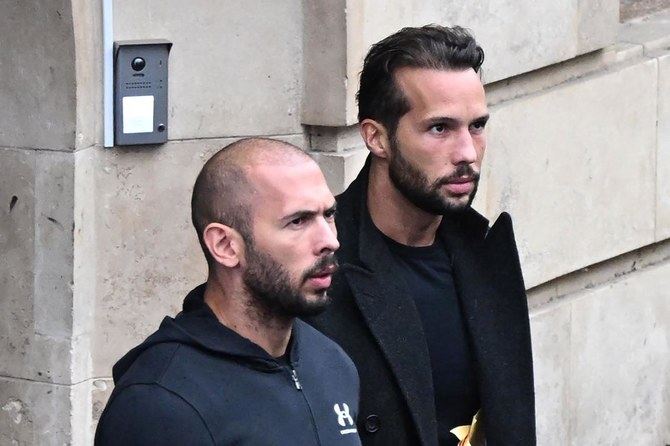
This file photo taken on Jan. 10, 2023 shows British-US former professional kickboxer and controversial influencer Andrew Tate (L) and his brother Tristan Tate (R) exiting a court in Bucharest, Romania. (AFP)
Short Url
Updated 13 March 2024
Follow

UK women suing Andrew Tate say extradition bid prompted by other complaints

  • A Romanian judge on Tuesday ordered the US-born Briton and his brother Tristan be sent to the UK to face the latest accusations
  • The women pursuing UK civil court action against Tate welcomed the development

LONDON: Four women suing influencer Andrew Tate in London for rape and assault allegations said Wednesday a UK request for his extradition from Romania stemmed from similar claims by “other women” in Britain.
A Romanian judge on Tuesday ordered the US-born Briton and his brother Tristan be sent to the UK to face the latest accusations, but only once after a separate Romanian criminal case against them is finished.
They face charges there of human trafficking, rape and forming a criminal group to sexually exploit women.
The pair, who deny all the claims, were arrested again in Romania on Monday on a European arrest warrant, issued following a request from Bedfordshire Police in southern England.
The force, which covers Tate’s hometown of Luton, said Tuesday the warrant resulted from “an ongoing investigation into allegations of rape and human trafficking.”
The women pursuing UK civil court action against Tate welcomed the development, while criticizing British prosecutors for deciding not to charge the social media figure with sex offenses in 2019.
“We understand that this extradition request was made because of criminal complaints of sexual assault made by other women, and not because of the complaints we made almost a decade ago,” they said in a joint statement.
They added UK authorities “have, at last, done the right thing” but that they were “still disappointed and distressed” that the Crown Prosecution Service (CPS) had not acted sooner.
The CPS makes the final decisions on prosecuting cases in England and Wales after reviewing police evidence.
The women said a four-year probe — by Hertfordshire police, also in southern England — into their claims resulted in the force “believing that the evidential test for prosecution had been met.”
They noted the CPS decision not to prosecute allowed Tate to relocate to Romania, where he allegedly committed new serious crimes.
“This might not have happened if the CPS had taken our complaints seriously,” their statement added.
“Last year, we asked the CPS to reconsider its decision. It refused to do so.”
The CPS did not respond to a request to comment.
It has previously defended its decision, saying the claims were fully investigated and did not meet its legal test for a realistic prospect of conviction.
A Bucharest court on Wednesday announced the Tate brothers could remain free from custody while they await trial, but subject to judicial supervision.
That requires them to appear before authorities regularly and forbids leaving the country.


US Justice Department official eyes cases against Cuba leaders as Trump floats ‘friendly takeover’

Updated 07 March 2026
Follow

US Justice Department official eyes cases against Cuba leaders as Trump floats ‘friendly takeover’

  • “Working group” formed to build cases against people connected to the Cuban government
  • Trump’s has increasingly displayed aggressive stance against Cuba’s communist leadership

MIAMI: The top Justice Department prosecutor in Miami is considering criminal investigations of Cuban government officials, according to people familiar with the matter. The inquiry comes as President Donald Trump has raised the possibility of a “friendly takeover” of the communist-run island.
Jason Reding Quiñones, the US attorney for the Southern District of Florida, has created a “working group” that includes federal prosecutors and officials from the Drug Enforcement Administration and other agencies to try to build cases against people connected to the Cuban government and its Communist Party, according to one of the people. They spoke on the condition of anonymity because they were not authorized to publicly discuss the effort.
It was not immediately clear which Cuban officials the office is targeting or what criminal charges prosecutors may be looking to bring.
The Justice Department said in a statement Friday that “federal prosecutors from across the country work every day to pursue justice, which includes efforts to combat transnational crime.”
The effort is taking place against the backdrop of Trump’s increasingly aggressive stance against Cuba’s communist leadership.
Emboldened by the US capture of Cuba’s close ally, Venezuelan President Nicolás Maduro, Trump last month said his administration was in high-level talks with officials in Havana to pursue “a friendly takeover” of the country. He repeated those claims this week, saying his attention would turn back to Cuba once the war with Iran winds down.
“They want to make a deal so bad,” Trump said of Cuba’s leadership.
While Cuba has faded from Washington’s radar as a major national security threat in recent decades, it remains a priority in the US Attorney’s office in Miami, whose political, economic and cultural life is dominated by Cuban-American exiles.
The FBI field office has a dedicated Cuba group that in 2024 was instrumental in the arrest of former US Ambassador Victor Manuel Rocha on charges of serving as a secret agent of Cuba stretching back to the 1970s.
In recent weeks, several Miami Republicans, in addition to Florida Sen. Rick Scott, have called on the Trump administration to reopen its criminal investigation into the 1996 shootdown of four planes operated by anti-communist exiles.
In a letter to Trump on Feb. 13, lawmakers including Reps. Maria Elvira Salazar and Carlos Gimenez highlighted decades-old news reports indicating that former President Raúl Castro — the head of Cuba’s military at the time — gave the order to shoot down the unarmed Cessna aircraft.
“We believe unequivocally that Raúl Castro is responsible for this heinous crime,” lawmakers wrote. “It is time for him to be brought to justice.”
While no indictment against Castro has been announced, Florida’s attorney general said this week that he would open a state-level investigation into the crime.
The Trump administration has also accused Cuba of not cooperating with American counterterrorism efforts, adding it alongside North Korea and Iran to a select few nations the US considers state sponsors of terrorism.
The designation stems from Cuba’s harboring of US fugitives and its refusal to extradite several Colombian rebel leaders while they were engaged in peace talks with the South American nation.