

Arab-Israeli conflict has expanded into ‘full-scale regional war’: Arab League envoy

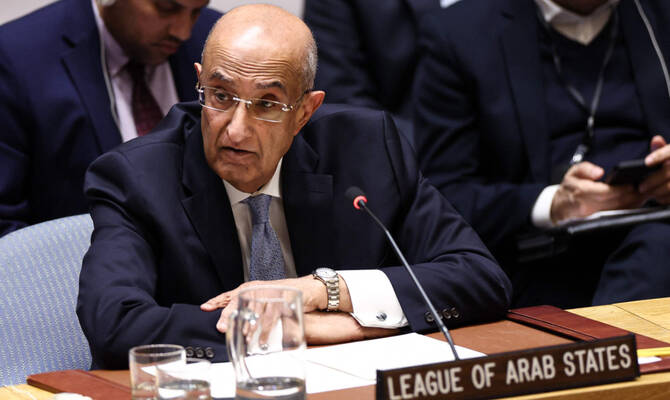
Permanent Observer of the League of Arab States to the United Nations Maged Abdelfattah Abdelaziz speaks during a United Nations Security Council meeting on the situation in the Middle East at UN headquarters in New York on February 28, 2026. (AFP)
Short Url
Updated 01 March 2026
Follow

Arab-Israeli conflict has expanded into ‘full-scale regional war’: Arab League envoy

  • The League of Arab States joins the Secretary-General of the United Nations in urging all states to respect their obligations under international law

NEW YORK: The Arab League on Saturday condemned the overnight escalation by Israel and Iran, warning that it risks igniting a full-scale regional war in the Middle East.

It also condemned Iran’s attacks on several Arab states, and affirmed “its support for any measures they take to defend themselves and to protect their populations.”

Speaking at an emergency UN Security Council session, the Arab League’s permanent observer, Maged Abdelfattah Abdelaziz, criticized Israel’s actions in Gaza, the West Bank and neighboring countries, calling them “a glaring failure of the multilateral international system.”

The Arab-Israeli conflict “has expanded into a full-scale regional war,” he said. “Israel seeks, through this escalation, to evade ending its occupation of Palestinian territories, to prevent the establishment of an independent Palestinian state, and to obstruct Palestine’s admission to the UN in implementation of the two-state solution and the core principles of international legitimacy.”

He accused Israel of broadening its military campaigns beyond Palestine to Syria, Lebanon, Yemen and Iran, describing them as attempts “to impose Israel’s hegemony on the Middle East by using military means, even if it is at the expense of the member states of the League of Arab States and the suffering of their peoples.”

Abdelaziz also criticized Israel’s stance on nuclear weapons, saying it has “refused to join the Nuclear Non-Proliferation Treaty,” declined “to subject its nuclear facilities to the IAEA (International Atomic Energy Agency) comprehensive safeguards regime,” and boycotted the UN conference on establishing a Middle East free of nuclear weapons.

“This Israeli stand reflects the fact that Israel wants to remain the only state acquiring ambiguous nuclear capabilities in the Middle East and capable of producing nuclear weapons,” he said.

Abdelaziz also condemned Iran’s attacks on several Arab states, calling them “cowardly and unjustified military assaults” that threaten to escalate the conflict further.

Missile attacks on Qatar, Bahrain, Kuwait, the UAE, Jordan, Saudi Arabia, Syria and Lebanon constitute “a blatant violation of the sovereignty of states that advocate for peace,” he said.

“The Arab League Secretariat expresses full solidarity with these Arab states in confronting these attacks.”

Abdelaziz urged the international community to act quickly to prevent further escalation and to return to dialogue, emphasizing that Arab states had previously sought to mediate the Iranian crisis.

“The League of Arab States joins the Secretary-General of the United Nations in urging all states to respect their obligations under international law, including the UN Charter, which clearly prohibits the threat or use of force against the territorial integrity or political independence of any state,” he said.

Abdelaziz called on the UNSC, with the US assuming the council’s presidency on Wednesday, to lead efforts to halt military operations and resume negotiations, drawing on “the positive momentum generated by last week’s Board of Peace meeting and by the role of (US) President (Donald) Trump in advancing global peace.”


Lebanese government imposes immediate ban on Hezbollah’s military activities

Updated 5 sec ago
Follow

Lebanese government imposes immediate ban on Hezbollah’s military activities


BERUIT: Lebanon's government said Hezbollah’s overnight attack against Israel were “illegal” and imposed an immediate ban on the group’s military activities, while also demanding its hand over its weapons.

Lebanese Prime Minister Nawaf Salam said only the state could decide whether to go to war and called on the Lebanese military to prevent the firing of projectiles and detain anyone involved.

The move comes after Iran-backed Hezbollah launched rockets at Israel, provoking retaliatory Israeli strikes. The government convened for five hours and 15 minutes in an early morning meeting on Monday before reaching its decision.

The Lebanese cabinet meeting, chaired by President Joseph Aoun, started at 8am with ministers discussing the repercussions Hezbollah's launching of missiles from southern Lebanon into Israel and the Israeli attacks on Lebanon.

Sources initially told Arab News that ministers were “pushing for a decisive response to Hezbollah’s recklessness, regardless of the consequences.”

Lebanese MP Melhem Khalaf said the priority was to “shelter people that are evacuating their homes in relatively safe places. What happened at dawn on Monday has taken us from one stage to another, and we don't know where they've taken us.”

As US-Israeli attacks on Iran continued, Hezbollah said it fired missiles from Lebanon into Israel early Monday in response to the killing of Iranian Supreme Leader Ali Khamenei and “repeated Israeli aggressions.”

There were no reports of injuries or damage, and Israel said it had intercepted one projectile, while several fell in open areas.

Israel retaliated with strikes on Lebanon, killing at least 31 people and wounding 149 others, according to Lebanon's Health Ministry. Around two thirds of the dead were in the south of the country.

Lebanon’s government said it was holding an emergency meeting after Hezbollah’s attack triggered the Israeli airstrikes.

Iran has been firing missiles at Israel and Arab states in a counter-offensive since the joint America-Israeli attack Saturday that killed Khamenei and other top Iranian officials. The war has quickly expanded to proxy forces, including Hezbollah firing out of Lebanon.

MP Bilal Abdullah told Arab News: “All the appeals issued by officials in Lebanon not to embroil us in this destructive war seem to have been in vain. We were supposed to protect Lebanon.

“Whoever launched the missiles and drones from Lebanon has slaughtered Lebanon. Displacing people is a major tragedy. We are in the winter season, and the cold is severe.”