

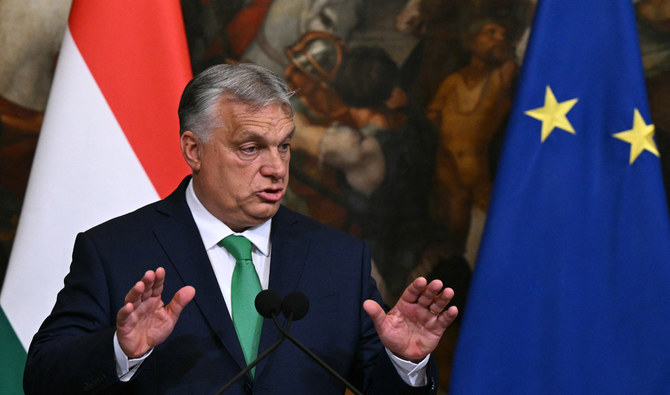

BRUSSELS: EU leaders voiced concerns Thursday at rumors that Hungarian premier Viktor Orban — at the helm of the EU presidency — was about to travel to Moscow, with Council President Charles Michel saying there was “no mandate” for it.
Orban is the only EU leader to have maintained close ties with the Kremlin following Russia’s invasion of Ukraine in 2022.
On Monday, Hungary took over the European Union’s rotating presidency, giving the central European country sway over the bloc’s agenda and priorities for the next six months.
“The EU rotating presidency has no mandate to engage with Russia on behalf of the EU,” Michel wrote on X, formerly Twitter.
“The European Council is clear: Russia is the aggressor, Ukraine is the victim. No discussions about Ukraine can take place without Ukraine,” he added.
Polish Prime Minister Donald Tusk also took to X, posting: “The rumors about your visit to Moscow cannot be true @PM_ViktorOrban, or can they?“
According to the investigative portal Vsquare and the media outlet RFE/RL, which quoted anonymous sources, Orban is expected to meet Russian President Vladimir Putin in Moscow on Friday, just days after traveling to Kyiv.
An EU official in Brussels told AFP that “numerous attempts” to confirm the reports of Orban’s trip “were unsuccessful.”
Orban “did not inform of any trip to Moscow,” the official said, adding that if the Hungarian prime minister had asked, “President Michel would have strongly advised against such a visit.”
If confirmed, the Moscow visit would be the first one by an EU leader since Austrian Chancellor Karl Nehammer in April 2022.
Asked by AFP earlier on Thursday about the rumored visit, the Hungarian government declined to comment.
But on Monday, Orban said there would be “surprising news from surprising places.”
Orban and Putin last met in October 2023 in Beijing, where they discussed energy cooperation.
On Tuesday, the Hungarian leader met Ukrainian President Volodymyr Zelensky in Kyiv.
During the visit, Orban urged Ukraine to work toward a “time-limited” ceasefire with Russia to speed up peace talks.
Zelensky instead called on Orban to back Kyiv’s steps to work for peace in conjunction with international partners.
Orban has repeatedly sought to soften EU sanctions in response to Russia’s invasion of Ukraine.
The nationalist leader, in power since 2010, regularly criticizes Europe’s financial and military support for Kyiv and blocked a 50-billion-euro ($53-billion) aid package for weeks.
He has also openly opposed holding EU membership talks with Kyiv as well as Brussels’ sanctions on Moscow — though Budapest has not used its veto to block the moves.
Earlier this year, Orban congratulated Putin on winning re-election in a vote condemned by the West.
He praised the maintaining of dialogue and “mutual respect” between Hungary and Russia “even in challenging geopolitical contexts.”


