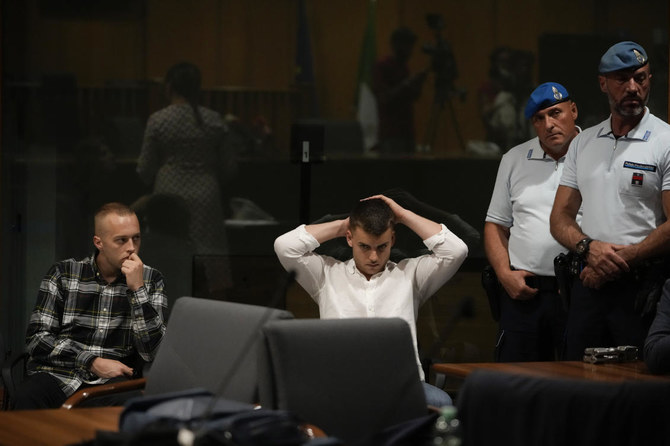
ROME: An Italian appeals court on Wednesday upheld the convictions of two American men in the slaying of an Italian plainclothes police officer during a botched sting operation but significantly reduced their sentences.
The new verdict, ordered after Italy’s highest court threw out the original convictions, drew acceptance from the men’s families and disappointment from the officer’s widow.
Finnegan Lee Elder and Gabriel Natale-Hjorth had been found guilty in the July 2019 slaying of Carabinieri Vice Brig. Mario Cerciello Rega, and after the first trial, were both sentenced to life in prison, Italy’s harshest penalty.
Those sentences were reduced on appeal before Italy’s highest Cassation Court last year ordered a new trial altogether. On Wednesday, the appeals court convicted Finnegan and sentenced him to 15 years and 2 months in prison; it sentenced Natale-Hjorth to 11 years and four months, along with an 800 euro ($863) fine.
“I don’t think we could ask for a reasonable, better decision today,” said Ethan Elder, Finnegan Lee Elder’s father.
Teenagers at the time of the slaying, the former schoolmates from the San Francisco Bay area had met up in Rome to spend a few days vacationing. The fatal confrontation took place after they arranged to meet a small-time drug dealer, who turned out to have been a police informant, to recover money lost in a bad drug deal. Instead, they were confronted by two officers.
Cerciello Riga was stabbed 11 times with a knife brought from the hotel room.
In ordering the retrial, the Cassation Court said it hadn’t been proven beyond a reasonable doubt that the defendants, with limited Italian language skills, had understood that they were dealing with Italian police officers when they went to meet the alleged drug dealer.
The defense had argued that the defendants didn’t know they were facing law enforcement when the attack happened, an argument repeated during the new trial.
Prosecutor Bruno Giangiacomo said his office would wait to read the court’s written reasonings before deciding on a possible appeal to the Cassation. In Italy, both defendants and prosecutors can appeal at every level of judgment.
“Both aggravating factors that were increasing the penalty were excluded,” Giangiacomo said after the verdict. “This could be a delicate point where we can think about an appeal to the Cassation court.” Prosecutors had asked that Finnegan be sentenced to 23 years and nine months and Natale-Hjorth to 23 years.
Rosa Maria Esilio, the widow of Cerciello Rega, was “devastated” by the verdict, said her lawyer Massimo Ferrandino.
“For five years she has been carrying a huge pain. She was the one who closed the eyes of her husband in the morgue. You can imagine her pain today too,” he said.
The killing of the officer in the storied Carabinieri paramilitary police corps shocked Italy, and the 35-year-old Cerciello Rega was mourned as a national hero.
Prosecutors alleged Elder stabbed Cerciello Rega with a knife that he brought with him on his trip to Europe and that Natale-Hjorth helped him hide in their hotel room. Under Italian law, an accomplice in an alleged murder can also be charged with murder without carrying out the slaying.
But lawyer Francesco Petrelli, who represented Natale-Hjorth, said the appeals court clearly recognized that there was a different level of participation by his client.
“There was a reduction, mainly of the responsibility,” he said, adding that “there was a shift from intentional malice to negligence.”
Prosecutors contend that the young Americans concocted a plot involving a stolen bag and cellphone after their failed attempt to buy cocaine with 80 euros ($96) in Rome’s Trastevere nightlife district. Natale-Hjorth and Elder testified they had paid for the cocaine but didn’t receive it.
In a statement released by lawyers after the new verdicts, Leah Elder, Finnegan Elder’s mother, insisted that her son was prepared to take responsibility for his actions and move on.
“This trial is unfortunately connected to the tragedy of a person’s death, a grave fact that has marked and will forever mark the lives of all the families involved,” she said. “Bringing out the truth of the facts would help Finnegan take full responsibility for the pain he caused with his tragic reaction. I hope that, even as he pays for his mistake, he will also open up to hope for the future.”


![]()

Italy appeals court upholds conviction of 2 Americans in death of policeman but reduces sentences
Short Url
https://arab.news/v5ayw
Italy appeals court upholds conviction of 2 Americans in death of policeman but reduces sentences
- The new verdict drew acceptance from the men’s families and disappointment from the officer’s widow
- Teenagers at the time of the slaying, the former schoolmates from the San Francisco Bay area had met up in Rome to spend a few days vacationing


Latest updates








© 2026 SAUDI RESEARCH & PUBLISHING COMPANY, All Rights Reserved And subject to Terms of Use Agreement.