

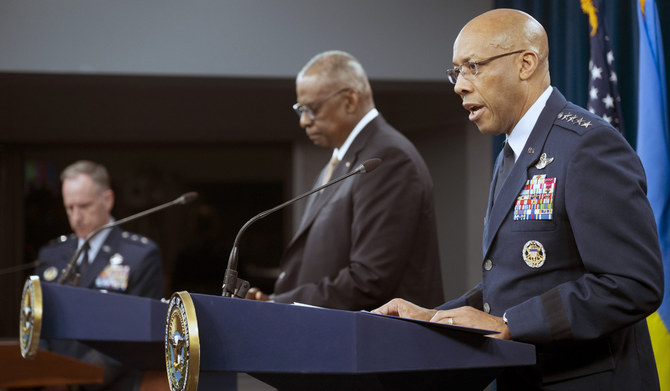

ESPARGOS, Cape Verde: The top US military officer said Sunday that an Israeli military offensive into Lebanon will risk an Iranian response in defense of Hezbollah, triggering a broader war that could put US forces in the region in danger.
Air Force Gen. CQ Brown, chairman of the Joint Chiefs of Staff, said Iran “would be more inclined to support Hezbollah.” He added Tehran supports Hamas, but would give greater backing to Hezbollah “particularly if they felt that Hezbollah was being significantly threatened.”
Brown spoke to reporters as he traveled to Botswana for a meeting of African defense ministers.
Israeli officials have threatened a military offensive in Lebanon if there is no negotiated end to push Hezbollah away from the border. Just days ago, Israel’s military said it had “approved and validated” plans for an offensive in Lebanon, even as the US works to prevent the months of cross-border attacks from spiraling into a full-blown war.
US officials have tried to broker a diplomatic solution to the conflict. The issue is expected to come up this week as Israeli Defense Minister Yoav Gallant visits Washington for meetings with US Defense Secretary Lloyd Austin and other senior US officials.
US President Joe Biden’s senior adviser Amos Hochstein met with officials in Lebanon and Israel last week in an effort to deescalate tensions. Hochstein told reporters in Beirut on Tuesday that it was a “very serious situation” and that a diplomatic solution to prevent a larger war was urgent.
Brown also said the US won’t likely be able to help Israel defend itself against a broader Hezbollah war as well as it helped Israel fight off the Iranian barrage of missiles and drones in April. It is harder to fend off the shorter-range rockets that Hezbollah fires routinely across the border into Israel, he said.
Pentagon officials have said that Austin has also raised concerns about a broader conflict when he spoke to Gallant in a recent phone call.
“Given the amount of rocket fire we’ve seen going from both sides of the border, we’ve certainly been concerned about that situation, and both publicly and privately have been urging all parties to restore calm along that border, and again, to seek a diplomatic solution,” said Maj. Gen. Pat Ryder, Pentagon press secretary last week.
A war between the two heavily-armed foes could be devastating to both countries and incur mass civilian casualties. Hezbollah’s rocket arsenal is believed to be far more extensive than Hamas’.
Israel and the Iranian-backed Hezbollah have exchanged fire across Lebanon’s border with northern Israel since fighters from the Hamas-controlled Gaza Strip staged a bloody assault on southern Israel in early October that set off the Israel-Hamas war in Gaza.
The situation escalated this month after an Israeli airstrike killed a senior Hezbollah military commander in southern Lebanon. Hezbollah retaliated by firing hundreds of rockets and explosive drones into northern Israel and Israel responded with a heavy assault on the militant group.
Israeli strikes have killed more than 400 people in Lebanon, including 70 civilians. On Israel’s side, 16 soldiers and 10 civilians have been killed.
An escalation in the conflict could also trigger wider involvement by other Iran-backed militant groups in the region, leading to all-out war.
Hezbollah leader Hassan Nasrallah said in a speech last Wednesday that militant leaders from Iran, Iraq, Syria, Yemen and other countries have previously offered to send tens of thousands of fighters to help Hezbollah, but he said the group already has more than 100,000 fighters.


