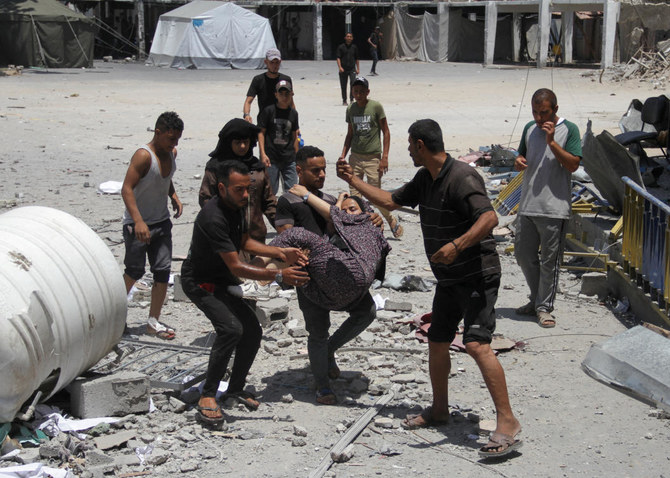
CAIRO: Eight Palestinians were killed on Sunday in an Israeli air strike on a training college near Gaza City being used to distribute aid, Palestinian witnesses said, as Israeli tanks pushed further into the southern city of Rafah.
The strike hit part of an industrial college run by the UN Palestinian refugee agency UNRWA now providing aid to displaced families, the witnesses said. UNRWA and the Israeli military did not immediately respond to requests for comment.
“Some people were coming to receive coupons and others had been displaced from their houses and they were sheltering here. Some were filling up water, others were receiving coupons, and suddenly we heard something falling. We ran away, those who were carrying water let it spill,” said Mohammed Tafesh, one of the witnesses.
A Reuters photographer saw a low-rise building completely demolished and bodies wrapped in blankets laid out beside the road, waiting to be taken away.
“We pulled out martyrs [from beneath the rubble], one who used to sell cold drinks and another who used to sell pastries and others who distributed or received coupons,” Tafesh said. “There are about four or five martyrs and 10 injured. Thank God, the condition of the injured is good.”
More than eight months into Israel’s war in the Hamas-administered Palestinian enclave, its advance is focused on the two areas its forces have yet to seize: Rafah on Gaza’s southern tip and the area surrounding Deir Al-Balah in the center.
Residents said Israeli tanks had advanced to the edge of the Mawasi displaced persons’ camp in the northwest of Rafah in fierce fighting with Hamas-led fighters, part of a push into western and northern Rafah in which they had blown up dozens of houses in recent days.
Images of two Israeli tanks stationed on a hilltop overlooking the coastal area went viral on social media, but Reuters could not independently verify them.
“The fighting with the resistance has been intense. The occupation forces are overlooking the Mawasi area now, which forced families there to head for Khan Younis,” said one resident, who asked not to be named, on a chat app.
The Israeli military said it was continuing “intelligence-based, targeted operations” in the Rafah area and had located weapons stores and tunnel shafts, and killed Palestinian gunmen.
The armed wings of Hamas and the Islamic Jihad movement said their fighters had attacked Israeli forces in Rafah with anti-tank rockets and mortar bombs and pre-planted explosive devices.
Another strike killed two people in Nuseirat in central Gaza.
On Saturday, Palestinian health officials said at least 40 Palestinians had been killed in separate Israeli strikes in some northern Gaza districts, where the Israeli army said it had attacked Hamas’s military infrastructure. Hamas said the targets were the civilian population.
In Beit Lahiya in the northern Gaza Strip, health officials at Kamal Adwan Hospital said a baby had died of malnutrition, taking the number of children dead of malnutrition or dehydration since Oct. 7 to at least 30, a number that health officials say reflects under-recording.
Israel’s ground and air campaign in Gaza was triggered when Hamas-led militants stormed into southern Israel on Oct. 7, killing around 1,200 people and seizing more than 250 hostages, according to Israeli tallies.
The offensive has left Gaza in ruins, killed almost 37,600 people, according to Palestinian health authorities, and left nearly the entire population homeless and destitute.


Israeli strike kills eight at Gaza aid center, witnesses say
https://arab.news/cjkz2
Israeli strike kills eight at Gaza aid center, witnesses say

- “Some people were coming to receive coupons and others had been displaced from their houses and they were sheltering here,” witness says


Hallelujah! This Christmas, join us as we wish for peace across the region
RIYADH: In continuing with a tradition that began in December 2022, Arab News extends a heartfelt Merry Christmas to our Christian readers and all who celebrate. This year’s special edition spotlights Christmas across the Middle East, emphasizing interfaith harmony, resilience and cultural integration. All wrapped with a special, and sincere, message of hope that we see peace spreading across the region in 2026.
Leading our coverage is an exclusive column from renowned scholar Dr. Mohammad bin Abdulkarim Al-Issa, secretary-general of the Muslim World League and president of the Organization of Muslim Scholars. His message clarifies a vital principle: “There is no Shariah text that prohibits congratulating non-Muslims on their religious holidays, including Christmas.” He frames this goodwill not as a dilution of faith, but as its strength; one that affirms human dignity and fosters the social harmony desperately needed today.
This theme of solidarity amid suffering is echoed from Bethlehem, where Palestinian pastor Rev. Dr. Munther Isaac explains that Palestinian Christianity is inseparable from national identity. In response to Gaza’s devastation, his congregation erected a nativity scene from rubble, the infant Jesus wrapped in a keffiyeh. “It was a message of faith,” he states. “Christ stands in solidarity with the suffering ... because he was born into suffering.”
From this depth emerges stories of renewal. In Damascus, festive lights return as Syrians of all faiths embrace a fragile peace. In Lebanon, celebrations pierce through political gloom with moments of joy. Jordan’s public spaces glow with trees and Fairouz’s Christmas hymns, while the UAE’s multicultural diaspora erupts in bustling, festive unity.
The historical and intellectual depth of the region’s Christian heritage is underscored by Dr. Abdellatif El-Menawy, who notes Egypt’s indispensable role in shaping Christianity from a spiritual message into a civilization. This legacy of deep-rooted faith finds vibrant, modern expression.
Here in Saudi Arabia, the festive season is acknowledged with innovative hospitality, as chefs reimagine Christmas menus through a lens of local flavors and creative culinary identity.
This special edition paints a picture far richer than simple seasonal cheer. It reveals a Middle East where different faiths deepen their own roots by extending respect to others, where celebrations are woven with threads of historical endurance, and where the message of Christmas — one of hope, peace and shared humanity — resonates with cheer and confidence.


