

Pakistan’s Sindh province suspends human milk bank, refers initiative to Islamic Ideology Council

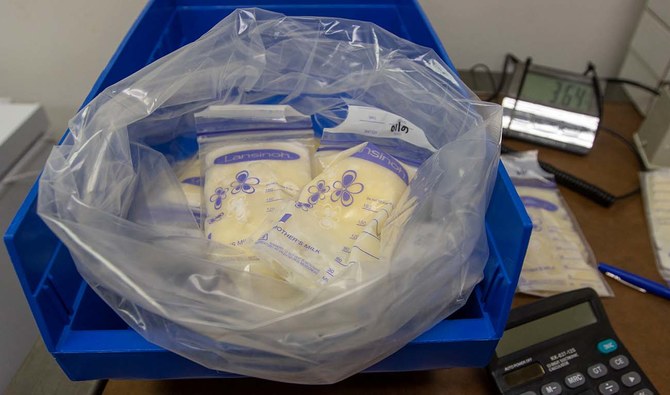
Donated human milk is seen at the Mountain West Mother’s Milk Bank on December 12, 2019 in Salt Lake City, Utah. (AFP/File)
Short Url
Updated 22 June 2024
Follow

Pakistan’s Sindh province suspends human milk bank, refers initiative to Islamic Ideology Council

  • Pakistan’s first human milk bank was set up earlier this month by Sindh Institute of Child Health and Neonatology
  • Facility was established in collaboration with UNICEF, described as “significant milestone in maternal health”

ISLAMABAD: The Sindh Institute of Child Health and Neonatology (SICHN) said this week Pakistan’s first human milk bank established earlier this month had been suspended pending further guidance from the Council of Islamic Ideology.

A human milk bank, breast milk bank or lactarium is a service that collects, screens, processes, pasteurizes, and dispenses by prescription human milk donated by nursing mothers who are not biologically related to the recipient infant. For women who are unable to breastfeed or produce enough milk, pasteurized donor breast milk can be an effective approach to feeding.

SICHN earlier this month announced its human milk bank facility, Pakistan’s first, established in collaboration with UNICEF, describing it as a “significant milestone in maternal health.”

“A recent revised fatwa issued by Darul Uloom Karachi dated 16ht June 2024 has prompted us to discontinue the functionality of the Human Milk Bank. This decision is in compliance with the updated religious guidance and reflects our ongoing commitment to operate within the framework of Islamic jurisprudence,” SICHN said in a statement dated June 21. 

“Moving forward, we will seek further guidance on this issue from both Darul Uloom Karachi and the Council of Islamic Ideology,” the statement added, referring to a religious body that advises the government on the compatibility of laws with Islam.

SICHN said the milk bank was initially set up after seeking and receiving a fatwa from the Darul Uloom Karachi, “which provided us with the necessary religious endorsement to proceed.” 

“This fatwa was critical in ensuring that our efforts were in harmony with Islamic teachings, providing reassurance to the community and stakeholders involved,” the institute said. 

The fatwa cited certain pre-conditions to establish the milk bank including that Muslim children should only be provided milk from Muslim mothers.

Iran is currently believed to be the only country in the Muslim world with a network of milk banks. In general, Islam makes the practice tricky. The opposition centers on a tenet called milk kinship, which states that a parent-child bond is formed when a woman gives milk to a baby who isn’t biologically related to her. 

To avoid future incestuous marriages between so-called milk siblings, the tenet says, the foster relationship must be clearly delineated. Since milk bank donors are typically anonymous and the donations are often combined, the practice is rejected in most of the Muslim world.


UN hails Pakistan’s peacekeepers serving in six missions worldwide

Updated 13 sec ago
Follow

UN hails Pakistan’s peacekeepers serving in six missions worldwide

  • Pakistan is the fifth-largest troop contributor, with 171 peacekeepers killed in UN service
  • Over 2,600 Pakistani military and police personnel are deployed across Africa and beyond

ISLAMABAD: The United Nations on Friday praised Pakistan’s contribution to global peacekeeping, saying Pakistani military and police personnel were currently serving in six UN missions around the world.

According to information shared by the world body alongside its social media post, Pakistan is the fifth-largest contributor to UN peacekeeping operations, with 2,662 personnel — including 147 women — deployed across missions in Abyei, the Central African Republic, Cyprus, the Democratic Republic of Congo, South Sudan and Western Sahara.

“In six UN peacekeeping missions around the world, over 2,600 military and police officers from Pakistan are serving for peace, leaving their families to protect those most at risk,” the UN said.

“We thank these brave women and men for their service and sacrifice,” it added.

Pakistan joined UN peacekeeping in 1960 when it deployed a contingent to the UN Operation in the Congo and has since played a prominent role in peace operations, undertaking tasks ranging from civilian protection and medical outreach to disaster response and infrastructure rebuilding, according to the UN.

A total of 171 Pakistani peacekeepers have lost their lives while serving under the UN flag, the organization said.

Pakistan’s Permanent Representative to the United Nations Asim Iftikhar Ahmad echoed the message, saying Pakistani peacekeepers had made the nation proud through their service.

“Pakistan has worked as part of UN Peacekeeping to serve the cause of international peace,” he said in a post on X. “Our brave men and women in blue helmets have made the nation proud through their dedicated service in support of communities affected by conflicts and wars.”