DUBAI: An attack by Yemen’s Houthi militants targeted a commercial ship traveling through the Gulf of Aden but apparently caused no damage, authorities said Saturday, in the latest strike on the shipping lane by the group.
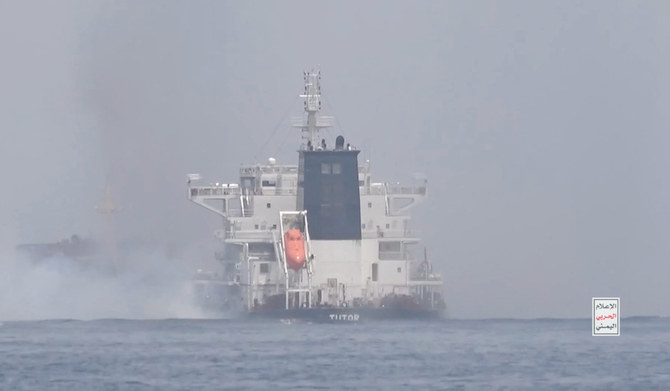
The Houthi attack comes after the sinking this week of the ship Tutor, which marked what appears to be a new escalation by the Iranian-backed Houthis in their campaign of strikes on ships in the vital maritime corridor over the Israel-Hamas war in the Gaza Strip.
Meanwhile, US officials reportedly ordered the USS Dwight D. Eisenhower, the aircraft carrier leading America’s response to the Houthi attacks, to return home after a twice-extended tour.
The captain of the ship targeted late Friday saw “explosions in the vicinity of the vessel,” the British military’s United Kingdom Maritime Trade Operations center said. A later briefing by the US-overseen Joint Maritime Information Center said the vessel initially reported two explosions off its port side and a third one later.
“The vessel was not hit and sustained no damage,” the center said. “The vessel and crew are reported to be safe and are proceeding to their next port of call.”
The Houthis, who have held Yemen’s capital, Sanaa, since 2014, claimed the attack Saturday night. Brig. Gen. Yahya Saree, a Houthi military spokesman, identified the vessel targeted as the bulk carrier Transworld Navigator.
The Houthis have launched more than 60 attacks targeting specific vessels and fired off other missiles and drones in their campaign that has killed a total of four sailors. They have seized one vessel and sunk two since November. A US-led airstrike campaign has targeted the Houthis since January, with a series of strikes May 30 killing at least 16 people and wounding 42 others, the militants say.
In March, the Belize-flagged Rubymar carrying fertilizer became the first to sink in the Red Sea after taking on water for days following a militant attack.
The Houthis have maintained that their attacks target ships linked to Israel, the United States or Britain. However, many of the ships attacked have little or no connection to the Israel-Hamas war.
Meanwhile, the US Naval Institute’s news service reported, citing an anonymous official, that the Eisenhower would be returning home to Norfolk, Virginia, after an over eight-month deployment in combat that the Navy says is its most intense since World War II. The report said an aircraft carrier operating in the Pacific would be taking the Eisenhower’s place.
The closest American aircraft carrier known to be operating in Asia is the USS Theodore Roosevelt. The Roosevelt anchored Saturday in Busan, South Korea, amid Seoul’s ongoing tensions with North Korea.
The Eisenhower had repeatedly been targeted by false attack claims by the Houthis during its time in the Red Sea. Saree on Saturday night claimed another attack on the carrier — but again provided no evidence to support it as the carrier was reportedly already scheduled to leave the region.

Houthi attack targets a ship in the Gulf of Aden as the Eisenhower reportedly heads home
https://arab.news/w95k3
Houthi attack targets a ship in the Gulf of Aden as the Eisenhower reportedly heads home
- The Houthi attack comes after the sinking this week of the ship Tutor
- US officials reportedly ordered the USS Dwight D. Eisenhower, the aircraft carrier leading America’s response to the Houthi attacks, to return home after a twice-extended tour
Lebanon PM publishes long-awaited banking law draft
- The law stipulates that each of the state, the central bank, commercial banks and depositors will share the losses accrued as a result of the financial crisis.
- Depositors with a limit of $100,000, over the course of four years
BEIRUT: Lebanese Prime Minister Nawaf Salam published on Friday a long-awaited banking draft bill, which distributes losses from the 2019 economic crisis between banks and the state.
The draft law is a key demand from the international community, which has conditioned economic aid to Lebanon on financial reforms.
In a televised speech, Salam said “this draft law constitutes a roadmap to getting out of the crisis” that still grips Lebanon.
The draft will be discussed by the Lebanese cabinet on Monday before being sent to parliament, where it could be blocked.
The law stipulates that each of the state, the central bank, commercial banks and depositors will share the losses accrued as a result of the financial crisis.
Depositors, who lost access to their funds after the crisis, will be able to retrieve their money, with a limit of $100,000, over the course of four years.
Salam said that 85 percent of depositors had less than $100,000 in their accounts.
The wealthiest depositors will see the remainder of their money compensated by asset-backed securities.
“I know that many of you are listening today with hearts full of anger, anger at a state that abandoned you,” Salam said.
“This bill may not be perfect... but it is a realistic and fair step toward restoring rights, halting the collapse.”
- ‘Banks are angry’ -
The International Monetary Fund, which closely monitored the drafting of the bill, had previously insisted on the need to “restore the viability of the banking sector consistent with international standards” and protect small depositors.
The Associations of Banks in Lebanon criticized the draft law on Monday, saying in a statement that it contains “serious shortcomings” and harms commercial banks.
“Banks are angry because the law opens the door to them sharing any part of the losses,” said Sami Zougheib, researcher at The Policy Initiative, a Beirut-based think tank.
He told AFP that banks would have preferred that the state bear full responsibility.
The text provides for the recapitalization of failing banks, while the government’s debt to the Central Bank will be converted into bonds.
Salam said that the bill aims to “revive the banking sector” which had collapsed, giving free rein to a parallel economy based on cash transactions, which facilitate money laundering and illicit trade.
According to government estimates, the losses resulting from the financial crisis amounted to about $70 billion, a figure that is expected to have increased over the six years that the crisis was left unaddressed.
Since assuming power, Salam and President Joseph Aoun have pledged to implement the necessary reforms and legislation.
In April, Lebanon’s parliament adopted a bank restructuring law, as the previous legislation was believed to have allowed a flight of capital at the outbreak of the 2019 crisis.
The new bill stipulates that politically exposed persons and major shareholders who transferred significant capital outside the country from 2019 onwards — while ordinary depositors were deprived of their savings — must return them within three months or face fines.
The draft law could still be blocked by parliament even if the cabinet approves it.
“Many lawmakers are directly exposed as large depositors or bank shareholders, politically allied with bank owners, and unwilling to pass a law that either angers banks or angers depositors,” Zougheib said.
Politicians and banking officials have repeatedly obstructed the reforms required by the international community for Lebanon to receive financial support.


