

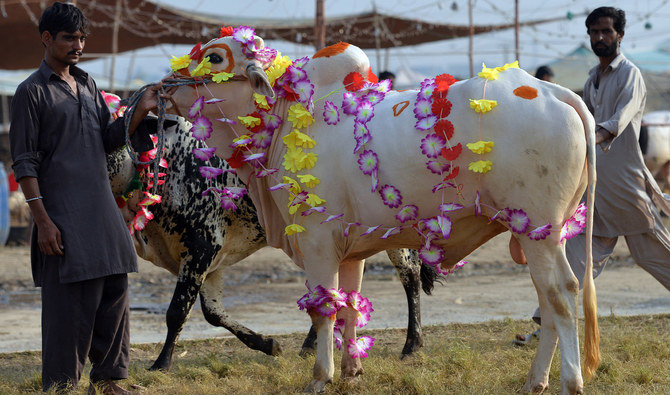
On Eid Al-Adha, animal accessories are all the rage 

A Pakistani livestock trader stands with a decorated cow as he waits for customers at the one of the main animal markets set up for the forthcoming sacrificial Eid Al-Adha festival in Islamabad on September 29, 2014. (AFP/File)
Short Url
Updated 17 June 2024
Follow

On Eid Al-Adha, animal accessories are all the rage 

  • Animal traders decorate bulls, lambs and goats to make them stand out and fetch higher prices
  • Customers buy animals, then purchase anklets, bells and colorful collars from decoration stalls

ISLAMABAD: Ashraf Khan picked up a colorful anklet and showed it to a customer from a range of collars, beads, bells and other ornaments at his stall of animal accessories at the Sangjani cattle market on the outskirts of the Pakistani capital of Islamabad.

The 33-year-old, who sets up a makeshift stall at the market every year, said the demand for animal accessories went up just as the demand for animals and their prices surged ahead of the major Islamic festival, marked by devout Muslims by slaughtering animals and sharing the meat with family and the poor.

Khan, who has been selling animal accessories for the last several years, said his clients not only included members of the public, but also traders who wanted to adorn their cows, sheep and bulls before putting them up for sale in order to better attract customers and fetch higher prices.

“We receive goats, lambs and bulls [at our decoration stall],” Ashraf said. “It takes Rs1,000 to Rs1,500 ($3-5) to decorate a goat with different types of materials. Decorating bulls ranges from Rs2,000 to Rs2,500 ($7-8).”

The 33-year-old sources ornaments from Islamabad’s twin city of Rawalpindi and sets up his stall in the Sangjani capital market a week before Eid.

“The price tag depends on the number and quality of items,” Khan said. 

Naik Muhammad, who brought 50 lambs to sell at Sangjani market, said a lamb cost him around Rs25,000 ($90) this year and he was looking to sell it for between Rs85,000 to Rs95,000 ($305-$341).

“The purpose of decoration is that customers like them more and the rates get better,” Muhammad said. “When customers like the animal then we can ask rates of our choice.”

Alamgir Khan, a fruit vendor in Islamabad, purchased a lamb for Rs77,500 ($278) after haggling with sellers for around three hours and brought it to Khan’s stall to buy accessories for decoration.

“We have spent some money on its decoration to make it look beautiful and then the children at home will see it and be happy, and that is a rewarding thing,” Alamgir told Arab News. “This is an animal for sacrifice, it should be adorned.”


T20 World Cup: Pakistan’s India boycott splits fans as politics overshadows cricket

Updated 5 sec ago
Follow

T20 World Cup: Pakistan’s India boycott splits fans as politics overshadows cricket

  • The boycott has dealt a blow to the ICC’s marquee event, with India-Pakistan matches ‌the biggest drivers ‌of global viewership, revenue
  • On the streets, many Pakistani fans back the boycott as a response to what they see as India’s growing influence over cricket governance

KARACHI: Pakistan’s decision to boycott its Twenty20 World Cup match against India has drawn widespread support from fans ​and administrators who hailed the move as a long-overdue stand in a rivalry in which sport and geopolitics have collided.

The government on Sunday cleared Pakistan to take part in the tournament beginning February 7 but barred the team from playing India in a February 15 group match in Colombo, a decision the International Cricket Council (ICC) said was not in the interests of the global game.

The boycott deepened a long freeze in bilateral cricket between the nuclear-armed neighbors — who have not played a full series since 2012–13 and now meet largely at neutral venues — and dealt a blow to the ICC’s marquee event, with India-Pakistan matches ‌the biggest drivers ‌of global viewership and revenue.

’ENOUGH IS ENOUGH’

For many in Pakistan, however, ‌the ⁠boycott ​was less ‌about cricketing issues, with Pakistan forfeiting two points by skipping the match, and more about symbolism.

“Enough is enough,” former Pakistan Cricket Board (PCB) chairman Najam Sethi told Reuters, accusing India’s board of politicizing the ICC. “It’s time to challenge this duplicitous approach by exercising PCB’s options in alliance with Bangladesh.”

The Indian government, the Board of Control for Cricket in India (BCCI) and the International Cricket Council did not respond to requests for comment.

The ICC said it was still awaiting an official communication from the Pakistan Cricket Board (PCB) conveying their “position of selective participation.”

“While the ICC respects the roles ⁠of governments in matters of national policy, this decision is not in the interest of the global game or the welfare of fans ‌worldwide, including millions in Pakistan,” the Dubai-based body said in a ‍statement on Sunday.

The government has not publicly detailed ‍its reasoning, but Mosharraf Zaidi, a spokesperson for Prime Minister Shehbaz Sharif, linked the move to security ‍tensions with India.

“Nothing is more important than the memory of Pakistani citizens and troops murdered by Indian proxy terrorists over the weekend,” Zaidi said. “With funerals taking place today, this was the least that could be done.”

The remarks followed coordinated attacks by Baloch separatist militants across Pakistan’s southwestern Balochistan province over the weekend that killed nearly 50 people.

India’s ​foreign ministry rejected Pakistan’s accusations, calling them “baseless” and accusing Islamabad of deflecting attention from its own internal issues.

Pakistan’s World Cup jersey has been branded the “Markhor Edition,” after the national ⁠animal, a symbol of resilience also used in military iconography, Geo TV reported.

’LET CRICKET JUST BE A GAME’

On the streets of Pakistan’s major cities, many cricket fans backed the boycott as a response to what they see as India’s growing influence over global cricket governance.

“This arrogance of India should be broken a little,” said Mohammad Asghar, a fan in Karachi. “They should realize someone has come forward to challenge them.”

Others drew parallels with Bangladesh’s earlier withdrawal from the tournament over safety concerns, a move that led to Scotland replacing them, and questioned why Pakistan should be held to a different standard.

“If Bangladesh can boycott for one player’s safety, why can’t Pakistan take a stand?” said Ayaz Ahmed.

The decision also sparked heated debate on social media, with users divided between calls for “self-respect” and warnings that skipping the match could further isolate Pakistan in global cricket.

Former Pakistan captain Shahid Afridi agreed.

“Cricket ‌can open doors when politics closes them,” he wrote on X. “It’s regrettable that Pakistan won’t play India, but this is the moment for the ICC to prove it is impartial.”