

Startup Wrap – Middle East SME funding activity flourishes with significant sums 

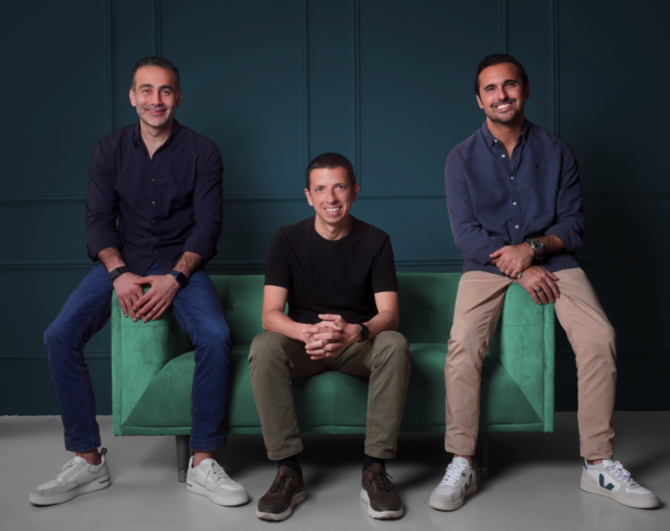
Rami Tabbara, Manar Mahmassani, and Ricardo Brizido from UAE-based proptech firm Stake, which raised $14 million in a series A funding round. Supplied
Short Url
Updated 01 October 2024
Follow

Startup Wrap – Middle East SME funding activity flourishes with significant sums 

CAIRO: The Middle East region has been witnessing a significant boost in startup activity, with numerous entrepreneurs securing funding across key sectors.  

Additionally, multiple investment pools were established, with Qatari and Emirati venture capitals aiming to further amplify the ecosystem. 

Regional startups are particularly eyeing the burgeoning Saudi market, with UAE-based proptech firm Stake raising $14 million in a series A funding round to enter the Kingdom.

The round was led by Middle East Venture Partners, with participation from Aramco’s Wa’ed Ventures, Mubadala, and Republic. 

Founded in 2021 by Rami Tabbara, Manar Mahmassani, and Ricardo Brizido, Stake is a digital real estate investment platform that offers options for income-generating properties in Dubai. 

The newly raised funds will be used to expand Stake’s services into Saudi Arabia this year. 

In 2022, Stake closed its pre-series A round at $8 million, backed by MEVP and BY Ventures, with participation from returning investors Vivium Holding and Combined Growth Real Estate. 

Saudi edtech Tahdir raises $270k in pre-seed round  

Saudi-based edtech Tahdir has closed a pre-seed funding round of $270,000 from a group of angel investors.  

Founded by Mohammed Al-Doukhi and Khalil Al-Haid, Tahdir’s platform automates daily school and educational management processes, and the company claims to be serving 92 schools with over 30,000 users. 

The investment will help the company enhance its capabilities and expand its operations within the Kingdom. 

Egypt-based medtech i‘SUPPLY secures pre-series A round  


i‘SUPPLY was founded in 2022 by Ibrahim Emam, Malek Sultan and Moustafa Zaki. Supplied

Egypt-based medical tech startup i‘SUPPLY has secured a pre-series A round, bringing its total funding to $2.5 million since its inception in 2022.  

This round saw participation from several investment funds, including Disruptech Ventures, OneStop Capital, Axian Investment CVC, and Egypt Ventures. 

Founded by Ibrahim Emam, Malek Sultan, and Moustafa Zaki, i‘SUPPLY aims to digitize the pharmaceutical business by offering a one-stop-shop solution to quickly predict and overcome supply chain disruptions.  

The new funding will bolster i’SUPPLY’s expansion plans, enhance its capabilities in financing small and medium-sized pharmacies, and further develop its fintech offerings and technological services. 

Egyptian fintech Sahl raises $6m in series A round 

Cairo-based fintech Sahl has raised $6 million in an investment that acts as a series A and seed funding round led by Ayady for Investment and Development. Existing investors Egypt Pay, Delta Electronic Systems, and E-Finance also participated in the round.  

Founded in 2020 by Ahmed Othman, Ibrahim Assal, and Abullah Assal, Sahl is a bill payment platform that allows users to recharge prepaid cards.  

The company is one of the few Egyptian firms integrating directly with several government entities.  

The new funds will help refine and develop Sahl’s offerings and extend its services to Saudi Arabia after its regional launch in the UAE.  

UAE’s Qstay raises $4.6m in pre-series A round 


Jumeirah beach residence. Supplied.

UAE-based hospitality platform Qstay has raised $4.6 million in a pre-series A funding round through a combination of conventional and convertible debt.  

Founded in 2020 by Artur Khayrullin, Ekaterina Rogozhina, Alec Fesenko, and Natalya Fesenko, Qstay operates as a virtual hotel brand with 200 units.  

Qstay provides digital app-based access to nearby pools, beaches, gyms, and spas for guests staying in beachfront properties.  

To date, the company has raised $11.1 million. In July 2022, Qstay closed a debt and equity Seed round of $6.5 million. 

UAE-based Polynome Group announces $100m fund for AI startups 

UAE-based event management company Polynome Group has announced a $100 million fund to invest in artificial intelligence startups.  

The fund will target startups in technology, AI software applications, and robotics, aligning with goals to expand the adoption of digital technologies beginning in the first quarter of 2025. 

The fund will adopt the “founders for founders” concept, investing in seed, series A, and growth stage startups with initial investments ranging from $500,000 to $5 million per company. 

UAE-based contech Tenderd secures $30m in series A funding 

Construction technology firm Tenderd has closed a $30 million series A funding round, led by A.P. Moller Holding, with new investors Quadri Ventures and Saurya Prakash joining existing investors Wa’ed Ventures, Nakhla Ventures, SOMA Capital, and Liquid 2 Ventures. 

Founded in 2018 by Arjun Mohan, Tenderd provides customers with AI-generated insights to increase asset utilization and reduce emissions, focusing on heavy industries such as construction and logistics.  

The capital will fuel technological innovations and support the UAE-based firm’s global expansion efforts. 

Qatar-based Rasmal Ventures launches first home-grown fund 

Qatar-based VC firm Rasmal Ventures LLC has launched its first home-grown fund, aiming to drive innovation and investment in Qatar and the Middle East and North Africa region.  

The Rasmal Innovation Fund I LLC targets high-performance startups in climate tech, fintech, business to business Software-as-a-Service, and AI sectors. 

For the initial closing, the fund has raised $30 million from institutional investors and family offices, with the goal of reaching $100 million in investment commitments. 

Kuwait-based travel tech Waves secures investment round 

Kuwait-based travel tech startup Waves has closed an investment round for an undisclosed amount, co-led by BNK Capital and Aujan Enterprises.  

Founded in 2021 by Abdulrahman Al-Sadoun and Sulaiman Al-Tunaib, Waves is an online marketplace for booking sea trips, marine activities, and chalets with operations in Kuwait, Saudi Arabia, Qatar, and the UAE. 

The investment will be used to enhance Waves’ services in Saudi Arabia. 

E-commerce platform Orisdi raises six-figure bridge round 

Iraq-based e-commerce platform Orisdi has raised a six-figure bridge round of investment, backed by existing investors including Al Sharqiya TV Group, Iraq Venture Partners, and various angel investors.  

Founded in 2019 by Ahmed Al-Kiremli and Hala Usama, Orisdi offers a range of products across verticals such as perfumes, cosmetics, appliances, stationery, and electronics. 

This funding round, which closed in April 2024, will support Orisdi’s business development efforts and highlight the potential of the e-commerce sector in Iraq.


How lifestyle-led real estate is reshaping Saudi Arabia’s urban future

Updated 25 January 2026
Follow

How lifestyle-led real estate is reshaping Saudi Arabia’s urban future

  • Government spending, regulatory changes, and incentives for foreign investors are fueling development

RIYADH: Saudi Arabia’s real estate sector is entering a new phase, one defined by lifestyle, experience, and quality of life rather than sheer housing volume.

Driven by Vision 2030, lifestyle-focused developments are set to outperform traditional residential projects, reshaping how people live, work, and connect across the Kingdom.
Government spending, regulatory changes, and incentives for foreign investors are also fueling development. Rising demand across residential, commercial, and logistics sectors, along with the push for smart cities and sustainability, is reshaping the market.
Saudi Arabia’s real estate market was valued at $77.2 billion in 2025 and is projected to grow to $137.8 billion by 2034, with a compound annual growth rate of 6.7 percent from 2026 to 2034, according to IMARC Group.

Lifestyle-focused real estate market 
Saudi Arabia’s real estate landscape has evolved beyond conventional housing. Guided by Vision 2030, it now plays a key role in enhancing quality of life, boosting tourism, and driving economic diversification.
According to Sally Menassa, partner at Arthur D. Little, what stands out today is a clear shift from volume-driven residential supply to lifestyle-led, experience-based development.
“As a result, the lifestyle-focused segment is expected to outperform conventional residential real estate, growing at around 8 percent annually over the next five years. This growth is being driven by changing consumer expectations, population growth, rising incomes, and the scale of public investment shaping new urban environments,” Menassa said.
She added that demand in the Kingdom’s real estate is rising across four key segments: mixed-use districts near urban hubs such as King Salman Park; wellness-focused communities prioritizing walkability and services; coastal living along the Red Sea with branded residences; and heritage-driven districts like Diriyah and Al Balad that blend culture, hospitality, and long-term value.
“Overall, this marks a fundamental shift in the Kingdom. Real estate is no longer an end in itself and about delivering buildings; it is becoming a platform for place-making, economic diversification, and sustained value creation,” the ADL partner explained.
From another perspective, Houssem Jemili, senior partner at Bain and Co. Middle East said: “Saudi’s real estate market is forecast at roughly 7–8 percent CAGR to 2030; ‘lifestyle’ demand is being pulled most by amenity-led mixed-use communities plus higher-spec, greener and wellness-leaning homes.”
A report from PwC Middle East released in 2025 focused on the future of sustainable real estate in Saudi Arabia, and  showed that the sector is shifting toward livability-focused, high-quality urban developments. Giga-projects are driving demand for mixed-use, wellness-focused, and socially connected communities that enhance quality of life.
Imad Shahrouri, cities sector lead partner, consulting, in Riyadh at PwC Middle East said: “By placing livability and human experience at the foundation of its urban agenda, Saudi Arabia is shaping a market where lifestyle-led developments will play an increasingly influential role in driving demand and investment.”

Core lifestyle elements developers are prioritizing  
Saudi developers are shifting from the traditional “build and sell” model to creating integrated lifestyle communities focused on long-term value and everyday living.
Menassa from ADL highlighted that the shift centers on enhancing public spaces — with walkable areas, parks, and wellness facilities — to promote healthier, more social lifestyles, especially for a younger, health-focused population.
“Convenience is also playing a bigger role in shaping residential districts. Schools, childcare centers, clinics, co-working spaces and a wide range of food and beverage options are increasingly located within walking distance of homes, reducing commuting time and making everyday life more efficient and connected,” she said.
The partner added: “Equally important is the role of culture and social activity. Many developments now incorporate cultural venues, entertainment spaces and destination dining, ensuring that neighborhoods remain active throughout the day and week rather than becoming dormant outside working hours.”
Menassa went on to stress that real estate in Saudi Arabia is evolving into a strategic tool for quality of life, tourism, and talent attraction. Driven by Vision 2030, developments now integrate smart infrastructure and global lifestyle standards, while staying rooted in local culture to meet the needs of a young, urban population.

FASTFACT

Driven by Vision 2030, lifestyle-focused developments are set to outperform traditional residential projects, reshaping how people live, work, and connect across the Kingdom.

From Bain’s lens, Jemili said: “Developers are prioritizing livable neighborhoods. Walkability, parks and sport, culture and entertainment access, and everyday convenience, shaped by Vision 2030’s Quality of Life agenda and the 70 percent homeownership-by-2030 push.”
Shahrouri from PwC shed light on how developers in the Kingdom prioritizing livability, wellbeing, and inclusive, community-focused spaces are, aligning with Vision 2030’s push to enhance daily life and promote social integration while reflecting local identity.
“As a result, lifestyle-led elements such as walkable neighborhoods, activated public spaces and integrated community facilities are becoming central to new destinations, ensuring future developments foster more connected, resilient and experience-rich ways of living,” he said.

Regions, cities key hubs for experiential development 
Several Saudi cities are emerging as prominent centers for lifestyle-focused, experiential development, each defined by its unique urban and economic character.
From ADL’s perspective, Riyadh is leading this shift as it positions itself as a global capital. The city is seeing strong demand for integrated, mixed-use districts that support live-work-play lifestyles.
“Developments such as KAFD, Diriyah, and areas surrounding King Salman Park reflect a growing preference for urban living that combines employment, culture, green space, and entertainment in close proximity,” Menassa said.
“Jeddah’s appeal is different, but equally compelling. Its strength lies in its coastal character, historic fabric, and more relaxed urban rhythm. Waterfront regeneration and heritage-led districts, particularly around Al Balad, are driving interest in developments that blend walkability, culture, and sea-facing lifestyles — attracting residents, investors, and tourists alike,” she added.
The partner continued to underline that destination developments along the Red Sea coast focus on sustainable, low-density communities blending hospitality, nature, and residential living, promoting wellness and eco-tourism.
Menassa noted that secondary cities like Abha and AlUla are emerging as hubs for outdoor living, culture, and heritage, supported by government policies and investments. 
These lifestyle-driven districts appeal to residents for livability and job access, and to investors for scale and stability, offering resilience through everyday services and cultural experiences.
From Bain’s side, Jemili explained that Riyadh and Jeddah stand out as the main hubs because they combine jobs, population growth, liquidity and are where “integrated community” formats scale fastest.
“We’re seeing the same in Makkah and Madinah; the focus is shifting from delivering more units to delivering higher-quality development and standards,” he said.
From PwC’s perspective, Shahrouri noted that regions across Saudi Arabia are becoming hubs for lifestyle-driven development, with large-scale regeneration creating sustainable, well-designed environments that enhance urban living and attract global investment.
“Flagship projects are reshaping their surroundings by focusing on the character and feel of place, bringing together community elements, environmental responsibility, and integrated urban design.”

 Their growing appeal comes from the balance they strike between modern infrastructure and a human-centered approach to planning, creating destinations where daily life feels more seamless and connected,” he said.

Next phase of Saudi real estate evolution
The next phase of Saudi Arabia’s real estate evolution is likely to be defined by integration, intelligence, and regeneration.
From ADL’s lens, Menassa explained that  Riyadh is set to feature highly vertical, dense urban environments designed for land efficiency and sustainability, with fully integrated live-work-play ecosystems that reduce commuting, boost productivity, and enhance social cohesion.
“The real shift, however, is toward AI-enabled and data-driven communities, where energy, mobility, and services are actively managed rather than passively consumed. Real estate will increasingly be judged not by how much is sold, but by how well places perform — in terms of livability, productivity, and environmental outcomes,” she said.
The partner noted that Saudi Arabia is boosting private sector involvement, public-private partnerships, and institutional investments to develop public spaces and social infrastructure. The focus is shifting from just constructing cities to designing lifestyles, using real estate as a key driver for economic growth and social transformation.
Jemili from Bain said: “The next phase is more about operating districts like platforms, digital twins, and real-time data to optimize energy, maintenance, mobility, and resident experience, creating tighter live-work-play loops. Rather than ‘building more.’”
From PwC’s side, Saudi Arabia is building a strong foundation for future cities by focusing on resilient, resource-efficient developments and adaptable infrastructure, paving the way for smart, connected urban models like vertical districts and digital neighborhoods.
“These emerging environments are set to respond more naturally to the needs of their communities. As the quality and experience of urban life continue to rise, our cities are poised to become more intelligent, enriching and future ready, evolving with their residents and reflecting the ambition of a nation transforming at pace,” Shahrouri concluded.