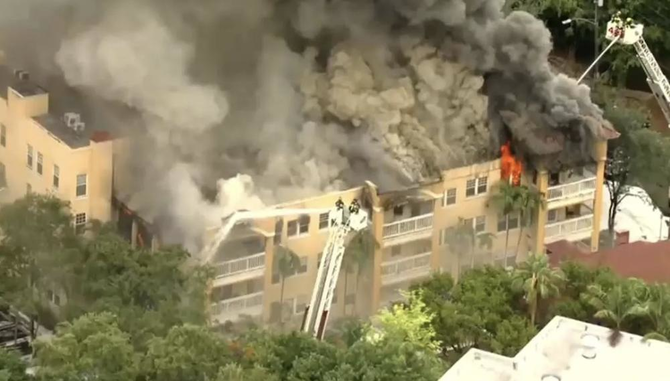
MIAMI: A massive fire broke out at a four-story apartment complex in Miami on Monday morning.
Firefighters and police officers arrived at the building just west of Interstate 95 near downtown Miami after receiving calls about a fire around 8:15 a.m., and began rescuing residents from the building’s balconies, Miami Mayor Francis Suarez said during a news conference.
Suarez said arriving first responders also found a man with gunshot wounds at the scene. He was taken to a hospital, where he was in critical condition. Officials said the shooting is part of an active investigation. They offered few other details.
The mayor said two firefighters were taken to a hospital due to heat exhaustion, and both were in stable condition.
Miami police officials said this was “an isolated incident,” meaning there is no gunman at large.
News helicopters showed flames rising from the building along with large plumes of smoke several hours after the fire started. At least two ladder trucks were pouring water and foam onto the building.
The Temple Court apartment complex is made up of one-bedroom and studio units near the Miami River.
Residents from the building, many of them elderly, were taken to a staging area where they were offered food and any medications they needed, Suarez said.
Smoke from the fire was also drifting over Interstate 95, and much of downtown Miami.
It was not immediately known whether anyone was injured in the fire.

Massive fire breaks out in 4-story apartment building near downtown Miami
Short Url
https://arab.news/ne7sv
Massive fire breaks out in 4-story apartment building near downtown Miami
- Mayor Suarez said arriving first responders also found a man with gunshot wounds at the scene
Congo refugees recount death and chaos as war reignites
RUSIZI: Congolese refugees described neighbors being massacred and losing children in the chaos as they fled into Rwanda to escape a surge in fighting despite a peace deal brokered by US President Donald Trump.
“I have 10 kids, but I’m here with only three. I don’t know what happened to the other seven, or their father,” Akilimali Mirindi, 40, told AFP in the Nyarushishi refugee camp in Rwanda’s Rusizi district.
Around 1,000 Congolese have ended up in this camp after renewed fighting broke out in eastern Democratic Republic of Congo earlier this month.
The M23 armed group, backed by Rwanda, has seized vast swathes of eastern DRC over the past year and is once again on the march, taking another key city, Uvira, in recent days.
Thousands have fled as civilians are again caught in the crossfire between the M23, Congolese forces and their allies.
Mirindi was living in Kamanyola near the Rwanda border when bombs started falling, destroying her house.
“Many people died, young and old. I saw corpses as we fled, jumping over some of them. I made a decision to cross into Rwanda with the rest,” she said.
Trump hosted the presidents of Rwanda and DRC, Paul Kagame and Felix Tshisekedi, on December 4 for an agreement aimed at ending the conflict, but the new offensive was already underway even as they were meeting.
“It’s clear there is no understanding between Kagame and Tshisekedi... If they don’t reach an understanding, war will go on,” said Thomas Mutabazi, 67, in the refugee camp.
“Bombs were raining down on us from different directions, some from FARDC (Congolese army) and Burundian soldiers, some from M23 as they returned fire,” he said.
“We had to leave our families and our fields. We don’t know anything, yet the brunt of war is faced by us and our families.”
- ‘Bombs following us’ -
The camp sits on a picturesque hill flanked by tea plantations, well-stocked by NGOs from the United Nations, World Food Programme and others.
There are dormitories and a football pitch for the children, but the mostly women and children at the camp spoke of having their homes and fields stripped bare or destroyed by soldiers.
Jeanette Bendereza, 37, had already fled her home in Kamanyola once this year — during the earlier M23 offensive, escaping to Burundi in February with her four children.
“We came back when they told us peace had returned. We found M23 in charge,” she said.
Then the violence restarted.
“We were used to a few bullets, but within a short time bombs started falling from Burundian fighters. That’s when we started running.”
Burundi has sent troops to help the DRC and finds itself increasingly threatened as the M23 takes towns and villages along its border.
“I ran with neighbors to Kamanyola... We could hear the bombs following us... I don’t know where my husband is now,” Bendereza said, adding she had lost her phone in the chaos.
Olinabangi Kayibanda, 56, had tried to hold out in Kamanyola as the fighting began.
“But when we started seeing people dying and others losing limbs due to bombs... even children were dying, so we decided to flee,” he said.
“I saw a neighbor of mine dead after her house was bombed. She died along with her two children in the house. She was also pregnant.”
“I have 10 kids, but I’m here with only three. I don’t know what happened to the other seven, or their father,” Akilimali Mirindi, 40, told AFP in the Nyarushishi refugee camp in Rwanda’s Rusizi district.
Around 1,000 Congolese have ended up in this camp after renewed fighting broke out in eastern Democratic Republic of Congo earlier this month.
The M23 armed group, backed by Rwanda, has seized vast swathes of eastern DRC over the past year and is once again on the march, taking another key city, Uvira, in recent days.
Thousands have fled as civilians are again caught in the crossfire between the M23, Congolese forces and their allies.
Mirindi was living in Kamanyola near the Rwanda border when bombs started falling, destroying her house.
“Many people died, young and old. I saw corpses as we fled, jumping over some of them. I made a decision to cross into Rwanda with the rest,” she said.
Trump hosted the presidents of Rwanda and DRC, Paul Kagame and Felix Tshisekedi, on December 4 for an agreement aimed at ending the conflict, but the new offensive was already underway even as they were meeting.
“It’s clear there is no understanding between Kagame and Tshisekedi... If they don’t reach an understanding, war will go on,” said Thomas Mutabazi, 67, in the refugee camp.
“Bombs were raining down on us from different directions, some from FARDC (Congolese army) and Burundian soldiers, some from M23 as they returned fire,” he said.
“We had to leave our families and our fields. We don’t know anything, yet the brunt of war is faced by us and our families.”
- ‘Bombs following us’ -
The camp sits on a picturesque hill flanked by tea plantations, well-stocked by NGOs from the United Nations, World Food Programme and others.
There are dormitories and a football pitch for the children, but the mostly women and children at the camp spoke of having their homes and fields stripped bare or destroyed by soldiers.
Jeanette Bendereza, 37, had already fled her home in Kamanyola once this year — during the earlier M23 offensive, escaping to Burundi in February with her four children.
“We came back when they told us peace had returned. We found M23 in charge,” she said.
Then the violence restarted.
“We were used to a few bullets, but within a short time bombs started falling from Burundian fighters. That’s when we started running.”
Burundi has sent troops to help the DRC and finds itself increasingly threatened as the M23 takes towns and villages along its border.
“I ran with neighbors to Kamanyola... We could hear the bombs following us... I don’t know where my husband is now,” Bendereza said, adding she had lost her phone in the chaos.
Olinabangi Kayibanda, 56, had tried to hold out in Kamanyola as the fighting began.
“But when we started seeing people dying and others losing limbs due to bombs... even children were dying, so we decided to flee,” he said.
“I saw a neighbor of mine dead after her house was bombed. She died along with her two children in the house. She was also pregnant.”
© 2025 SAUDI RESEARCH & PUBLISHING COMPANY, All Rights Reserved And subject to Terms of Use Agreement.


