

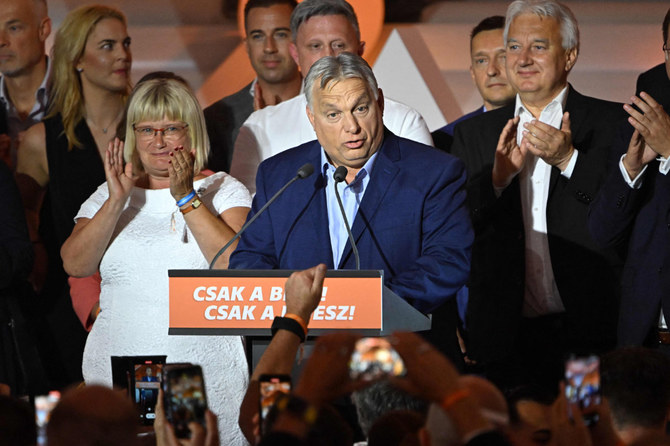

BUDAPEST: Hungarian Prime Minister Viktor Orban’s nationalist party appeared set to take the most votes in Sunday’s European Parliament elections, a race that pitted the long-serving leader against a new challenger that has upended Orban’s grip on Hungarian politics in recent months.
With 55 percent of votes counted, Orban’s Fidesz party had 43 percent of the vote, enough to send 11 delegates of Hungary’s 21 total seats in the European Union’s legislature.
While Fidesz took a plurality of votes, it was down sharply from 52 percent support in 2019 EU elections and looked set to lose two seats in what was widely seen as a referendum on Orban’s popularity.
Preliminary results showed that more than 56 percent of eligible voters cast a ballot, setting a record for participation in an EU election in Hungary.
While Fidesz has dominated Hungarian politics since 2010, many are deeply dissatisfied with how it has governed the country. A deep economic crisis and a recent series of scandals involving Fidesz politicians have rocked the party which prides itself on upholding family values and Christian conservatism.
Those factors led to the emergence of one of the most formidable challengers Orban has ever faced, Peter Magyar, who broke ranks with Orban’s party in February and in a matter of months built up Hungary’s strongest opposition party.
That party, Respect and Freedom (TISZA), stood at 31 percent of the vote Sunday, amounting to seven delegates to the European Parliament.

Peter Magyar, who broke ranks with Orbán’s party in February and formed the Respect and Freedom (TISZA) Party, speaks in Budapest on June 9, 2024, before the announcement of the partial results of the European Parliament and municipal elections. (Reuters)
Magyar gathered a crowd of supporters next to the Danube River in Budapest on Sunday evening to await results. As strong storms approached the city, he addressed the crowd and encouraged them to take cover until the storm passed.
But he struck an optimistic tone concerning the election results, casting the day as a turning point in Hungarian politics, which have centered around Orban for more than 14 years.
“Althought we don’t know the results yet,” he said, “today is a milestone. I would like to ask everyone to remember this day well. On June 9, 2024, an era has come to an end.”
Magyar has planned to use the elections to propel himself and his movement to challenge and defeat Orban in the next national ballot scheduled for 2026. The 43-year-old lawyer’s accusations of widespread corruption in Orban’s government, and claims that Fidesz has used a “propaganda machine” to sow deep social divisions, have resonated with many Hungarians who desire change.
On the eve of the election, he mobilized tens of thousands of demonstrators in Budapest in a final appeal for support for his new party.
While the favorable result for TISZA portended a shift in Hungary’s domestic politics, right-wing populists like Orban made significant gains across Europe in the election, stirring fears that the world’s biggest trading bloc’s ability to make decisions could be undermined as war rages in Ukraine and anti-migrant sentiment mounts.
Hungary’s far-right Our Homeland party gained 6 percent of the vote Sunday, sending a delegate to Brussels for the first time.
Orban, the Kremlin’s closest EU ally, had expressed hopes that parties across Europe that oppose providing military support to Ukraine would gain a majority in the EU legislature.
Hungary is set to take over the EU’s rotating six-month presidency in July.
The five-time prime minister cast the elections as a contest that would decide whether Russia’s war in Ukraine would engulf Europe. He campaigned heavily on fears that the war could escalate to involve Hungary directly if his political opponents were successful.
He has blamed “pro-war” politicians in Washington and Brussels for increasing tensions with Russia and portrayed his refusal to supply Kyiv with military aid and other support as a “pro-peace” position unique in Europe.
After casting his vote earlier in the day, Antal Zámbó, a 75-year-old retiree in Budapest, said he supported Orban and Fidesz as he believed they would deliver “a more peaceful life.”
“Everyone benefits if there is peace in their surroundings as well as on the global stage,” he said.
A TISZA supporter, Gyula Nemet, 71, said governance by Orban’s party since 2010 has “not only proved that they are incompetent, but they totally divided this country.”
“Hungary has been pushed to the sidelines in Europe. We became totally segregated,” he said. “This cannot go on. We definitely need a positive change, integration with Europe and among the Hungarian people.”


