



BRUSSELS: Voting has ended to elect the European Union’s regional lawmakers for the next five-year term after the last remaining polls closed in Italy, as surging far-right parties dealt a body blow to two of the bloc’s most important leaders: French President Emmanuel Macron and German Chancellor Olaf Scholz.
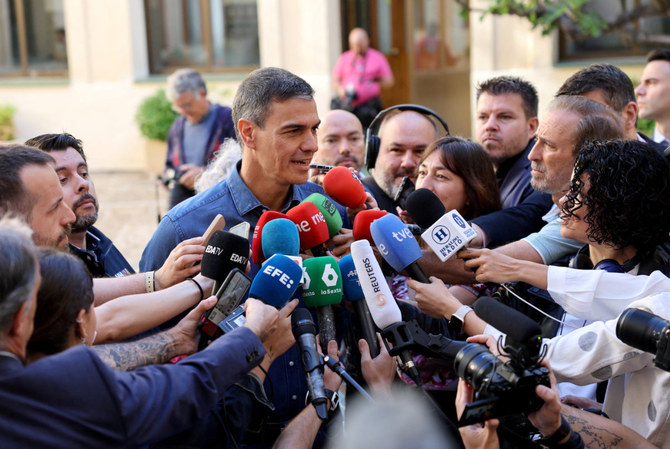
In Spain, the center-right People’s Party (PP) came out on top, garnering 22 seats out of the 61 allocated to the country, and dealing a blow to the Socialist-led government of Prime Minister Pedro Sanchez.
In Italy, Prime Minister Giorgia Meloni’s arch-conservative Brothers of Italy group won the most votes in the weekend EU parliamentary election, exit polls said, confirming its status as the country's most popular party.
Official results were expected any moment after Italian polling stations closed at 11 p.m. local time (2100GMT), officially ending a marathon election spanning four days across 27 bloc member countries.
An initial projection provided by the European Union indicated far-right parties have made big gains at the European Parliament.
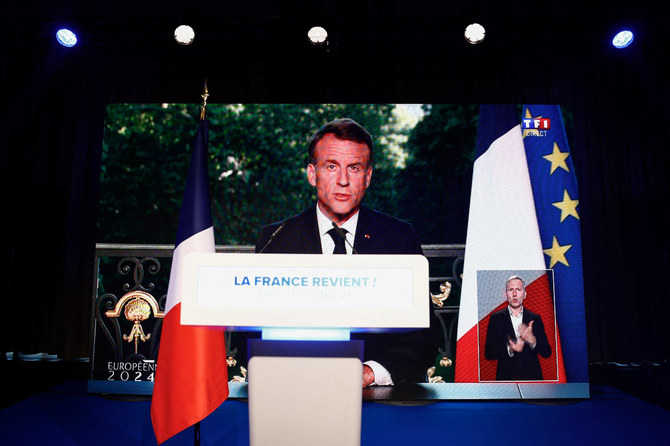
In France, the National Rally party of Marine Le Pen dominated the polls to such an extent that Macron immediately dissolved the national parliament and called for new elections, a massive political risk since his party could suffer more losses, hobbling the rest of his presidential term that ends in 2027.
Le Pen was delighted to accept the challenge. “We’re ready to turn the country around, ready to defend the interests of the French, ready to put an end to mass immigration,” she said, echoing the rallying cry of so many far-right leaders in other countries who were celebrating substantial wins.
Macron acknowledged the thud of defeat. “I’ve heard your message, your concerns, and I won’t leave them unanswered,” he said, adding that calling a snap election only underscored his democratic credentials.
In Germany, the most populous nation in the 27-member bloc, projections indicated that the AfD overcame a string of scandals involving its top candidate to rise to 16.5 percent, up from 11 percent in 2019. In comparison, the combined result for the three parties in the German governing coalition barely topped 30 percent.
Scholz suffered such an ignominious fate that his long-established Social Democratic party fell behind the extreme-right Alternative for Germany, which surged into second place. “After all the prophecies of doom, after the barrage of the last few weeks, we are the second strongest force,” a jubilant AfD leader Alice Weidel said.
The four-day polls in the 27 EU countries were the world’s second-biggest exercise in democracy, behind India’s recent election. At the end, the rise of the far right was even more stunning than many analysts predicted.
The French National Rally crystalized it as it stood at over 30 percent or about twice as much as Macron’s pro-European centrist Renew party that is projected to reach around 15 percent.
Overall across the EU, two mainstream and pro-European groups, the Christian Democrats and the Socialists, remained the dominant forces. The gains of the far right came at the expense of the Greens, who were expected to lose about 20 seats and fall back to sixth position in the legislature. Macron’s pro-business Renew group also lost big.
For decades, the European Union, which has its roots in the defeat of Nazi Germany and fascist Italy, confined the hard right to the political fringes. With its strong showing in these elections, the far right could now become a major player in policies ranging from migration to security and climate.
Germany, traditionally a stronghold for environmentalists, exemplified the humbling of the Greens, who were predicted to fall from 20 percent to 12 percent. With further losses expected in France and elsewhere, the defeat of the Greens could well have an impact on the EU’s overall climate change policies, still the most progressive across the globe.
The center-right Christian Democratic bloc of EU Commission President Ursula von der Leyen, which already weakened its green credentials ahead of the polls, dominated in Germany with almost 30 percent, easily beating Scholz’s Social Democrats, who fell to 14 percent, even behind the AfD.
“What you have already set as a trend is all the better – strongest force, stable, in difficult times and by a distance,” von der Leyen told her German supporters by video link from Brussels.
Italy’s PM Meloni solidifies top spot in EU vote — exit poll
As well as France, the hard right, which focused its campaign on migration and crime, was expected to make significant gains in Italy, where Premier Giorgia Meloni was tipped to consolidate her power.
An exit poll for state broadcaster RAI said Brothers of Italy won between 26-30 percent of the vote, with the center-left opposition Democratic Party (PD) coming second with 21-25 percent
The other main opposition party, the 5-Star Movement, was seen on 10-14 percent, while Forza Italia, founded by the late Silvio Berlusconi, was in fourth place on 8.5-10.5 percent, potentially beating its old ally, the far-right League, which was on 8-10 percent.
Brothers of Italy won just 6.4 percent of the vote in the last EU ballot in 2019, but jumped ahead of all other parties in 2022 national elections, when it took 26 percent, with Italians seeing Meloni as a no-nonsense, straight-talking leader.
Her party traces its roots back to a neo-fascist group and her 2022 victory set the tone for far-right gains across Europe, including in the June 6-9 EU ballot, which has seen the continent swing sharply right.
Meloni governs in Rome with the center-right Forza Italia and the League, presenting this as a model for the next EU government in Brussels, where Commission President Ursula von der Leyen will need to build consensus to secure a second term.
If confirmed, the PD result would represent a good score for its leader Elly Schlein, who took charge of the party in 2023 and has struggled to impose her will on the old guard. The PD won 19 percent in 2022 and Schlein was anxious to improve on that.
The one disappointment for all parties this weekend was the turnout, which was expected to come in at around or even beneath 50 percent — a record low in a country that has had historically strong voter participation.
Spain’s right wing wins
In Spain, Prime Minister Sanchez’s Socialists, spearheaded by Energy Minister Teresa Ribera, earned 20 seats after a campaign in which the opposition honed in on private corruption allegations against the premier’s wife and an amnesty law for Catalan pro-independence leaders passed just one week before the election.
With 99.7 percent of the vote counted, far-right Vox finished third with six lawmakers, up from the four it had in the previous legislature.
Still, in terms of vote share, support for Vox dipped to 9.6 percent from 12.4 percent in the July 2023 general election. The far-right party is struggling to break a vote ceiling of 14 percent, making it an outlier compared to its peers in other EU countries.
Alvise Perez, a far-right social media influencer running against what he describes as universal corruption, managed to obtain three seats with a campaign mostly conducted through the messaging app Telegram.
The combined right won nearly 50 percent, while the left followed with 43 percent.
The leftist vote was split between Sumar — the junior partner in the government coalition — that won three seats and hard-left Podemos, led by former Equality Minister Irene Montero, which got two.
Poland's Tusk holds on
Bucking the trend was former EU leader and current Polish Prime Minister Donald Tusk, who overcame Law and Justice, the national conservative party that governed Poland from 2015-23 and drove it ever further to the right. A poll showed Tusk’s party won with 38 percent, compared to 34 percent for his bitter nemesis.
“Of these large, ambitious countries, of the EU leaders, Poland has shown that democracy, honesty and Europe triumph here,” Tusk told his supporters. “I am so moved.”
He declared, “We showed that we are a light of hope for Europe.”
EU lawmakers, who serve a five-year term in the 720-seat Parliament, have a say in issues from financial rules to climate and agriculture policy. They approve the EU budget, which bankrolls priorities including infrastructure projects, farm subsidies and aid delivered to Ukraine. And they hold a veto over appointments to the powerful EU commission.
These elections come at a testing time for voter confidence in a bloc of some 450 million people. Over the last five years, the EU has been shaken by the coronavirus pandemic, an economic slump and an energy crisis fueled by the biggest land conflict in Europe since the Second World War. But political campaigning often focuses on issues of concern in individual countries rather than on broader European interests.
Since the last EU election in 2019, populist or far-right parties now lead governments in three nations — Hungary, Slovakia and Italy — and are part of ruling coalitions in others including Sweden, Finland and, soon, the Netherlands. Polls give the populists an advantage in France, Belgium, Austria and Italy.
“Right is good,” Hungarian Prime Minister Viktor Orbán, who leads a stridently nationalist and anti-migrant government, told reporters after casting his ballot. “To go right is always good. Go right!”