Indonesia: Discussions with Board of Peace ‘on hold’ due to Iran war

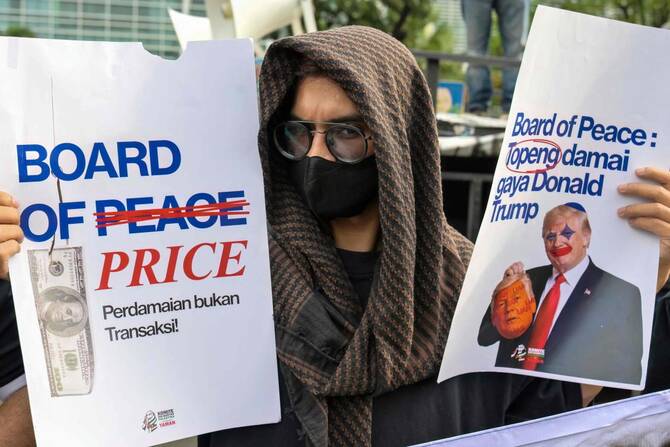
A protester holds placards that read "Board of Price: Peace is not a transaction" and "Board of Peace: peace mask Donald Trump-style" during a demonstration condemning US and Israeli attacks on Iran and Palestinians in front of the US Embassy in Jakarta on March 3, 2026. (AFP)
Short Url
Updated 04 March 2026
Follow

Indonesia: Discussions with Board of Peace ‘on hold’ due to Iran war

  • Indonesia’s participation on the ⁠board has drawn criticism from experts and Muslim ‌groups at home

JAKARTA: Indonesia’s foreign minister ‌said talks on US President Donald Trump’s Gaza “Board of Peace,” of which the Southeast Asian nation is a key troop-contributing member, were on ​hold due to the Middle East war.
The US and Israeli air war against Iran has killed scores of civilians, thrown global air transport into chaos and sent oil prices surging after the effective closure of the Strait of Hormuz.
“All BoP discussions are on hold as all attention has shifted to the situation in Iran,” Minister Sugiono, who ‌goes by one name, ‌said late on Tuesday in ​response ‌to ⁠a ​question on calls ⁠for Indonesia to exit the peace board in the aftermath of the fresh conflict in the Middle East.
“We will also consult with our friends and colleagues in the Gulf because they are also under attack,” Sugiono told reporters after attending an event alongside President Prabowo Subianto.
Indonesia’s participation on the ⁠board has drawn criticism from experts and Muslim ‌groups at home, who ‌say it compromises the world’s largest Muslim-majority ​nation’s longstanding support for the Palestinian ‌cause.
Indonesia backs a two-state solution.
The Indonesian Ulema Council, ‌a leading clerical body, said on March 1 that Indonesia should leave the board, citing Trump’s attack on Iran as rendering the initiative ineffective.
Meanwhile, Nahdlatul Ulama, Indonesia’s largest Muslim organization, said Jakarta should ‌use its position to press Israel and the United States to halt the violence.
Trump first ⁠proposed the ⁠board in September when he unveiled a plan to end Israel’s war in Gaza, later expanding its remit to address other global conflicts typically handled by the United Nations.
Sugiono also said Prabowo is willing to be a mediator in the Iran war in a bid “to cool down and de-escalate the situation in the region.”
Indonesia is readying 1,000 troops for potential deployment in Gaza by early April as part of a proposed multinational peacekeeping force, its army said, as ​part of the UN-mandated International ​Stabilization Force. It has also been given the deputy commander role of the force.


US NATO envoy says allies must ‘pull weight’ after Czech defense cut

Updated 6 sec ago
Follow

US NATO envoy says allies must ‘pull weight’ after Czech defense cut

PRAGUE, March 12 : The United States’ ambassador to ‌NATO said on Thursday that all allies must “pull their weight,” after Czech lawmakers approved a 2026 budget that cuts defense outlays.
Czech Prime Minister ​Andrej Babis’ government, in power since December, pushed a revamped budget through the lower house on Wednesday evening which cut the defense ministry’s allocation versus a previous proposal to 154.8 billion crowns ($7.31 billion), or 1.73 percent of gross domestic product.
That is below a NATO target of 2 percent of GDP already expected before alliance members pledged last year in the Hague ‌to raise defense spending ‌to 3.5 percent of GDP plus ​1.5 percent ‌on ⁠other defense-relevant investments ​over ⁠the next decade.
The Czech Finance Ministry says total defense spending in the budget will reach 2.07 percent of GDP, but the country’s budget watchdog has warned that includes money earmarked elsewhere, like for the transport ministry for road projects, that may not be recognized by NATO.
“All Allies must pull their weight and ⁠honor The Hague Defense Commitment,” US Ambassador to ‌NATO Matthew Whitaker said on X ‌on Thursday with a picture of ​a news headline on the Czech ‌budget approval.
“These numbers are not arbitrary. They are about ‌meeting the moment — and the moment requires 5 percent as the standard. No excuses, no opt-outs.”
European NATO countries are under pressure to raise defense spending amid the Ukraine-Russia war ‌and at US President Donald Trump’s urging.
Babis, whose populist ANO party won elections last year, said ⁠in February ⁠the country was “certainly not” on the path to raising core defense spending to the 3.5 percent target, saying there was a different focus, like on health care.
The budget watchdog on Thursday reiterated “strong doubts” that some spending deemed defense in this year’s budget would meet NATO’s definition.
President Petr Pavel, a former NATO official, has also said defense cuts risked a loss of trust from allies — but has signalled he would not veto the budget.
US Ambassador to Prague Nicholas Merrick said last ​week the Czech Republic may ​slip to the bottom of NATO’s defense-spending ranks.