

Nordic left-wing parties gain, far-right declines in EU vote

1 / 3
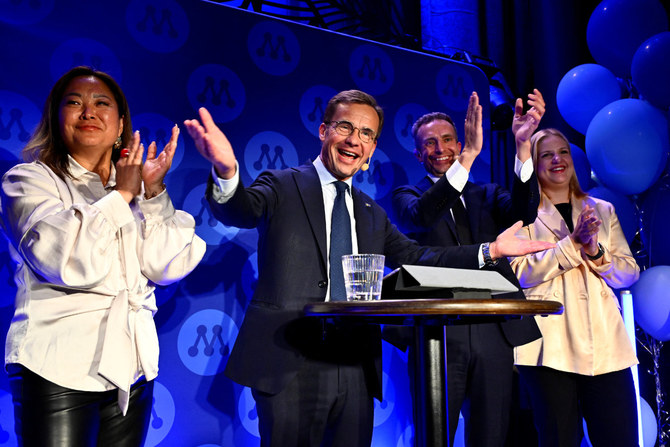
Sweden's Moderates' top candidates for the EU elections Jessica Polfjard, Tomas Tobe and Prime Minister Ulf Kristersson react in Stockholm, Sweden on June 9, 2024. (TT News Agency/Anders Wiklund via REUTERS)
2 / 3
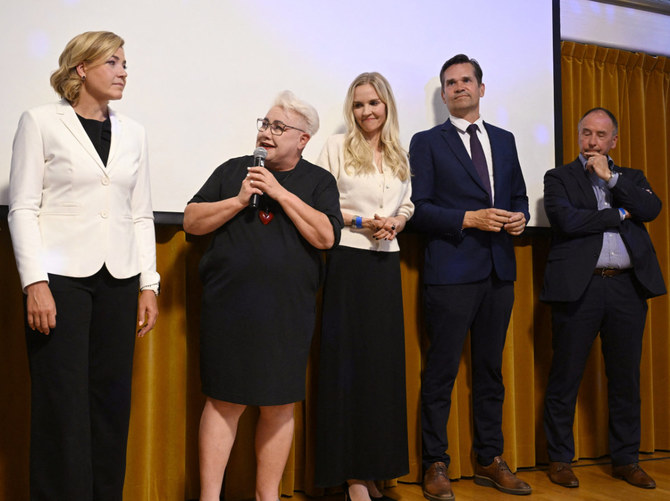
European elections candidates Henna Virkkunen, Sirpa Pietikainen, Aura Salla, Mika Aaltola and Pekka Toveri attend the National Coalition's European parliament election reception in Helsinki, Finland, on June 9, 2024. (Lehtikuva/Antti Aimo-Koivisto via REUTERS)
3 / 3
Danish Foreign Minister Lars Loekke Rasmussen, of The Moderates party, casts his vote at a polling station at Nyboder School during the European Parliament election, in Copenhagen, Denmark, on June 9, 2024. (Ritzau Scanpix/Ida Marie Odgaard/via REUTERS)
Short Url
Updated 10 June 2024
Follow

Nordic left-wing parties gain, far-right declines in EU vote

  • The anti-immigration Sweden Democrats lost seats for the first time while the Green Party gained ground
  • In Denmark, the Socialist People’s Party became the largest party while the Social Democrats declined
  • In Finland, the big surprise of the evening was the socialist Left Alliance

STOCKHOLM: Left-wing and green parties made gains across the Nordics in Sunday’s EU elections, official results showed, while far-right parties saw their support diminish.

The anti-immigration Sweden Democrats, which is propping up Ulf Kristersson’s government, had been expected to gain votes and pass Kristersson’s conservative Moderate Party to become the second largest — as it did in the country’s 2022 general election.
Instead, the party ended up losing ground for the first time in an election in the party’s history. It won 13.2 percent of the vote, down 2.1 percentage points from the 2019 election — with over 90 percent of votes counted.
Party leader Jimmie Akesson blamed media focus on a report by broadcaster TV4 into the party’s use of anonymous “troll” accounts — which set off a political scandal in the country.
“We haven’t been allowed to talk about how we are going to improve Europe, but have had to answer completely different questions,” Akesson told an election party.
But he stressed that the party would still keep their three seats in the European parliament.
The country’s Green Party emerged as the country’s third largest with 13.8 percent of the vote, an increase of 2.3 percentage points compared to the 2019 election,
The Left Party also saw a boost of 4.2 percentage points, reaching 11 percent.

In Denmark, the Socialist People’s Party became the largest party with 17.4 percent of the vote, up 4.2 percentage points compared to the 2019 result — with more than 99 percent of votes counted.
The ruling Social Democrats lost 5.9 percentage points and winning 15.6 percent of the votes.
Denmark was rocked by an attack on Prime Minister Mette Frederiksen on Friday, when a man hit her on a Copenhagen square.
Frederiksen did not attend any election night events.
In Finland, the big surprise of the evening was the socialist Left Alliance, which had 17.3 percent of the vote, with all votes counted — an increase of 10.4 percentage points compared to the 2019 election.
“It feels like I’m in some type of shock,” Left Alliance party leader Li Andersson told broadcaster YLE. “I couldn’t be happier.”
The result meant the party secured three out of Finland’s 15 seats in the European Parliament, up from the one they got in the previous election.
Prime Minister Petteri Orpo’s National Coalition Party still won the most votes with 24.8 percent, giving them four seats.
The far-right Finns Party, part of Orpo’s coalition government, saw its support fall drastically.
They won only 7.6 percent of votes, down 6.2 percentage points — leaving them with only one seat instead of two.


Trump says he asked Putin not to target Kyiv for 1 week during brutal cold spell

Updated 7 sec ago
Follow

Trump says he asked Putin not to target Kyiv for 1 week during brutal cold spell

  • “I personally asked President Putin not to fire on Kyiv and the cities and towns for a week during this ... extraordinary cold,” Trump said
  • Zelensky, for his part, thanked Trump for his effort and welcomed the “possibility” of a pause

KYIV: US President Donald Trump said Thursday that President Vladimir Putin has agreed not to target the Ukrainian capital and other towns for one week as the region experiences frigid temperatures.
There was no immediate confirmation from the Kremlin that Putin has agreed to such a pause.
Russia has been pounding Ukraine’s critical infrastructure, hoping to wear down public resistance to the war while leaving many around the country having to endure the dead of winter without heat.
“I personally asked President Putin not to fire on Kyiv and the cities and towns for a week during this ... extraordinary cold,” Trump said during a Cabinet meeting at the White House, adding that Putin has “agreed to that.”
Kremlin spokesman Dmitry Peskov was asked earlier Thursday whether a mutual halt on strikes on energy facilities was being discussed between Russia and Ukraine, and he refused to comment on the issue.
Ukrainian President Volodymyr Zelensky late Wednesday had warned that Moscow was planning another large-scale barrage despite plans for further US-brokered peace talks at the weekend.
Trump said he was pleased that Putin has agreed to the pause. Kyiv, which has grappled with severe power shortages this winter, is forecast to enter a brutally cold stretch starting Friday that is expected to last into next week. Temperatures in some areas will drop to minus 30 degrees Celsius (minus 22 Fahrenheit), the State Emergency Service warned.
“A lot of people said, ‘Don’t waste the call. You’re not going to get that.’” the Republican US president said of his request of Putin. “And he did it. And we’re very happy that they did it.”
Zelensky, for his part, thanked Trump for his effort and welcomed the “possibility” of a pause in Russian military action on Kyiv and beyond. “Power supply is a foundation of life,” Zelensky said in his social media post.
Trump did not say when the call with Putin took place or when the ceasefire would go into effect. The White House did not immediately respond to a query seeking clarity about the scope and timing of the limited pause in the nearly four-year war.
Russia has sought to deny Ukrainian civilians heat and running water over the course of the war, which began with Russia’s full-scale invasion on Feb. 24, 2022. Ukrainian officials describe the strategy as “weaponizing winter.”
Last year was the deadliest for civilians in Ukraine since 2022 as Russia intensified its aerial barrages behind the front line, according to the UN Human Rights Monitoring Mission in the country.
The war killed 2,514 civilians and injured 12,142 in Ukraine — 31 percent higher than in 2024, it said.