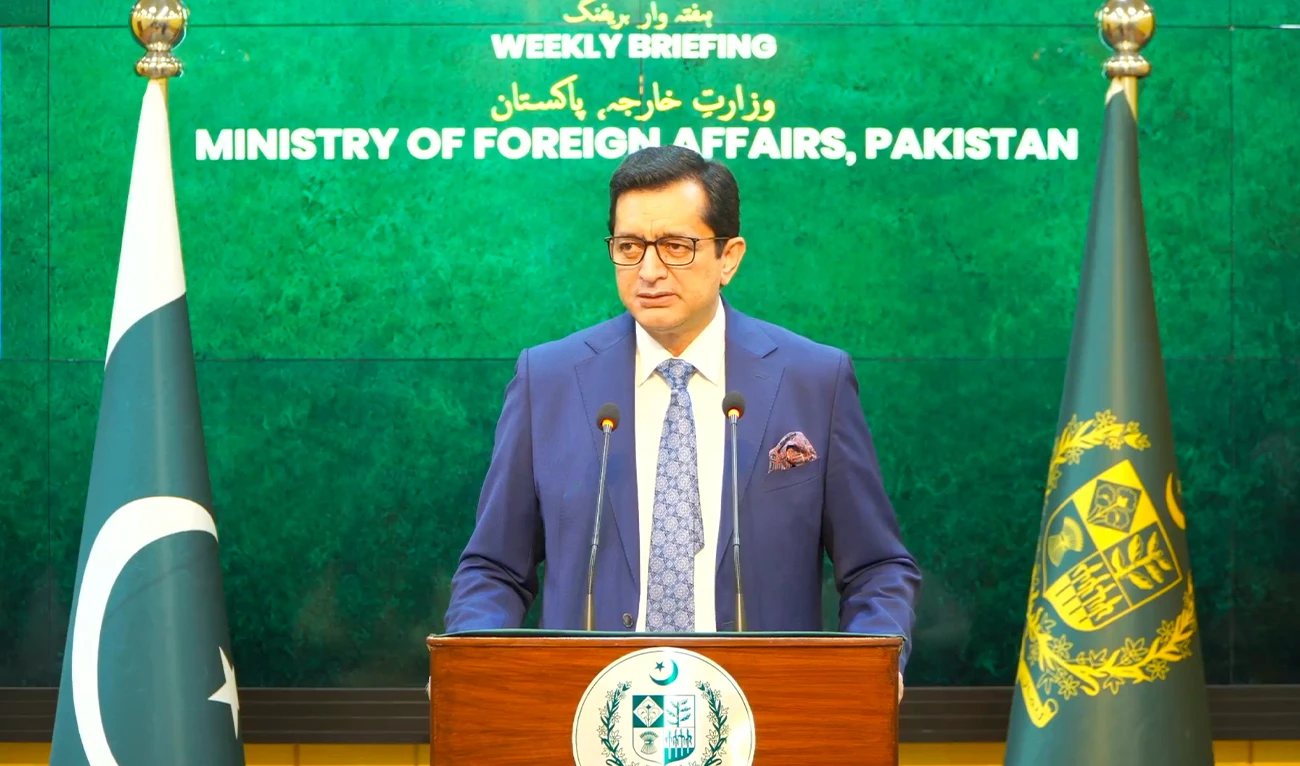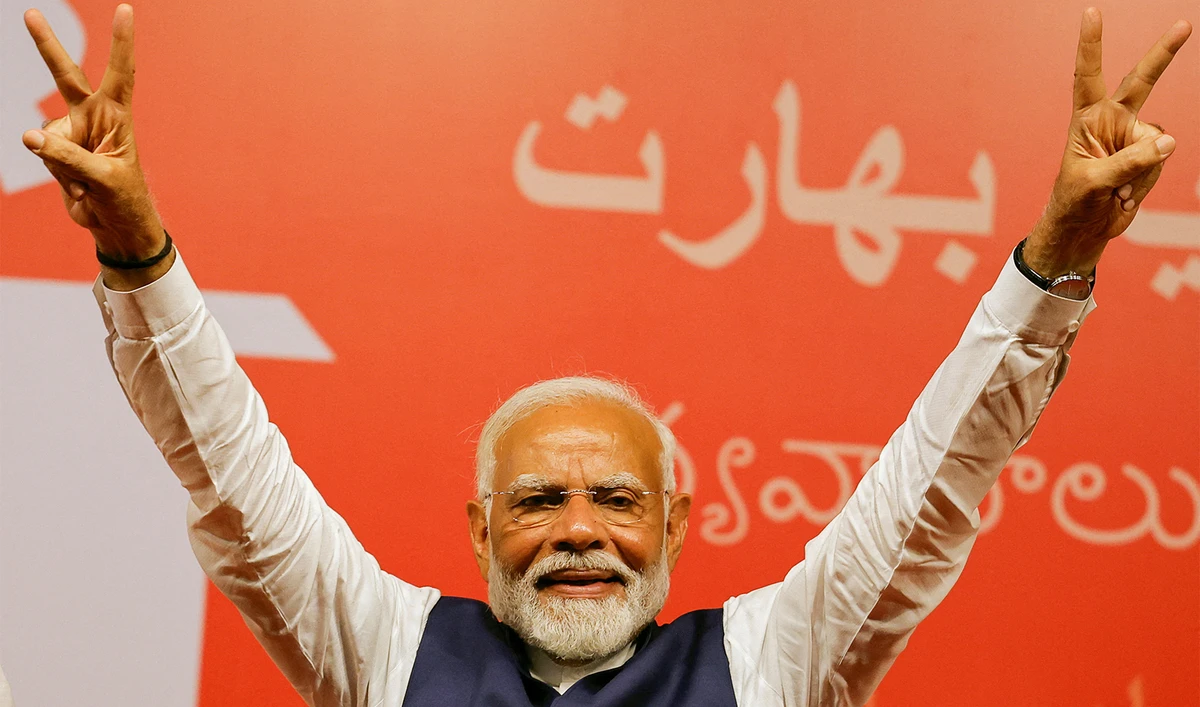
- Foreign office spokesperson says Pakistan has always desired cooperative relations with all its neighbors
- Experts expect Modi’s third term to be ‘less hostile’ for Pakistan, due to his weakened political position
ISLAMABAD: Pakistan’s Foreign Office on Sunday urged peaceful coexistence and expressed hope that India would foster an environment conducive to peace, dialogue and the resolution of longstanding disputes, including Kashmir, as Narendra Modi appeared set to take oath for a historic third term.
Modi is leading a coalition that won most seats in the recent election. His Bharatiya Janata Party (BJP), part of the National Democratic Alliance (NDA), governed India for a decade, but lost its absolute majority and is now relying on allies to form a government.
The Muslim-majority Himalayan region of Kashmir has been a flashpoint between Pakistan and India since their independence from the British rule in 1947. Both countries rule part of the Himalayan territory, but claim it in full and have fought two wars over the disputed region.
Modi’s government canceled the limited autonomy Kashmir had under India’s constitution in 2019, a move accompanied by a huge security clampdown, mass arrests of local political leaders and a months-long telecommunications blackout.
Pakistani Foreign Office spokesperson Mumtaz Zahra Baloch said Pakistan always desired cooperative relations with all its neighbors, including India, and consistently advocated constructive dialogue and engagement to resolve Kashmir and all outstanding issues.
“Pakistan believes in peaceful coexistence,” Baloch told Arab News on Sunday. “We want peace and stability in the region and Pakistan has been acting in a responsible manner, notwithstanding the difficulties and rhetoric coming from India.”
She expressed hope that India would take steps to create a “conducive environment for advancement of peace and dialogue” and resolution of longstanding disputes for the mutual benefit of the two peoples.
Pakistani foreign affairs and political experts expect India to be “less hostile” to Pakistan under Modi’s third term due to his weakened political position and strong influence of allied parties.
“Pakistanis are quite happy that Modi has been cut down to size in the elections so it will be a more chastened and somewhat weakened Modi now sitting in the Prime Minister’s office in Delhi, dependent on his political survival on regional allies who are not much hostile to Muslims or Pakistan,” Mushahid Hussain Syed, a former senator and political expert, told Arab News.
“Pakistan hopes and expects a less hostile India with a more subdued Indian approach to Pakistan in terms of tone and rhetoric.”
Though, he said, Pakistan would not be expecting any major change or breakthrough in ties with India after the elections.
“However, India could extend an olive branch to both China and Pakistan on some lowkey steps toward normalization like restoration of ambassadorial ties with Pakistan or dropping opposition to Pakistan hosting the SAARC (South Asian Association for Regional Cooperation) Summit,” Syed added.
Aizaz Ahmad Chaudhry, a former Pakistani foreign secretary, said India’s foreign policy under Modi’s third term was expected to remain consistent, balancing its relations with major powers like the US, Russia, and China, while strengthening ties with the Gulf nations.
He said Modi had severed connections with Pakistan across all domains, displaying “extreme hostility” toward Pakistan during his election campaign.
“It appears that in his third term, Modi might not take any positive initiative toward Pakistan, even though he wants a stable western border to continue his focus on his economic vision and goals,” Chaudhry told Arab News.
He said Pakistan’s government would be wise to wait for an initiative from the Modi administration. “Should he change his mind and approach Pakistan for limited cooperation, we should respond positively,” Chaudhry added.
Dr. Salma Malik, an assistant professor at Department of Defense and Strategic Studies in Islamabad’s Quaid-i-Azam University, said it could be a “Catch 22 situation.”
“Modi might adopt a harder approach toward Pakistan to regain support from the conservative Hindu lobby, or he might take a softer approach if any of his allies advocate for it,” she told Arab News.
“If any of the alliance partners are open to having a meaningful dialogue with Pakistan then there could be a space.”
Abdul Basit Khan, a research fellow at the S. Rajaratnam School of International Studies in Singapore, said Modi would rely more on the US on the external front during his third term.
“A weak PM Modi will be heavily relying on the United States and a pro-US Modi will be more anti-China as he will have to go ahead with the American agenda,” he told Arab News. “For Pakistan, it can be more pragmatic and less hostile due to US influence.”
Khan believed Modi would not have the same amount of power that he exercised in the last two terms. “So, the body language and the flamboyance that we saw in the first two terms will be missing in this term,” he said.