

Sync Summit at Ithra ends with world premiere of documentary

1 / 4
Bahraini filmmaker and influencer Omar Farooq premiered his Ithra-produced documentary, “The Dark Side of Japan,” at the closing of the Sync Summit. (Supplied)
2 / 4
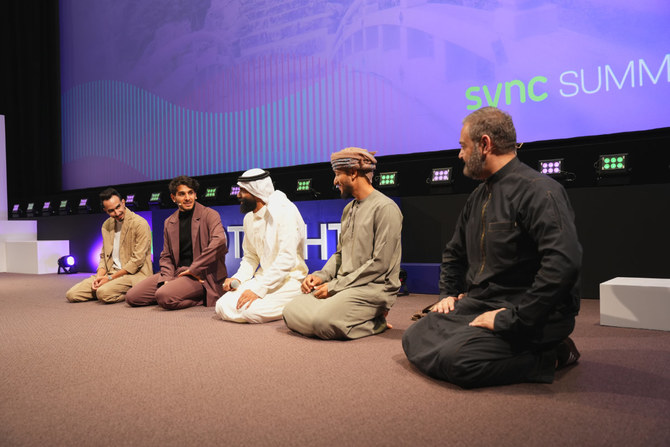
Omar Farooq (second L) alongside his Japan-filming team. Majed Z. Samman (far R), the head of performing arts and cinema at Ithra, moderated the panel. (Supplied)
3 / 4
The panel sat on the floor, Japanese style, for the panel discussion. (Supplied)
4 / 4
Audience members awaiting the start of the documentary. (Supplied)
Short Url
Updated 24 May 2024
Follow

Sync Summit at Ithra ends with world premiere of documentary

  • The documentary takes viewers on a trip as he journeys to places near and far within Japan to interact with locals, expats and visitors about their relationship to technology and nature

DHAHRAN: For the finale of the two-day Sync Digital Wellbeing Summit at the King Abdulaziz Center for World Culture, or Ithra, a documentary titled “The Dark Side of Japan” premiered at the Ithra Cinema on Thursday. 

The Bahraini creative influencer, Omar Farooq, who was the narrator in the documentary, was there in-person with his team to answer questions after the screening.

As part of the Sync Spotlight series, the documentary tied together all the various themes explored during the summit, of which technology and wellness topics were explored on stage and at various points throughout the center. The documentary, which was filmed in Japan, showcases Farooq as he observes the Japanese people’s intense interactions with — and addictions to — their screens. Amid the bright lights of flashy Tokyo emerges a lingering dark side of loneliness, heads down, and fingers scrolling endlessly.

The filmmaker and influencer tried to convey an important message the old-fashioned way before the film premiere. He asked every attendee to take a moment to look under their seats. After a minute of awkward shuffling, it was revealed that an envelope was placed there so they could tuck their phones away and watch the documentary phone-free.



An envelope that was placed under each seat at the Ithra Cinema instructing viewers to place their phones there and enjoy the documentary phone-free. (Supplied)

Farooq wanted the audience to be completely immersed and to be on the journey alongside him.

The documentary takes viewers on a trip as he journeys to places near and far within Japan to interact with locals, expats and visitors about their relationship to technology and nature. He spoke to families of young children about the school system and he spent time with adults of various backgrounds to ask about their preferences: city life or country life?

“It’s hard to keep a close relationship with people (in Tokyo). We don’t have time to care about others,” a Japanese artist told him in one scene.  

Wildly popular, with 3.9 million followers on instagram, Farooq was on hand to have a discussion on stage after the screening. Moderated by Ithra’s own head of a performing arts and cinema, Majed Z. Samman, who had studied in Japan and was familiar with the Japanese culture, they were joined by Mohammed Alhajri and Ahmed Alsayed, both of whom were with Farooq in Japan to assist with the filming. They sat on the floor, Japanese style, on stage for the discussion.



The panel sat on the floor, Japanese style, for the panel discussion. (Supplied) 

“This documentary isn’t about Japan,” Farooq cautioned the audience. Japan was merely an example of a place that has been plagued by hyper internet addiction and loss of real world connection. He asks the question: “Will this be our future? Is it already our present?”

He instructs viewers to look within and not just walk away as a programmed robot on autopilot; constantly shackled to their smartphones and ignoring the world around them.

After the initial screening, there were two other screenings back-to-back at the cinema, both of which were sold out.

The Ithra-produced documentary was mostly in Arabic, with some English and some Japanese.


Saudi meteorology center warns of heavy rain across Kingdom, public told to avoid flood-prone areas

Updated 14 December 2025
Follow

Saudi meteorology center warns of heavy rain across Kingdom, public told to avoid flood-prone areas

  • Stay away from valleys and waterways at least until Thursday, Civil Defense cautions
  • National Center for Meteorology center warns of possible thunderstorms and dust storms

RIYADH: Saudi Arabia’s National Center for Meteorology (NCM) has warned of thunderstorms across the Kingdom that could lead to flash floods, and officials cautioned the public against venturing in low-lying places prone to flooding.

In its weather forecast for Sunday, the meteorology center said “moderate to heavy thunderstorms are expected, leading to flash floods, accompanied by hail showers and active winds that will stir up dust and sand” in several provinces of the Kingdom.

These include Riyadh, Qassim, Hail, Madinah, Makkah, Al-Baha, Asir, Jazan and parts of the Eastern Province. Light to moderate storms are expected in parts of the Northern Borders, Al-Jouf and Tabuk, the NCM said.

In a separate advisory, the General Directorate of Civil Defense urged the public to avoid places prone to flash floods and valleys at least until December 18.

 A lake forms in the desert following days of rain in Rafha city in the Northern Borders Province, near the Saudi border with Iraq. (SPA)

Since the past few days, various parts of Saudi Arabia had been blessed with light to moderate rain as full winter weather set in.

In separate reports, the Saudi Press Agency published images of beautiful landscapes that have emerged after being revitalized by rain.

Deserts rejuvenated

Among these are Al-Nafud (The Great Nafud Desert) in the Kingdom’s north, where moderate to heavy rainfall have “transformed the landscape, turning the golden sand dunes into stunning formations,” and also created streams and lakes.

Plants are beginning to sprout in Al-Nafud Desert after getting rain. (SPA)

“The cool weather has since made the Nafud a prime destination for desert and camping enthusiasts from inside and outside (Rafha) governorate,” SPA said.

Rain have also rejuvenated the Imam Turki Bin Abdullah Royal Reserve, the Kingdom’s second-largest nature reserve, spanning parts of the Northern Borders, Hail, Qassim, Al-Jouf and Eastern Province.

In the Northern Borders province, the Wadi Arar has come alive, refilling the province’s 11 operational dams. 

With streams flowing into Wadi Arar, dams in the Northern Borders province are being replenished. (SPA)

“The deserts of Arar City ... have become an enchanting destination for hikers and nature enthusiasts following recent rainfall. The resulting rainfalls have created a stunning scenery, with flowing streams winding through sand dunes and ravines,” SPA said.

Cool, verdant mountains 

In Asir and adjacent provinces in the southwest, fog shrouding mountain peaks and the city of Abha have resulted in beautiful winter sceneries, attracting nature lovers and photography enthusiasts.

Abha city in Asir shrouded with fog as full winter weather sets in. (SPA)

Futher south in Najran province, days of rain have increased vegetation cover and revitalized the valley’s natural streams.

One of the foremost attractions is the Wadi Mughaydid on the slopes of the Sarawat range’s Maghra Mountains in northwest Najran, renowned for its pristine natural beauty.

Stretching 25 kilometers from Bir Askar Park to Shaab Baran, the valley’s unique geography combines verdant plains with towering mountains, making it an ideal destination for hiking and nature enthusiasts, according to SPA.

View of Wadi Mughaydid in Najran coming to life following days of rain. (SPA)