

India shuts schools as temperatures soar

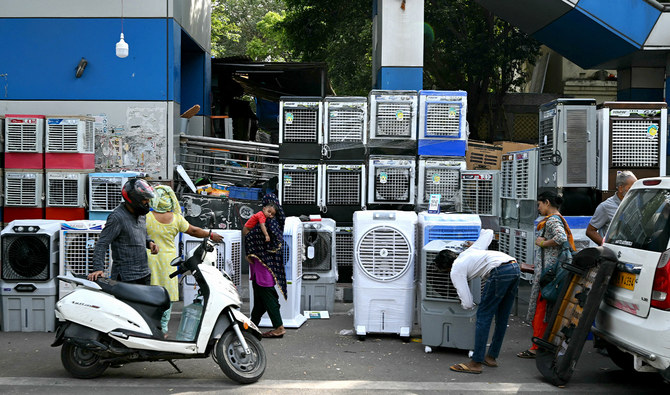
People buy air coolers from a roadside vendor on a hot summer afternoon in New Delhi on May 20, 2024, amid the ongoing heatwave. (AFP)
Short Url
Updated 21 May 2024
Follow

India shuts schools as temperatures soar

  • India’s weather bureau has warned of “severe heat wave conditions” this week
  • Sweltering heat has dipped voter turnout in India, where world’s largest election is underway

New Delhi: Indian authorities in the capital have ordered schools shut early for the summer holiday, after temperatures hit 47.4 degrees Celsius (117 degrees Fahrenheit) with Delhi gripped by a “severe heatwave.”

Delhi city officials asked schools to shut with “immediate effect” due to the blistering heat, according to a government order quoted by the Hindustan Times Tuesday, cutting short the term by a few days.

India’s weather bureau has warned of “severe heatwave conditions” this week, with the mercury reaching the sizzling peak of 47.4 degrees Celsius in Delhi’s Najafgarh suburb on Monday, the hottest temperature countrywide.

Authorities in other states — including Haryana, Madhya Pradesh, Punjab and Rajasthan — have also ordered schools close, Indian Today reported.

India is no stranger to searing summer temperatures.

But years of scientific research have found climate change is causing heatwaves to become longer, more frequent and more intense.

The Indian Meteorological Department warned of the impact of the heat on the health especially for infants, the elderly and those with chronic diseases.

In May 2022, parts of Delhi hit 49.2 degrees Celsius (120.5 Fahrenheit), Indian media reported at the time.

The next round of voting in India’s six-week-long election takes place on Saturday, including in Delhi.

Turnout in voting has dipped, with analysts suggesting the hotter-than-average weather is a factor — as well as the widespread expectation that Prime Minister Narendra Modi will easily win a third term.

India’s election commission has formed a task force to review the impact of heatwaves and humidity before each round of voting.

At the same time, India’s southern states including Tamil Nadu and Kerala have been lashed by heavy rains over the past few days.

Severe storms also hit parts of the country last week, including in the financial capital Mumbai, where strong winds flattened a giant billboard that killed 16 people and left dozens more trapped.


Tourists empty out of Cuba as US fuel blockade bites

Updated 3 sec ago
Follow

Tourists empty out of Cuba as US fuel blockade bites

  • Several nations have advised against travel to Cuba since the US tightened a decades-old embargo
  • The island of 9.6 million inhabitants has faced hard times since the US trade embargo took hold in 1962
HAVANA: With rolling power cuts, hotel closures, and flight routes suspended for lack of fuel, tourists are gradually emptying out of Cuba, deepening a severe crisis on the cash-strapped island.
Several nations have advised against travel to Cuba since the US tightened a decades-old embargo by choking vital oil imports.
“I found only one taxi,” said French tourist Frederic Monnet, who cut short a trip to a picturesque valley in western Cuba to head back to Havana.
“There might be no taxis afterward,” he said.
A petroleum shortage has led to regular hours-long power cuts, long queues at petrol stations, and has forced many airlines to announce that they will cancel regular services.
About 30 hotels and resorts across the island are being temporarily closed due to low occupancy and fuel rationing, according to an internal Tourism Ministry document obtained by AFP.
Since January, a flotilla of US warships have stopped Venezuelan tankers from delivering oil to Cuban ports.
Washington has also threatened Mexico and other exporter with punitive tariffs if they continue deliveries.
Several Canadian and Russian airlines are sending empty flights to Cuba to retrieve thousands of otherwise stranded passengers, and others are introducing refueling stops in the route home.
American tourist Liam Burnell contacted his airline to make sure he could get a flight back.
“There was a danger that I might not be able to return, because the airport says it doesn’t have enough fuel for the planes,” he said.
‘Critical, critical’
An absence of tourists is more than an inconvenience for the Cuban government.
Tourism is traditionally Cuba’s second major source of foreign currency, behind revenue from doctors sent abroad.
The revenue is vital to pay for food, fuel, and other imports.
And the 300,000 Cubans who make a living off the tourist industry are already feeling the pinch.
A hop-on, hop-off bus touring Havana’s sites on Thursday was virtually empty.
Horses idled in the shade of colonial buildings, waiting for carriages to fill with visitors.
“The situation is critical, critical, critical,” said 34-year-old Juan Arteaga, who drives one of the island’s many classic 1950s cars so beloved by tourists.
“There are few cars (on the street) because there is little fuel left. Whoever had a reserve is keeping it,” he said.
“When my gasoline runs out, I go home. What else can I do?” he said.
The island of 9.6 million inhabitants has faced hard times since the US trade embargo took hold in 1962, and in recent years the severe economic crisis has also been marked by shortages of food and medicine.
On Thursday, two Mexican navy ships arrived in Cuba with more than 800 tons of much-needed humanitarian aid — fresh and powdered milk, meat, cookies, beans, rice and personal hygiene items, according to the Mexican foreign ministry.
Musician Victor Estevez said because tourism has been “a lifeline for all Cubans...if that is affected, then we are really going to be in trouble.”
“The well-being of my family depends on me.”
The tourism sector had already been severely hit by the Covid-19 pandemic, experiencing a 70 percent decline in revenue between 2019 and 2025.
Tourism expert Jose Luis Perello said the island now faces the prospect of “a disastrous year.”