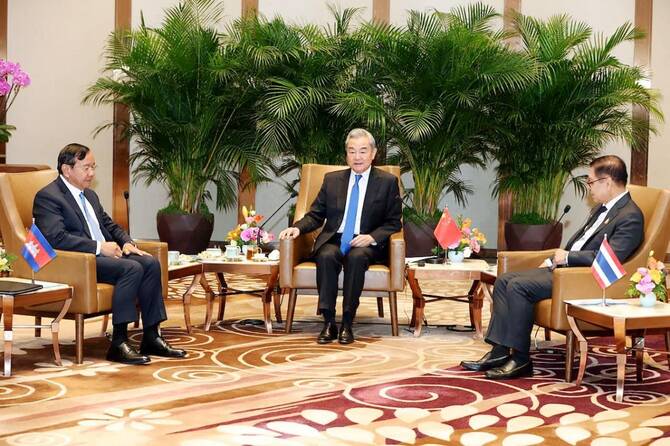
HONG KONG: Foreign ministers from Cambodia and Thailand convened with their Chinese counterpart on Monday as the Beijing government, building on its expanding presence in global diplomacy, sought to play a stronger mediating role in the violent border dispute between the two Southeast Asian countries.
The trilateral meeting, held in a southwestern Chinese province north of the contested border, came two days after Thailand and Cambodia signed a fresh ceasefire agreement to end weeks of fighting that killed more than 100 people and forced the evacuation of hundreds of thousands on both sides of the border.
“We haven’t resolved everything, but I think we are making progress in the right direction and we have to keep up the momentum,” Thai Foreign Minister Sihasak Phuangketkeow told reporters after the meeting in Yunnan province. He said chief priorities are to ensure a sustained ceasefire and continue rebuilding trust.
It was noteworthy that the meeting was held in Yunnan, nearer to the dispute and to Southeast Asia, rather than in Beijing, the Chinese capital and seat of government about 2,500 kilometers (1,300 miles) northeast.
The meetings represented China’s latest efforts to strengthen its role as an international mediator and, in particular, its influence in Asian regional crises. As China grows into an economic and political force globally, Beijing has spent the past decade and more working in various ways to increase its voice as a third party in diplomatic matters.
Hopes for peace expressed
During the meeting Monday, Chinese Foreign Minister Wang Yi called for joint efforts to promote regional peace, stability and development — language typical for China in such situations.
“Allowing the flames of war to be reignited is absolutely not what the people of the two countries want and not what China, as your friend, wants to see. Therefore, we should resolutely look ahead and move forward,” Wang said.
Cambodian Foreign Minister Prak Sokhonn said he believed the latest ceasefire would last and would create an environment for both nations to resume previously agreed-upon ways to settle differences, according to a Chinese interpreter. Sihasak also expressed hopes for peace with neighboring countries.
After the meeting, Chinese official news agency Xinhua quoted Wang as saying the three nations reached a consensus to move forward with the ceasefire without reversal, maintain dialogue and restore ties between the two Southeast Asian countries step by step.
A statement released by Xinhua, the Cambodian state news agency Agence Kampuchea Presse and the Thai Foreign Ministry said the three sides had in-depth exchanges on maintaining the ceasefire. The next key step was to work toward resuming normal exchanges, it said. China said it was ready to provide immediate humanitarian assistance for displaced residents, the statement said.
The countries also agreed to take more robust measures to combat transnational crimes, including telecom and online scams, the statement said.
Sihasak and Prak Sokhonn had also held separate meetings with Wang on Sunday, the first day of the two-day gathering.
Disputes persist
The two Southeast Asian countries originally reached a ceasefire in July. It was brokered by Malaysia and pushed through under pressure from US President Donald Trump, who threatened to withhold trade privileges unless Thailand and Cambodia agreed. The preliminary pact was followed by a more detailed October agreement.
But Thailand and Cambodia carried on a bitter propaganda war, with minor, cross-border violence continuing. The tensions erupted into heavy fighting in early December.
The Saturday agreement calls for Thailand, after the ceasefire has held for 72 hours, to repatriate 18 Cambodian soldiers who have been held prisoner since the earlier fighting in July. Their release has been a major demand of the Cambodian side.
The agreement also calls on both sides to adhere to international agreements against deploying land mines, a major concern of Thailand.
Sihasak said Thailand would start repatriating the 18 Cambodian soldiers if the ceasefire could be maintained for 72 hours with no additional incidents. Thailand would also ask Cambodia to facilitate the return of remaining Thais in the Cambodian border city of Poipet, he said.
Also Monday, Cambodian Prime Minister Hun Manet issued a statement to all Cambodian combatants along the Thai border. “Even though we can still fight,” he said, “as a small country we still have nothing to gain from prolonging the fighting for a long time.”


Top diplomats of China, Cambodia and Thailand meet as Beijing seeks a stronger role in dispute
https://arab.news/nc8an
Top diplomats of China, Cambodia and Thailand meet as Beijing seeks a stronger role in dispute

- The trilateral meeting Monday was held in a southwestern Chinese province north of the region where the dispute is still simmering
- The meeting came two days after Thailand and Cambodia signed a fresh ceasefire agreement


Russia to free two Hungarian-Ukrainian POWs, Putin says
- Ukraine accused the two countries of having “manipulated the sensitive issue of prisoners of war“
- “You will be able to take them with you on the plane you arrived on and the plane you will return to Budapest on,” Putin told Szijjarto
MOSCOW: Russia will free two Ukrainian-Hungarian nationals captured while fighting for Ukraine, President Vladimir Putin said Wednesday, after Hungarian Prime Minister Viktor Orban appealed for their release in a phone call.
Ukraine accused the two countries of having “manipulated the sensitive issue of prisoners of war” and of staging the release as a PR stunt ahead of parliamentary elections in Hungary in April.
In a meeting with Hungarian Foreign Minister Peter Szijjarto in Moscow, Putin said the two soldiers were “forcibly conscripted” by Ukraine and that he personally made the decision to release them.
“As the prime minister requested, you will be able to take them with you on the plane you arrived on and the plane you will return to Budapest on,” Putin told Szijjarto.
Hungary is one of the few European countries to maintain close ties with Russia amid its Ukraine offensive and has consistently opposed military aid for Kyiv.
Ukraine is home to a large Hungarian minority, most of whom live in the western Zakarpattia region and hold dual citizenship.
The Russian defense ministry published a video last week purporting to show a dual Hungarian-Ukrainian citizen prisoner of war, alleging he had been forced to enlist in the Ukrainian army.
During their meeting, Szijjarto also urged Moscow not to raise energy prices, after fighting in the Middle East spurred by joint US-Israeli strikes on Iran sent markets into turmoil.
“I came here... to be assured and obtain a guarantee that even in the midst of the current crisis, the quantities of natural gas and crude oil necessary for Hungary’s energy security will be available, and that they will be delivered to Hungary from Russia at the same price,” Szijjarto said.
Putin said Russia was happy to discuss the issue of energy.
“Not everything depends on us, but, I repeat, we have always been reliable suppliers,” Putin told Szijjarto.
Hungary is the European Union’s biggest importer of Russian fossil fuels, having maintained purchases and secured exemptions from sanctions despite pressure from Brussels amid the Ukraine war.
Budapest was already facing disruption from the closure of the Druzhba pipeline, which transports Russian oil to Hungary and which Ukraine says was damaged in a Russian strike in January.
Both Hungary and Slovakia, as well as the Kremlin, accuse Kyiv of deliberately stalling its reopening. Kyiv says the threat of another attack is holding up repairs.


