

Pakistan, Bangladesh signal thaw as military officials discuss defense cooperation in Dhaka

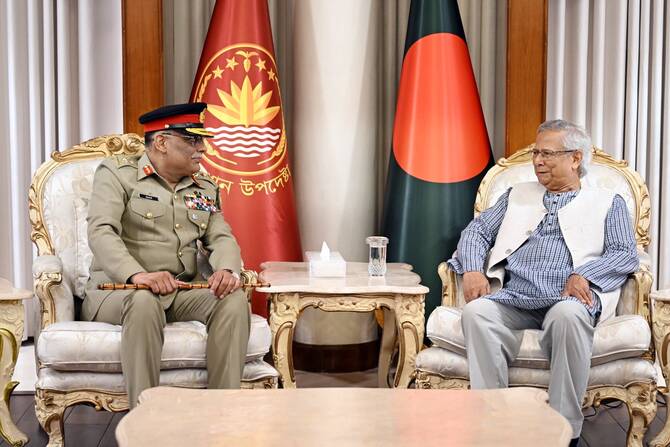
Pakistan’s Chairman of the Joint Chiefs of Staff Committee (CJCSC), General Sahir Shamshad Mirza in a meeting with Bangladesh’s Chief Adviser Muhammad Yunus in Dhaka on October 26, 2025. (@ChiefAdviserGoB/X)
Short Url
Updated 27 October 2025
Follow

Pakistan, Bangladesh signal thaw as military officials discuss defense cooperation in Dhaka

  • Pakistan’s CJCSC Sahir Shamshad Mirza holds talks with Bangladesh leadership on defense and security cooperation
  • Visit follows earlier senior-level exchanges this year as Islamabad and Dhaka cautiously reopen diplomatic channels

ISLAMABAD: Pakistan and Bangladesh have signaled a gradual easing of tensions as Chairman Joint Chiefs of Staff Committee (CJCSC) General Sahir Shamshad Mirza held meetings with senior civilian and military leadership in Dhaka to discuss defense and security cooperation, Pakistan’s military said on Monday.

Pakistan and Bangladesh were once one nation, but they split in 1971 after a bloody civil war, which saw the part previously referred to as East Pakistan seceding to form the independent nation of Bangladesh.

In the years since, Bangladeshi leaders, particularly former prime minister Sheikh Hasina, chose to maintain close ties with India, Pakistan’s arch-rival. Ties between Pakistan and Bangladesh have warmed up since Hasina’s ouster as a result of a student-led uprising in August 2024, with both sides cautiously reopening diplomatic channels. 

In January, Bangladesh’s Principal Staff Officer of the Armed Forces Division, Lt. Gen. S. M. Kamr-ul-Hassan, undertook a rare multi-day visit to Pakistan. In August, Pakistan’s Deputy Prime Minister and Foreign Minister Ishaq Dar visited Dhaka for official talks. Mirza’s visit marks the latest in this sequence of renewed high-level contacts.

“Both sides held detailed discussion on the evolving global and regional environment and security situation and recognized the importance of strengthening bilateral defense and security cooperation,” the Inter-Services Public Relations (ISPR) said. 

“The Chairman JCSC reaffirmed Pakistan’s appreciation for its longstanding fraternal ties with Bangladesh and highlighted the shared resolve to further deepen these relations on the basis of sovereign equality and mutual respect,” the statement added.

“Both sides expressed optimism about improving defense and security collaboration and reaffirmed their commitment to expanding military-to-military engagements and related initiatives.”

Mirza also visited the School of Infantry and Tactics in Sylhet, interacting with faculty and students. According to ISPR, Bangladesh’s civil-military leadership “appreciated the high professional standards of Pakistan Armed Forces and their achievements and sacrifices in the fight against terrorism.”

Earlier, at Senakunjo, General Mirza received a Guard of Honour and laid a wreath at Shikha Anirban, the national memorial honoring Bangladesh’s war martyrs.

This February, Bangladesh resumed direct trade with Pakistan for the first time since its independence in 1971, with the first shipment of 50,000 tons of rice leaving Port Qasim under a government-to-government deal.


Peace can only prevail if Afghanistan renounces support for ‘terrorism’— Pakistan defense chief

Updated 04 March 2026
Follow

Peace can only prevail if Afghanistan renounces support for ‘terrorism’— Pakistan defense chief

  • Pakistan’s chief of defense forces visits South Waziristan district bordering Afghanistan
  • Pakistan says has killed 481 Afghan Taliban operatives since clashes began last Thursday

ISLAMABAD: Pakistan’s Chief of Defense Forces Field Marshal Syed Asim Munir said on Wednesday that peace with Afghanistan can only prevail if Kabul renounces support for “terrorism” and “terrorist” organizations, the military’s media wing said as the two countries remain locked in conflict. 

Fighting between the two neighbors, the worst in decades, broke out last Thursday night after Afghan forces attacked Pakistan’s military installations along their shared border. Afghanistan said its attacks were in response to earlier airstrikes by Pakistan against alleged militant hideouts in its country. 

Pakistan accuses Afghanistan of sheltering militant outfits such as the Tehreek-e-Taliban Pakistan (TTP) on its soil who have launched attacks against Pakistani civilians and security forces in recent years. Kabul denies the allegations. 

Munir visited Wana town in Pakistan’s South Waziristan district to review the security situation and troops’ operational preparedness at the Afghan border, the Pakistani military’s media wing said in a statement. 

“The Field Marshal reiterated that peace could only prevail between both sides if the Afghan Taliban renounced their support for terrorism and terrorist organizations,” the Inter-Services Public Relations (ISPR) said. 

The military chief said the use of Afghan soil by militant outfits to launch attacks against Pakistan was unacceptable, vowing that “all necessary measures” would be taken to neutralize cross-border threats. 

During the visit, Munir was briefed by military commanders about ongoing intelligence-based operations and measures being taken by the military to manage the border with Afghanistan.

He was also briefed about “Operation Ghazab Lil Haq” or “Wrath for the Truth,” the name Pakistan has given to its military operation against Afghan forces, the ISPR said. 

The Pakistani military chief spoke to troops deployed in the area, praising their vigilance, professional conduct and high morale, the ISPR said. 

Pakistan’s Information Minister Attaullah Tarar said on Wednesday that the military has killed 481 Taliban operatives, injured more than 690 and destroyed 226 Afghan checkposts since clashes began. 

Arab News has been unable to verify claims by both sides about the damages they claim to have inflicted on each other.

Afghanistan has signaled it is open for dialogue but Pakistan rejected the offer, saying it would continue its military operations till its objectives were achieved. 

Since the conflict began, diplomatic efforts have intensified with several countries, including global bodies such as the European Union and United Nations, urging restraint and calling for talks.

Turkish President Recep Tayyip Erdogan told Pakistani Prime Minister Shehbaz Sharif that ⁠Ankara would help ⁠reinstate a ceasefire, the Turkish Presidency said on Tuesday, as other countries that had offered to mediate have since been hit by the conflict in the Gulf.