

Modi accused of hate speech for calling Muslims ‘infiltrators’ at a rally days into India’s election

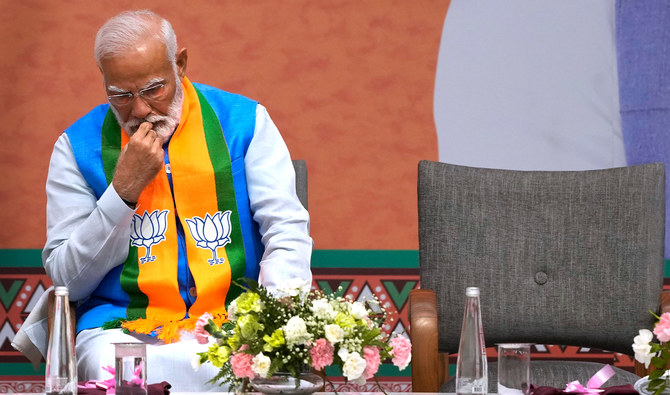
Indian Prime Minister Narendra Modi listens to Bharatiya Janata Party (BJP) President JP Nadda speak during an event organized to release their party's manifesto for the upcoming national parliamentary elections in New Delhi, India, on April 14, 2024. (REUTERS)
Short Url
Updated 23 April 2024
Follow

Modi accused of hate speech for calling Muslims ‘infiltrators’ at a rally days into India’s election

  • Congress spokesperson says party has sought action from India’s election commission against Modi 
  • India’s election code of conduct forbids candidates to “appeal to caste or communal feelings” for votes

NEW DELHI: India’s main opposition party accused Prime Minister Narendra Modi of hate speech after he called Muslims “infiltrators” and used some of his most incendiary rhetoric to date about the minority faith in a campaign rally days after the country began its weekslong general election.

At the rally on Sunday in the western state of Rajasthan, Modi said that when the Congress party was in government, “they said Muslims have the first right over the country’s resources.” If it returns to power, the party “will gather all your wealth and distribute it among those who have more children,” he said as the crowd applauded.

“They will distribute it among infiltrators,” he continued, saying, “Do you think your hard-earned money should be given to infiltrators?”

Abhishek Manu Singhvi, a spokesperson for Congress, called the prime minister’s remarks “deeply, deeply objectionable” and said the party on Monday had sought action from the Election Commission of India, which oversees the six-week voting period. The first votes were cast Friday.

The remarks sparked fierce criticism for peddling anti-Muslim tropes, and for breaking election rules which bar candidates from engaging in any activity that aggravates religious tensions. The Election Commission of India’s model code of conduct forbids candidates to “appeal to caste or communal feelings” to secure votes.

Asaduddin Owaidi, a Muslim lawmaker and president of the All India Majlis-e-Ittehad-ul-Muslimeen party, said on Sunday: “Modi today called Muslims infiltrators and people with many children. Since 2002 till this day, the only Modi guarantee has been to abuse Muslims and get votes.”

Critics of Modi — an avowed Hindu nationalist — say India’s tradition of diversity and secularism has come under attack since his party won power in 2014 and returned for a second term in 2019. They accuse Modi’s BJP of fostering religious intolerance and sometimes even violence. The party denies the accusation and say their policies benefit all Indians.

But rights groups say that attacks against minorities has become more brazen under Modi. Scores of Muslims have been lynched by Hindu mobs over allegations of eating beef or smuggling cows, an animal considered holy to Hindus. Muslim businesses have been boycotted, their homes and businesses have been bulldozed and places of worship set on fire. Some open calls have been made for their genocide.

Modi’s remarks on Sunday were based on a 2006 statement by then-Prime Minister Manmohan Singh of the Congress party. Singh said that India’s lower-castes, tribes, women and, “in particular the Muslim minority” were empowered to share in the country’s development equally.

“They must have the first claim on resources,” Singh had said. A day later, his office clarified that Singh was referring to all of the disadvantaged groups.

Modi and his Hindu nationalist Bharatiya Janata Party are expected to win, according to most surveys. The results come out on June 4.

The Congress party’s president, Mallikarjun Kharge, described Modi’s comments as “hate speech.” “In the history of India, no prime minister has lowered the dignity of his post as much as Modi has,” Kharge wrote on social media platform X.

In its petition to the election commission, the party said that Modi and the BJP have repeatedly used religion, religious symbols and sentiments in their election campaign with impunity. “These actions have been further bolstered by the commission’s inaction in penalizing the prime minister and the BJP for their blatant violations of electoral laws,” it said.

The commission’s code of conduct is not legally binding on its own, but it can issue notices and suspend campaigners for a certain amount of time over violations.
“We decline comment,” a spokesperson for the commission told the Press Trust of India news agency on Monday.

In his speech, Modi also referred to a Hindu nationalist myth that Muslims were overtaking the Hindu population by having more children. Hindus comprise 80 percent of India’s 1.4 billion population, while the country’s 200 million Muslims make up 14 percent. Official data shows that fertility rates among Muslims have dropped the fastest among religious groups in recent decades, from 4.4 in 1992-93 to 2.3 between 2019-21, just a bit higher than Hindus at 1.94.

Modi’s BJP has previously referred to Muslims as infiltrators and cast them as illegal migrants who crossed into India from Bangladesh and Pakistan. Several states run by the BJP have also made laws that restrict interfaith marriage, citing the myth of ” love jihad,” an unproven conspiracy theory that claims Muslim men use marriage to convert Hindu women.

Through it all, Modi has maintained a conspicuous silence, which critics say has emboldened some of his most extreme supporters and enabled more hate speech against Muslims.


Trump says Iran ‘want to negotiate’ after reports of hundreds killed in protests

Updated 57 min 24 sec ago
Follow

Trump says Iran ‘want to negotiate’ after reports of hundreds killed in protests

  • US President Donald Trump said Sunday that Iran’s leadership had called him seeking “to negotiate” after he repeatedly threatened to intervene militarily if Tehran killed protesters

WASHINGTON: US President Donald Trump said Sunday that Iran’s leadership had called him seeking “to negotiate” after he repeatedly threatened to intervene militarily if Tehran killed protesters.
For two weeks, Iran has been rocked by a protest movement that has swelled in spite of a crackdown rights groups warn has become a “massacre.”
Initially sparked by anger over the rising cost of living, the demonstrations have evolved into a serious challenge of the theocratic system in place since the 1979 revolution.
Information has continued to trickle out of Iran despite a days-long Internet shutdown, with videos filtering out of capital Tehran and other cities over the past three nights showing large demonstrations.
As reports emerge of a growing protest death toll, and images show bodies piled outside a morgue, Trump said Tehran indicated its willingness to talk.
“The leaders of Iran called” yesterday, Trump told reporters aboard Air Force One, adding that “a meeting is being set up... They want to negotiate.”
He added, however, that “we may have to act before a meeting.”
The US-based Center for Human Rights in Iran (CHRI) said it had received “eyewitness accounts and credible reports indicating that hundreds of protesters have been killed across Iran during the current Internet shutdown.”
“A massacre is unfolding,” it said.
The Norway-based NGO Iran Human Rights (IHR) said it confirmed the killing of at least 192 protesters but that the actual toll could be much higher.
“Unverified reports indicate that at least several hundreds, and according to some sources, more than 2,000 people may have been killed,” said IHR.
More than 2,600 protesters have been arrested, IHR estimates.
A video circulating on Sunday showed dozens of bodies accumulating outside a morgue south of Tehran.
The footage, geolocated by AFP to Kahrizak, showed bodies wrapped in black bags, with what appeared to be grieving relatives searching for loved ones.
Near paralysis
In Tehran, an AFP journalist described a city in a state of near paralysis.
The price of meat has nearly doubled since the start of the protests, and many shops are closed. Those that do open must close at around 4:00 or 5:00 pm, when security forces deploy en masse.
There were fewer videos showing protests on social media Sunday, but it was not clear to what extent that was due to the Internet shutdown.
One widely shared video showed protesters again gathering in the Pounak district of Tehran shouting slogans in favor of the ousted monarchy.
The protests have become one of the biggest challenges to the rule of supreme leader Ayatollah Ali Khamenei, 86, coming in the wake of Israel’s 12-day war against the Islamic republic in June, which was backed by the United States.
State TV has aired images of burning buildings, including a mosque, as well as funeral processions for security personnel.
But after three days of mass actions, state outlets were at pains to present a picture of calm returning, broadcasting images of smooth-flowing traffic on Sunday. Tehran Governor Mohammad-Sadegh Motamedian insisted in televised comments that “the number of protests is decreasing.”
The Iranian government on Sunday declared three days of national mourning for “martyrs” including members of the security forces killed.
President Masoud Pezeshkian also urged Iranians to join a “national resistance march” Monday to denounce the violence.
In response to Trump’s repeated threats to intervene, Iran’s parliament speaker Mohammad Bagher Ghalibaf said Iran would hit back, calling US military and shipping “legitimate targets” in comments broadcast by state TV.
‘Stand with the people’
Reza Pahlavi, the US-based son of Iran’s ousted shah, who has emerged as an anti-government figurehead, said he was prepared to return to the country and lead a democratic transition.
“I’m already planning on that,” he told Fox News on Sunday.
He later urged Iran’s security forces and government workers to join the demonstrators.
“Employees of state institutions, as well as members of the armed and security forces, have a choice: stand with the people and become allies of the nation, or choose complicity with the murderers of the people,” he said in a social media post.
He also urged protesters to replace the flags outside of Iranian embassies.
“The time has come for them to be adorned with Iran’s national flag,” he said.
The ceremonial, pre-revolution flag has become an emblem of the global rallies that have mushroomed in support of Iran’s demonstrators.
In London, protesters managed over the weekend to swap out the Iranian embassy flag, hoisting in its place the tri-colored banner used under the last shah.