

Bangladesh halts controversial relocation of Rohingya refugees to remote island

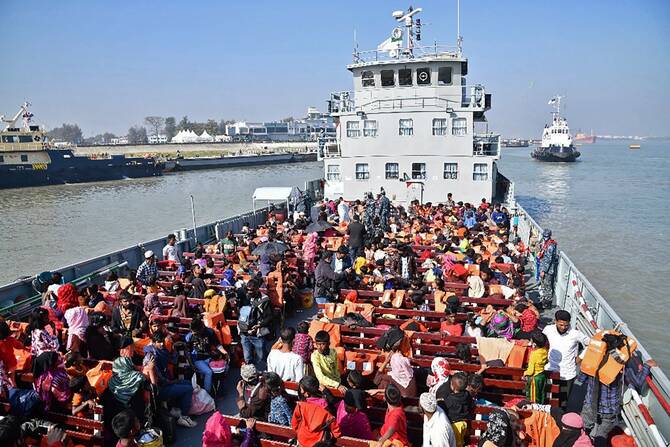
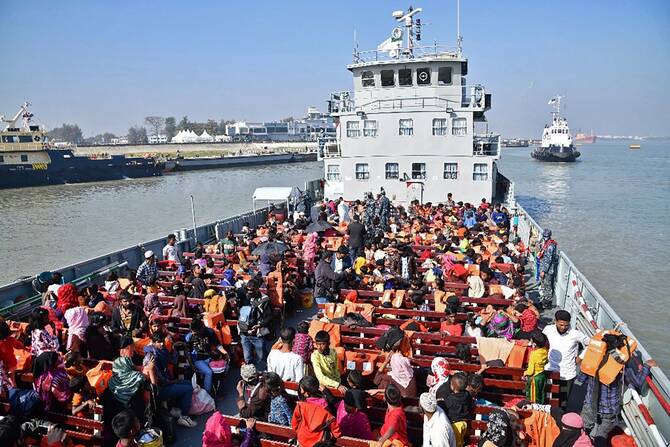
Rohingya refugees are seen on a Bangladesh's Navy ship as they are being relocated to the Bhashan Char island in the Bay of Bengal, in Chittagong on Jan. 29, 2021. (AFP/File)
Short Url
Updated 29 December 2025
Follow

Bangladesh halts controversial relocation of Rohingya refugees to remote island

  • Administration of ousted PM Sheikh Hasina spent about $350m on the project
  • Rohingya refuse to move to island and 10,000 have fled, top refugee official says

DHAKA: When Bangladesh launched a multi-million-dollar project to relocate Rohingya refugees to a remote island, it promised a better life. Five years on, the controversial plan has stalled, as authorities find it is unsustainable and refugees flee back to overcrowded mainland camps.

The Bhasan Char island emerged naturally from river sediments some 20 years ago. It lies in the Bay of Bengal, over 60 km from Bangladesh’s mainland.

Never inhabited, the 40 sq. km area was developed to accommodate 100,000 Rohingya refugees from the cramped camps of the coastal Cox’s Bazar district.

Relocation to the island started in early December 2020, despite protests from the UN and humanitarian organizations, which warned that it was vulnerable to cyclones and flooding, and that its isolation restricted access to emergency services.

Over 1,600 people were then moved to Bhasan Char by the Bangladesh Navy, followed by another 1,800 the same month. During 25 such transfers, more than 38,000 refugees were resettled on the island by October 2024.

The relocation project was spearheaded by the government of former Prime Minister Sheikh Hasina, who was ousted last year. The new administration has since suspended it indefinitely.

“The Bangladesh government will not conduct any further relocation of the Rohingya to Bhasan Char island. The main reason is that the country’s present government considers the project not viable,” Mizanur Rahman, refugee relief and repatriation commissioner in Cox’s Bazar, told Arab News on Sunday.

The government’s decision was prompted by data from UN agencies, which showed that operations on Bhasan Char involved 30 percent higher costs compared with the mainland camps in Cox’s Bazar, Rahman said.

“On the other hand, the Rohingya are not voluntarily coming forward for relocation to the island. Many of those previously relocated have fled ... Around 29,000 are currently living on the island, while about 10,000 have returned to Cox’s Bazar on their own.”

A mostly Muslim ethnic minority, the Rohingya have lived for centuries in Myanmar’s western Rakhine state but were stripped of their citizenship in the 1980s and have faced systemic persecution ever since.

In 2017 alone, some 750,000 of them crossed to neighboring Bangladesh, fleeing a deadly crackdown by Myanmar’s military. Today, about 1.3 million of them shelter in 33 camps in the coastal Cox’s Bazar district, making it the world’s largest refugee settlement.

Bhasan Char, where the Bangladeshi government spent an estimated $350 million to construct concrete residential buildings, cyclone shelters, roads, freshwater systems, and other infrastructure, offered better living conditions than the squalid camps.

But there was no regular transport service to the island, its inhabitants were not allowed to travel freely, and livelihood opportunities were few and dependent on aid coming from the mainland.

Rahman said: “Considering all aspects, we can say that Rohingya relocation to Bhasan Char is currently halted. Following the fall of Sheikh Hasina’s regime, only one batch of Rohingya was relocated to the island.

“The relocation was conducted with government funding, but the government is no longer allowing any funds for this purpose.”

“The Bangladeshi government has spent around $350 million on it from its own funds ... It seems the project has not turned out to be successful.”


US border agent shoots and wounds two people in Portland

Updated 5 sec ago
Follow

US border agent shoots and wounds two people in Portland

  • The Portland shooting unfolded Thursday afternoon as US Border Patrol ‌agents were ‌conducting a targeted vehicle stop, the Department of Homeland ‌Security ⁠said ​in a ‌statement

A US immigration agent shot and wounded a ​man and a woman in Portland, Oregon, authorities said on Thursday, leading local officials to call for calm given public outrage over the ICE shooting death of a Minnesota woman a day earlier.
“We understand the heightened emotion and tension many are feeling in the wake of the shooting in Minneapolis, but I am asking the community to remain calm as we work to learn more,” Portland police chief Bob Day said in a statement.
The Portland shooting unfolded Thursday afternoon as US Border Patrol ‌agents were ‌conducting a targeted vehicle stop, the Department of Homeland ‌Security ⁠said ​in a ‌statement.
The statement said the driver, a suspected Venezuelan gang member, attempted to “weaponize” his vehicle and run over the agents. In response, DHS said, “an agent fired a defensive shot” and the driver and a passenger drove away.
Reuters was unable to independently verify the circumstances of the incident.
Portland police said that the shooting took place near a medical clinic in eastern Portland. Six minutes after arriving at the scene and determining federal agents were involved in ⁠the shooting, police were informed that two people with gunshot wounds — a man and a woman — were asking for ‌help at a location about 2 miles (3 km) to the ‍northeast of the medical clinic.
Police said ‍they applied tourniquets to the man and woman, who were taken to a ‍hospital. Their condition was unknown.
The shooting came just a day after a federal agent from US Immigration and Customs Enforcement (ICE), a separate agency within the Department of Homeland Security, fatally shot a 37-year-old mother of three in her car in Minneapolis.
That shooting has prompted two days ​of protests in Minneapolis. Officers from both ICE and Border Patrol have been deployed in cities across the United States as part of Republican President Donald ⁠Trump’s immigration crackdown.
While the aggressive enforcement operations have been cheered by the president’s supporters, Democrats and civil rights activists have decried the posture as an unnecessary provocation.
US officials contend criminal suspects and anti-Trump activists have increasingly used their cars as weapons, though video evidence has sometimes contradicted their claims.
Portland Mayor Keith Wilson said in a statement his city was now grappling with violence at the hands of federal agents and that “we cannot sit by while constitutional protections erode and bloodshed mounts.”
He called on ICE to halt all its operations in the city until an investigation can be completed.
“Federal militarization undermines effective, community-based public safety, and it runs counter to the values that define our region,” Wilson said. “I will use ‌every legal and legislative tool available to protect our residents’ civil and human rights.”