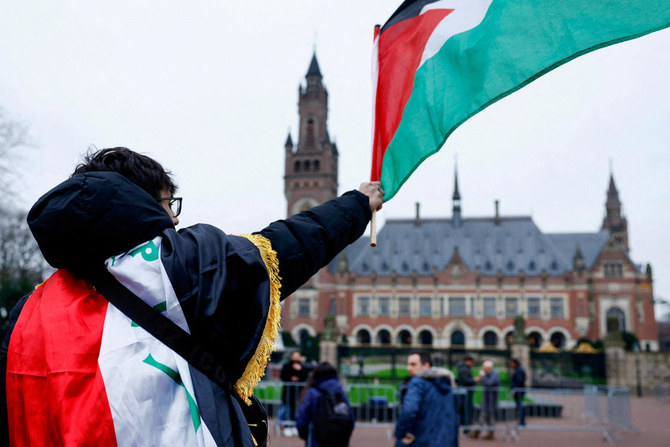
THE HAGUE: The United Nations’ top court opens two days of hearings on Thursday into a request from South Africa to make sure Israel halts its military operation in the southern Gaza city of Rafah, where more than half of Gaza’s population has sought shelter.
It is the fourth time South Africa has asked the International Court of Justice for emergency measures since the nation launched proceedings alleging that Israel’s military action in its war with Hamas in Gaza amounts to genocide.
According to the latest request, the previous preliminary orders by The Hague-based court were not sufficient to address “a brutal military attack on the sole remaining refuge for the people of Gaza.”
Israel has portrayed Rafah as the last stronghold of the militant group, brushing off warnings from the United States and other allies that any major operation there would be catastrophic for civilians.
South Africa has asked the court to order Israel to withdraw from Rafah; to take measures to ensure unimpeded access for UN officials, humanitarian organizations and journalists to the Gaza Strip; and to report back within one week on how it is meeting these demands.
During hearings earlier this year, Israel strongly denied committing genocide in Gaza and said it does all it can to spare civilians and is only targeting Hamas militants. It says Hamas’ tactic of embedding in civilian areas makes it difficult to avoid civilian casualties.
In January, judges ordered Israel to do all it can to prevent death, destruction and any acts of genocide in Gaza, but the panel stopped short of ordering an end to the military offensive that has laid waste to the Palestinian enclave.
In a second order in March, the court said Israel must take measures to improve the humanitarian situation in Gaza, including opening more land crossings to allow food, water, fuel and other supplies to enter.
Most of Gaza’s population of 2.3 million people have been displaced since fighting began.
The war began with a Hamas attack on southern Israel on Oct. 7 in which Palestinian militants killed around 1,200 people and took about 250 hostages. Gaza’s Health Ministry says over 35,000 Palestinians have been killed in the war, without distinguishing between civilians and combatants in its count.
South Africa initiated proceedings in December 2023 and sees the legal campaign as rooted in issues central to its identity. Its governing party, the African National Congress, has long compared Israel’s policies in Gaza and the occupied West Bank to its own history under the apartheid regime of white minority rule, which restricted most Blacks to “homelands.” Apartheid ended in 1994.
On Sunday, Egypt announced it plans to join the case. The Ministry of Foreign Affairs said Israeli military actions “constitute a flagrant violation of international law, humanitarian law, and the Fourth Geneva Convention of 1949 regarding the protection of civilians during wartime.”
Several countries have also indicated they plan to intervene, but so far only Libya, Nicaragua and Colombia have filed formal requests to do so.

The top UN court holds hearings on Israeli military incursion into Rafah
Short Url
https://arab.news/rqsbf
The top UN court holds hearings on Israeli military incursion into Rafah
- It is the fourth time South Africa has asked the ICJ for emergency measures
- South Africa has asked the court to order Israel to withdraw from Rafah
Hamas to elect first leader since Sinwar killed by Israel
- Role left vacant since Israel killed Yahya Sinwar in 2024
- Khalil Al-Hayya and Khaled Meshaal are seen as frontrunners
CAIRO: Hamas is expected to elect a new leader this month, two sources in the group told Reuters, filling the role left vacant since Israel killed Yahya Sinwar in 2024 despite concerns that a successor could suffer the same fate.
Khalil Al-Hayya and Khaled Meshaal are seen as frontrunners for the helm at a vital moment for the militant Islamist group, battered by two years of war ignited by its October 7, 2023 attack on Israel and facing international demands to disarm.
Both men reside in Qatar and sit on a five-man council that has run Hamas since Israel killed Sinwar, a mastermind of the October 7 attack. His predecessor, Ismail Haniyeh, was assassinated by Israel while on a visit to Iran in 2024.
The election process has already begun, the sources said. The leader is chosen in a secret ballot by Hamas’ Shoura Council, a 50-member body that includes Hamas members in the Israeli-occupied West Bank, the Gaza Strip, and exile.
A Hamas spokesperson declined to comment.
Tough challenges
The sources said a deputy leader will also be elected to replace Saleh Al-Arouri, who was killed by an Israeli airstrike in Lebanon in 2024.
Sources close to Hamas said it was determined to conclude the vote, though some preferred an extension of collective leadership.
Hamas watchers regard Meshaal as part of a pragmatic wing with good ties to Sunni Muslim countries, and Hayya, the group’s lead negotiator, as part of a camp that deepened its relations with Iran.
Hamas faces some of the toughest challenges since it was founded in 1987. While fighting has largely abated in Gaza since the US-brokered ceasefire in October, Israel still holds almost half the coastal enclave, attacks continue, and conditions for Gaza’s 2 million people remain dire.
Hamas has also drawn criticism within Gaza because of the heavy toll inflicted by the war, with much of the enclave reduced to ruins and more than 71,000 people killed, according to Gaza health authorities.
Hamas-led militants killed some 1,200 people and abducted 251 others in the October 7 cross-border assault on Israel.
US President Donald Trump’s ceasefire plan for Gaza demands Hamas disarm and foresees the enclave being run by a technocratic Palestinian administration overseen by an international body called the Board of Peace.
Targeted by Israel
Hamas has so far refused to disarm, saying the question of armed resistance is a matter for wider debate among Palestinian factions and that it would be ready to surrender its weapons to a future Palestinian state, an outcome Israel has ruled out.
Hamas is designated as a terrorist organization by Western powers including the United States.
Born in Gaza, Hayya was among Hamas leaders targeted by an Israeli airstrike on Qatar in September.
Israeli Prime Minister Benjamin Netanyahu later expressed regret to the emir of Qatar — a US ally — in a three-way call with Trump and affirmed Israel would not conduct such an attack again in the future, the White House said at the time.
Meshaal previously led Hamas for almost two decades. Israeli agents tried to assassinate him in Jordan in 1997 by injecting him with poison.
His relations with Iran were strained in 2012 when he distanced Hamas from Tehran’s Syrian ally, the now-ousted President Bashar Assad, early in the Arab Spring uprisings.
Hamas was founded as the Palestinian branch of the Muslim Brotherhood and is the main rival to the Palestinians’ Fatah national movement led by 90-year-old President Mahmoud Abbas.
Hamas’ founding charter called for the destruction of Israel, although its leaders have at times offered a long-term truce with Israel in return for a viable Palestinian state on all Palestinian territory occupied by Israel in the 1967 war.
Israel regards this approach as a ruse.
Analyst Reham Owda said there were limited differences between Hayya and Meshaal over the conflict with Israel but believed Meshaal had better chances as he could “market (Hamas) internationally and help rebuild its capabilities.”
Khalil Al-Hayya and Khaled Meshaal are seen as frontrunners for the helm at a vital moment for the militant Islamist group, battered by two years of war ignited by its October 7, 2023 attack on Israel and facing international demands to disarm.
Both men reside in Qatar and sit on a five-man council that has run Hamas since Israel killed Sinwar, a mastermind of the October 7 attack. His predecessor, Ismail Haniyeh, was assassinated by Israel while on a visit to Iran in 2024.
The election process has already begun, the sources said. The leader is chosen in a secret ballot by Hamas’ Shoura Council, a 50-member body that includes Hamas members in the Israeli-occupied West Bank, the Gaza Strip, and exile.
A Hamas spokesperson declined to comment.
Tough challenges
The sources said a deputy leader will also be elected to replace Saleh Al-Arouri, who was killed by an Israeli airstrike in Lebanon in 2024.
Sources close to Hamas said it was determined to conclude the vote, though some preferred an extension of collective leadership.
Hamas watchers regard Meshaal as part of a pragmatic wing with good ties to Sunni Muslim countries, and Hayya, the group’s lead negotiator, as part of a camp that deepened its relations with Iran.
Hamas faces some of the toughest challenges since it was founded in 1987. While fighting has largely abated in Gaza since the US-brokered ceasefire in October, Israel still holds almost half the coastal enclave, attacks continue, and conditions for Gaza’s 2 million people remain dire.
Hamas has also drawn criticism within Gaza because of the heavy toll inflicted by the war, with much of the enclave reduced to ruins and more than 71,000 people killed, according to Gaza health authorities.
Hamas-led militants killed some 1,200 people and abducted 251 others in the October 7 cross-border assault on Israel.
US President Donald Trump’s ceasefire plan for Gaza demands Hamas disarm and foresees the enclave being run by a technocratic Palestinian administration overseen by an international body called the Board of Peace.
Targeted by Israel
Hamas has so far refused to disarm, saying the question of armed resistance is a matter for wider debate among Palestinian factions and that it would be ready to surrender its weapons to a future Palestinian state, an outcome Israel has ruled out.
Hamas is designated as a terrorist organization by Western powers including the United States.
Born in Gaza, Hayya was among Hamas leaders targeted by an Israeli airstrike on Qatar in September.
Israeli Prime Minister Benjamin Netanyahu later expressed regret to the emir of Qatar — a US ally — in a three-way call with Trump and affirmed Israel would not conduct such an attack again in the future, the White House said at the time.
Meshaal previously led Hamas for almost two decades. Israeli agents tried to assassinate him in Jordan in 1997 by injecting him with poison.
His relations with Iran were strained in 2012 when he distanced Hamas from Tehran’s Syrian ally, the now-ousted President Bashar Assad, early in the Arab Spring uprisings.
Hamas was founded as the Palestinian branch of the Muslim Brotherhood and is the main rival to the Palestinians’ Fatah national movement led by 90-year-old President Mahmoud Abbas.
Hamas’ founding charter called for the destruction of Israel, although its leaders have at times offered a long-term truce with Israel in return for a viable Palestinian state on all Palestinian territory occupied by Israel in the 1967 war.
Israel regards this approach as a ruse.
Analyst Reham Owda said there were limited differences between Hayya and Meshaal over the conflict with Israel but believed Meshaal had better chances as he could “market (Hamas) internationally and help rebuild its capabilities.”
© 2026 SAUDI RESEARCH & PUBLISHING COMPANY, All Rights Reserved And subject to Terms of Use Agreement.