

In scenic Abbottabad, an old church tells a tale of religious unity, colonial heritage

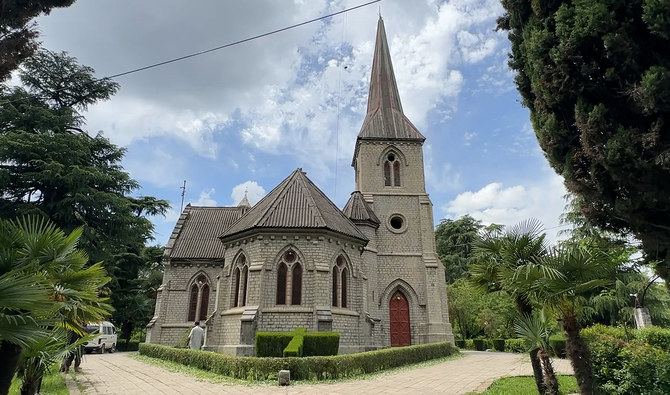
The picture taken on April 30, 2024 shows exterior view of St. Luke’s Church in Pakistan's Abbottabad. (AN photo)
Short Url
Updated 02 May 2024
Follow

In scenic Abbottabad, an old church tells a tale of religious unity, colonial heritage

  • St. Luke’s Church was built in 1864 on land donated by Queen Victoria, empress of India
  • Can seat up to 150 worshippers, expanding into outdoor area to host larger crowds

ABBOTTABAD: Located in Abbottabad, a picturesque city set against the mountainous terrain of Pakistan’s northwestern Khyber Pakhtunkhwa province, the 160-year-old St. Luke’s Church has a tale to tell of religious unity and the region’s colonial history. 

Built in 1864 during British rule, the Anglican-Protestant church was established to serve British officials serving in the Indian subcontinent. Construction of St. Luke’s commenced in 1854-55, with initial delays due to slow fund-raising and then a brief interruption due to the Indian Rebellion of 1857. It was completed and then consecrated by the Bishop of Calcutta in 1864. 

Despite disruptions during the partition of British India in 1947 and the birth of Pakistan, the church has continued to host mass and retained many of its original architectural elements.

“During its construction, the church’s exterior was built with stones that were cut and laid by hand,” Rev. Rafiq Javed, a priest at the church appointed by the Diocese of Peshawar, told Arab News this week, explaining the history of St. Luke’s Church.

“The inner part [of the church] is built using mud, lentils, jute, sawdust, and paste made of eggs. The eggs were provided by the local people.”

St. Luke’s Church retains many elements from the time of its construction, such as stained-glass windows and old locks and their gigantic keys. A pipe organ stands in the church foyer.

Javed said the musical instrument had become unusable due to water damage some 50 years ago but its sound was once well known across the Abbottabad valley.

The church walls display plaques dating back to 1865 and serving as a memory of fallen British soldiers. One also comes across a metallic device permanently fixed on one of the stairs at the church’s entrance that was used by British troops to remove mud from their shoes before going to the main hall for worship.

The local Christian community says the church property was donated by Queen Victoria, empress of India, and one of its gates was named after her. The church property comprises the vicar’s home as well as staff quarters for caretakers of the building.

The church seats up to 150 worshippers, expanding into the outdoor area to accommodate larger crowds during special occasions such as Christmas and Easter.

Christianity, the third largest religion in Muslim-majority Pakistan, is followed by 1.27 percent of the population, according to the 2017 Census. The community has roughly equal proportions of Catholics and Protestants, with a small number of Eastern Orthodox and Oriental Orthodox Christians as well. There are around 4,000 Christians in Abbottabad, according to local estimates.

Javed the priest said the building of the church was a community effort:

“At the time, the people who lived here included Hindus and our Muslim brothers as well and they also lent a hand in building this church. The eggs [to make paste] were provided by the local Hindu and Muslim communities.”


UN torture expert decries Pakistan ex-PM Khan’s detention

Updated 12 December 2025
Follow

UN torture expert decries Pakistan ex-PM Khan’s detention

  • Khan’s party alleges government is holding him in solitary confinement, barring prison visits
  • Pakistan’s government rejects allegations former premier is being denied basic rights in prison

GENEVA: Pakistan’s former prime minister Imran Khan is being held in conditions that could amount to torture and other inhuman or degrading treatment, the United Nations’ special rapporteur on torture warned Friday.

Alice Jill Edwards urged Pakistan to take immediate and effective action to address reports of the 73-year-old’s inhumane and undignified detention conditions.

“I call on Pakistani authorities to ensure that Khan’s conditions of detention fully comply with international norms and standards,” Edwards said in a statement.

“Since his transfer to Adiala Jail in Rawalpindi on September 26, 2023, Imran Khan has reportedly been held for excessive periods in solitary confinement, confined for 23 hours a day in his cell, and with highly restricted access to the outside world,” she said.

“His cell is reportedly under constant camera surveillance.”

Khan an all-rounder who captained Pakistan to victory in the 1992 Cricket World Cup, upended Pakistani politics by becoming the prime minister in 2018.

Edwards said prolonged or indefinite solitary confinement is prohibited under international human rights law and constitutes a form of psychological torture when it lasts longer than 15 days.

“Khan’s solitary confinement should be lifted without delay. Not only is it an unlawful measure, extended isolation can bring about very harmful consequences for his physical and mental health,” she said.

UN special rapporteurs are independent experts mandated by the Human Rights Council. They do not, therefore, speak for the United Nations itself.

Initially a strong backer of the country’s powerful military leadership, Khan was ousted in a no-confidence vote in 2022, and has since been jailed on a slew of corruption charges that he denies.

He has accused the military of orchestrating his downfall and pursuing his Tehreek-e-Insaf (PTI) party and its allies.

Khan’s supporters say he is being denied prison visits from lawyers and family after a fiery social media post this month accusing army leader Field Marshal Asim Munir of persecuting him.

According to information Edwards has received, visits from Khan’s lawyers and relatives are frequently interrupted or ended prematurely, while he is held in a small cell lacking natural light and adequate ventilation.

“Anyone deprived of liberty must be treated with humanity and dignity,” the UN expert said.

“Detention conditions must reflect the individual’s age and health situation, including appropriate sleeping arrangements, climatic protection, adequate space, lighting, heating, and ventilation.”

Edwards has raised Khan’s situation with the Pakistani government.