

Iranian president arrives in Pakistan for three-day visit to bolster ties

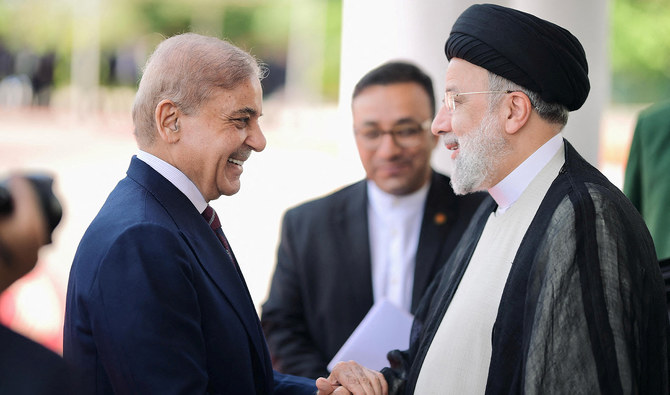
Pakistan's Prime Minister Shehbaz Sharif greets Iranian President Ebrahim Raisi on his three-day official visit in Islamabad, Pakistan April 22, 2024. (PM Office)
Short Url
Updated 22 April 2024
Follow

Iranian president arrives in Pakistan for three-day visit to bolster ties

  • Ebrahim Raisi arrives in Islamabad with high-level delegation and “large” team of businesspersons, says foreign office
  • Raisi’s visit to Pakistan takes place amid surging Middle East tensions following Israel’s airstrikes against Iran last week

ISLAMABAD: Iranian President Ebrahim Raisi arrived in Islamabad on Monday for a three-day visit to the country, Pakistan’s foreign office said, with his trip aimed at strengthening bilateral ties between the two countries amid surging tensions in the Middle East.

The Iranian president arrived in the federal capital with his spouse, a high-level delegation of cabinet members and a team of businesspersons. He was welcomed at the Islamabad Airport by Pakistan’s Federal Minister for Housing and Works Mian Riaz Hussain Pirzada and Pakistan’s Ambassador to Iran Mudassir Tipu.

Raisi’s visit takes place days after Iran and Israel exchanged drone and missile strikes, escalating tensions in the already volatile Middle East.

“Prime Minister Shehbaz Sharif welcomed Iran’s President Ebrahim Raisi at the Prime Minister’s House,” Sharif’s office said in a statement. “Both representatives exchanged good wishes for one another.”
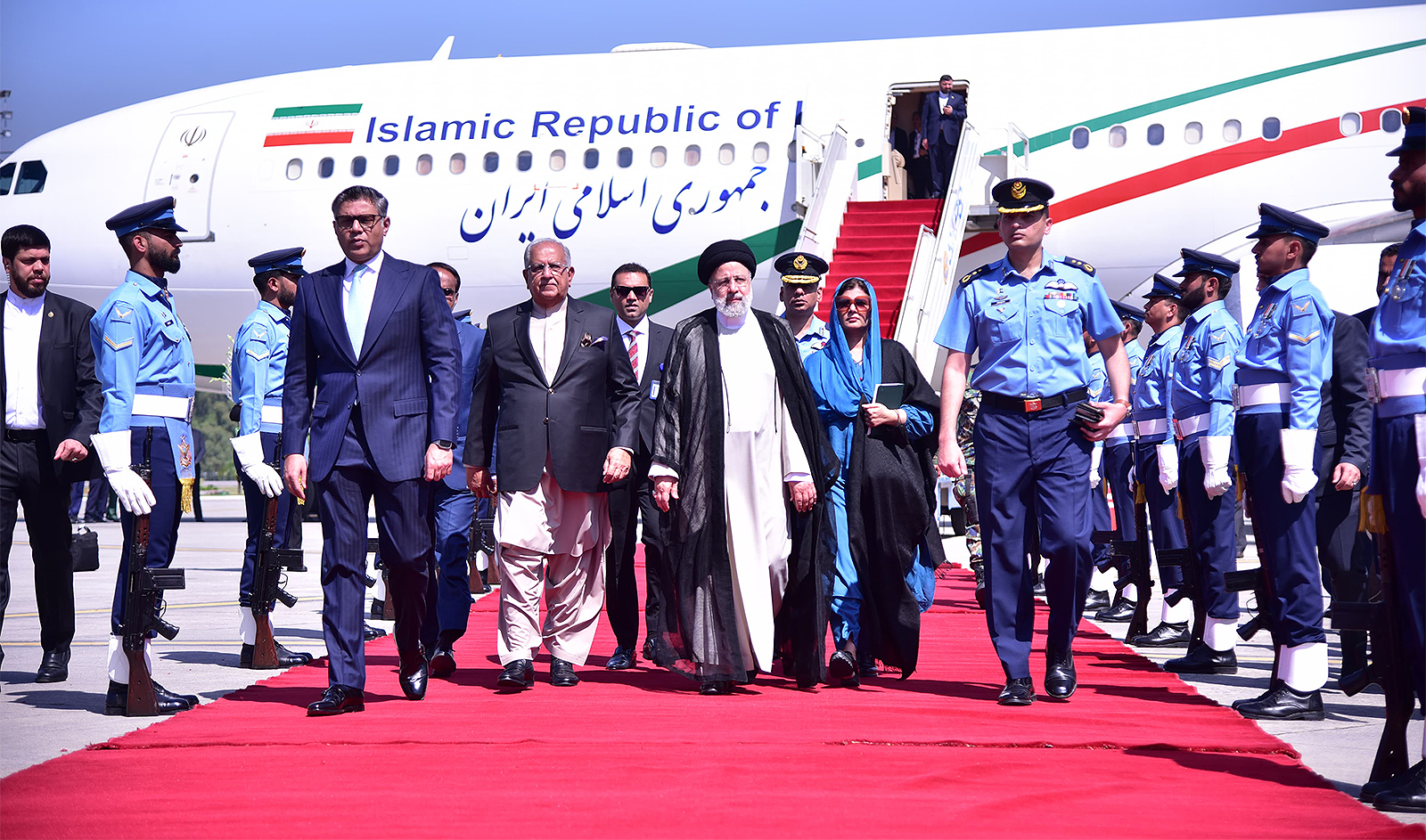


Iranian President Ebrahim Raisi (center) arrives in Islamabad, Pakistan on April 22, 2024. (Government of Pakistan)

Raisi was presented with a guard of honor by a Pakistan Army contingent upon his arrival at the Prime Minister’s House. Sharif and the Iranian president then planted a sapling at the Prime Minister’s House to mark the annual Earth Day. 

The Iranian president also met Pakistan’s Foreign Minister Ishaq Dar, during which the two agreed to enhance cooperation in various areas. “They also discussed regional and global developments and affirmed commitment to peace and constructive dialogue for resolving regional challenges,” the foreign office said. 
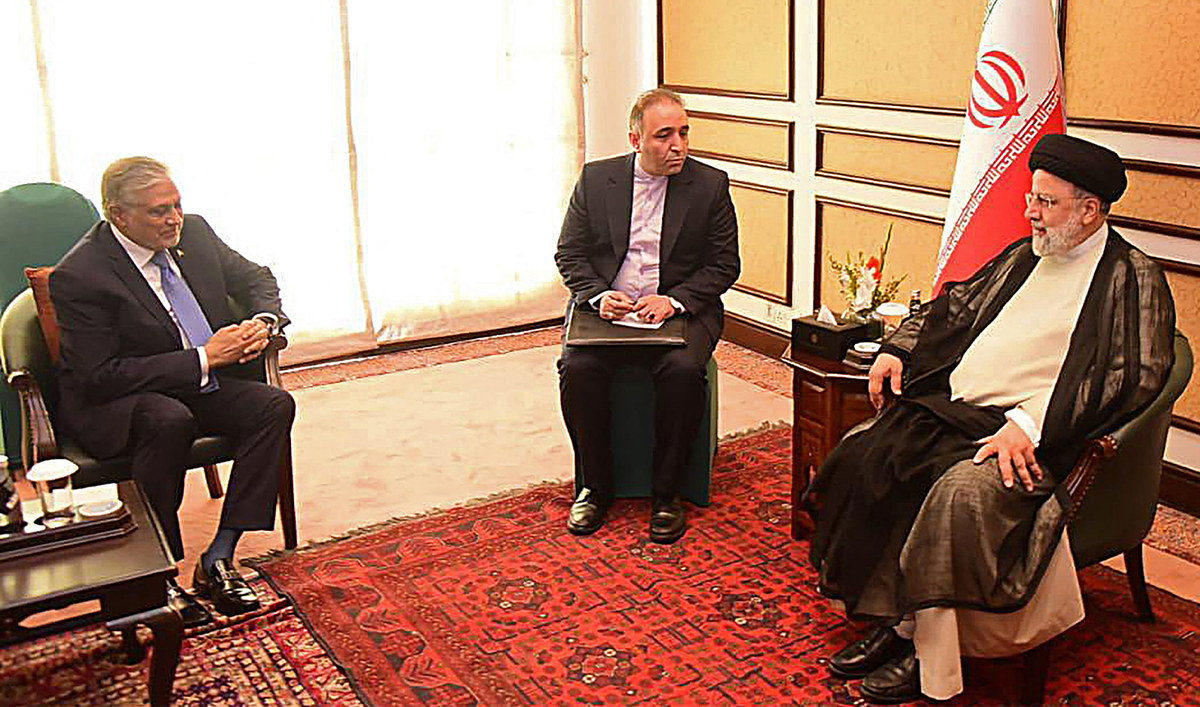


This handout photograph taken and released by the Pakistan Foreign Office on April 22, 2024, shows Iran’s President Ebrahim Raisi (R) speaking with Pakistan's Foreign Minister Ishaq Dar (L) during their meeting in Islamabad, Pakistan. (Pakistan's Foreign Office)

During his visit from April 22-24, the Iranian head of state is scheduled to meet Pakistan’s prime minister, president, Senate chairman and National Assembly speaker, the foreign office said in a statement on Friday, adding that he would also visit Karachi and Lahore cities to meet the country’s provincial leadership.

Raisi’s visit will be the first by any head of state to Pakistan after the contentious elections of February 2024.

Pakistan and Iran are often at odds with each other over instability on their shared porous border, with both countries routinely trading blame for not rooting out militancy.

Tensions surged in January when Pakistan and Iran exchanged airstrikes, both claiming to target alleged militant hideouts in each other’s countries. Both sides have since then undertaken peace overtures and restored bilateral ties.

“The two sides will have a wide-ranging agenda to further strengthen Pakistan-Iran ties and enhance cooperation in diverse fields including trade, connectivity, energy, agriculture, and people-to-people contacts,” the foreign office said.

Discussions would also focus on regional and global developments as well as bilateral cooperation to combat “terrorism,” the statement added.

“Pakistan and Iran enjoy strong bilateral ties anchored in history, culture and religion,” the foreign office said. “This visit provides an important opportunity to further strengthen Pakistan-Iran relations.”


Pakistan minister calls for integrating ocean awareness into education to preserve ecosystems

Updated 31 January 2026
Follow

Pakistan minister calls for integrating ocean awareness into education to preserve ecosystems

  • Pakistan’s maritime sector posted a record $360 million profit in 2025 following a year of sweeping reforms
  • Junaid Anwar Chaudhry says education equips youth to make informed decisions, contribute to blue economy

KARACHI: Pakistan’s Maritime Affairs Minister Junaid Anwar Chaudhry has urged integrating ocean awareness into formal education systems and empowering youth as active partners in order to preserve marine ecosystems, his ministry said on Saturday.

Chaudhry said this at a meeting with Minister of State for Education and Professional Training, Wajiha Qamar, who called on him and discussed strategies for enhancing marine education, literacy, and youth engagement in sustainable ocean management.

Pakistan’s maritime sector posted a record Rs100 billion ($360 million) profit in 2025 following a year of sweeping reforms aimed at improving port efficiency, cost-cutting, and safeguarding marine ecosystems to boost the blue economy.

“Understanding our oceans is no longer optional, it is essential for climate resilience, sustainable development, and the long-term health of our maritime resources,” Chaudhry said, highlighting the critical role of marine literacy.

The minister said education equips youth to make informed decisions and actively contribute to marine conservation and the blue economy, urging inclusion of marine ecosystems, conservation and human-ocean interactions into curricula, teacher training and global citizenship programs.

“Initiatives like ‘Ocean Literacy for All’ can mainstream these elements in national policies, school programs, and community workshops to build proactive citizenship on marine challenges,” he added.

Ocean Literacy for All is a UNESCO Intergovernmental Oceanographic Commission–coordinated global initiative under the UN Ocean Decade (2021–2030) that promotes ocean awareness, education, and conservation.

Chaudhry announced reforms in maritime education, including granting degree-awarding status to the Pakistan Marine Academy, and the establishment of the Maritime Educational Endowment Fund (MEEF) to provide scholarships for deserving children from coastal communities.

“The scholarship program promotes inclusive development by enabling access to quality education for youth from over 70 coastal and fishing communities, particularly in Sindh and Balochistan,” he said.

The discussions underscored raising awareness about oceans, coastal ecosystems and marine resources, according to the Pakistani maritime affairs ministry. Both ministers stressed the need to integrate climate and marine education from classrooms

to community programs, addressing risks like rising sea temperatures, coastal erosion, biodiversity loss and pollution.

“Incorporating marine science and ocean literacy into curricula can help students connect local challenges with global trends,” Qamar said, underscoring education’s transformative power in building social resilience.

The meeting explored translating complex marine science into accessible public knowledge through sustained, solution-oriented awareness campaigns, according to the maritime affairs ministry.

With coastline facing pressures from climate change, pollution, and overexploitation, the ministers called for a coordinated approach blending formal education, informal learning and youth-led advocacy.

“A joint effort by the Ministries of Maritime Affairs and Education can cultivate an ocean-literate generation, transforming vulnerability into resilience and ensuring the long-term sustainability of coastal and marine ecosystems,” Chaudhry said.