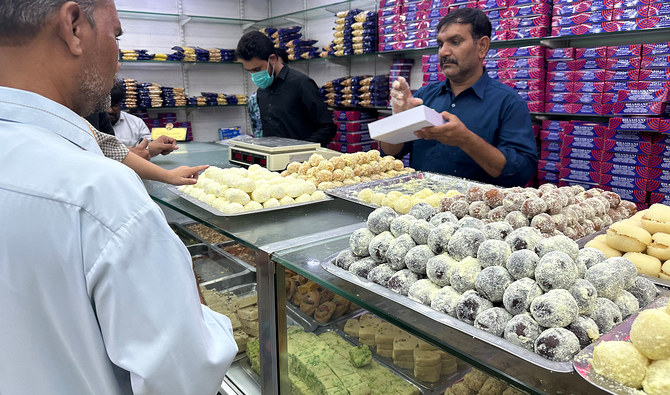
KARACHI: As Chand Raat, the night of the crescent moon, heralds the end of the Muslim fasting month of Ramadan and the arrival of Eid Al-Fitr, residents of Karachi throng the city’s popular sweet shops to buy sweetmeat, honoring a time-honored tradition of celebrating Mithi or Sweet Eid.
While various desserts, especially sheer khurma and kheer, grace the festive spreads in almost every household, different kinds of sweetmeats, locally known as mithai, also hold a central place in the hearts of people.
“Until you have mithai, there is no Eid and you cannot enjoy the celebration,” Zubair-ud-Din, a customer, told Arab News while purchased cham-cham from a downtown Karachi sweets shop.
“To buy mithai, one must wait in a queue for a long time,” he continued. “But it is necessary to take Mithai with you.”
“There is no Eid without mithai,” he said, adding he had always been taking sweets from his favorite Bhashani Sweets since its taste was “unmatched.”
Asif Bhashani, the owner of the outlet whose family migrated to Pakistan from Bangladesh in 1971 and brought all its recipes, Eid Al-Fitr is synonymous with sweetmeats displayed at his shop.
“It’s rightly called [sweet Eid] because mithai dominates everything,” he said. “People’s focus is on mithai and cakes, not just in Pakistan but all over the world. It’s a tradition.”
With Ramadan’s progression, Bhashani Sweets experiences a new surge in demand, reaching its zenith on Chand Raat, the eve preceding Eid.
The owner of the shop said people not only purchased sweets for their own families but also got them for friends and colleagues before visiting them.
“People send our sweets all over the world, to their relatives, to friends, whether in the United Arab Emirates, Saudi Arabia, Europe or Canada,” he said. “People send our Bhashani mithai, especially cham-cham.”
Although every sweet shop is flooded with customers, Bhashani, Dilpasand and Rehmat-e-Shireen are the leading outlets in the city.
“Our commitment to quality distinguishes us as the preferred choice of people,” said Asif Nadeem at Rehmat-e-Shireen located at Karachi’s popular Tariq Road, highlighting the surge in sales at his shop.
“Our customers increase several times in number during Eid,” he added.
Choosing the finest sweets from the top shops is preferred by people who aspire to present the best to their guests, according to Arsala Khan, who purchased five kilograms of cham-cham and gulab jaman besides other sweet delights.
“When guests arrive, we offer them mithai, so we buy these sweets from a good place,” he told Arab News, adding that his spread was also decorated with rice pudding, sheer khurma and home-made carrot halwa.
“This is Sweet Eid and for Sweet Eid, sweet things should be mandatory,” he said. “That’s why we purchase Mithai.”
“It’s a day of happiness, guests arrive and mithai is essential for guests,” he added.


![]()

‘No mithai, no Eid’: Karachi’s sweet shops bustle as Eid Al-Fitr celebrations continue
Short Url
https://arab.news/c4dba
‘No mithai, no Eid’: Karachi’s sweet shops bustle as Eid Al-Fitr celebrations continue
- On the night of the crescent moon, people visit their favorite shops to purchase different varieties of sweetmeats
- Despite thousands of these shops in the city, a large chunk of customers go to the top ones for quality sweets
Latest updates


Recommended


© 2026 SAUDI RESEARCH & PUBLISHING COMPANY, All Rights Reserved And subject to Terms of Use Agreement.