

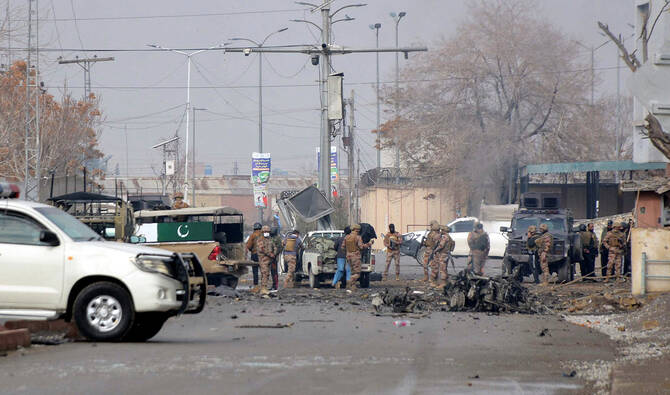

PESHAWAR: Pakistani forces have concluded a security operation in the southwestern Balochistan province and killed 216 militants after a series of coordinated attacks by separatist militants last week, the military’s media wing said on Thursday.
Separatist militant group Baloch Liberation Army (BLA) claimed responsibility for a series of attacks in Balochistan last Friday and Saturday in multiple districts across the province, one of the deadliest flare-ups in the area in recent years.
Pakistan military’s media wing, the Inter-Services Public Relations (ISPR), said security forces launched operations in Panjgur and Harnai district’s outskirts on Jan. 29 based on intelligence confirming the presence of “terrorist elements,” killing 41 militants.
It said the military launched a broader series of intelligence-based operations in multiple areas of the province after that to dismantle “terrorist sleeper cells,” referring to it as “Operation Radd-ul-Fitna-1.”
“As a result of these well-coordinated engagements and subsequent clearance operations, 216 terrorists have been sent to hell, significantly degrading the leadership, command-and-control structures and operational capabilities of terrorist networks,” the ISPR said in a statement.
The military said 36 civilians, including women and children, were killed by militants while 22 security forces and law enforcement personnel also lost their lives.
The ISPR said a substantial cache of foreign-origin weapons, ammunition, explosives and equipment were also recovered during the counteroffensive operations.
“Preliminary analysis indicates systematic external facilitation and logistical support to these extremist proxies,” the statement said.
The military said Pakistan’s armed forces remain steadfast in their resolve to combat “terrorism,” vowing that counterterror operations will continue until militants are completely eliminated.
“Operation Radd-ul-Fitna-1 stands as a testament to Pakistan’s and particularly Balochistan’s proud peoples’ unwavering commitment to always prefer peace over violence, unity over division and development over violence,” the ISPR said.
’SITUATION NORMAL ACROSS BALOCHISTAN’
Speaking to reporters later in the evening, Balochistan Government Spokesperson Shahid Rind said there were still combing operations taking place in Quetta.
“Otherwise, the situation in the entire Balochistan, including Nushki and Quetta, is normal,” Rind said.
In Quetta, around 100 suspicious persons have been taken into custody in search and combing operations. The official said the suspects are being questioned, adding that not only illegal light weapons but also RPGs and anti-aircraft guns were obtained from certain homes.
He said the examinations of grade 8 and 9 students in Quetta will take place as per schedule, adding that the nationwide polio vaccination campaign will also take place in the province, except for Nushki.
Rind said all highways in Balochistan were open for traffic, except for a small part of the road in Nushki that was damaged by blasts. Rind said authorities are busy repairing the road and would open it for traffic within 12-24 hours.
He said Internet services across Quetta will be restored tonight, except for areas where the search and combing operations are being conducted.
Pakistan’s government has accused India of being behind the militant attacks in Balochistan, charges that New Delhi has rejected as “baseless.”
Balochistan, Pakistan’s largest province by land area, has long faced a separatist insurgency that has intensified in recent years. Militants frequently target security forces, government officials, infrastructure projects, foreigners and non-local workers.
The province holds vast reserves of minerals and hydrocarbons and is central to the multibillion-dollar China-Pakistan Economic Corridor (CPEC), a flagship component of China’s Belt and Road Initiative.
Separatist groups such as the BLA accuse Islamabad of exploiting Balochistan’s natural resources while denying locals a fair share. Pakistan’s civilian and military leadership reject the claim and say they are investing in the province’s development.


