Pakistan election regulator delays Senate polls in northwest province amid oath-taking controversy

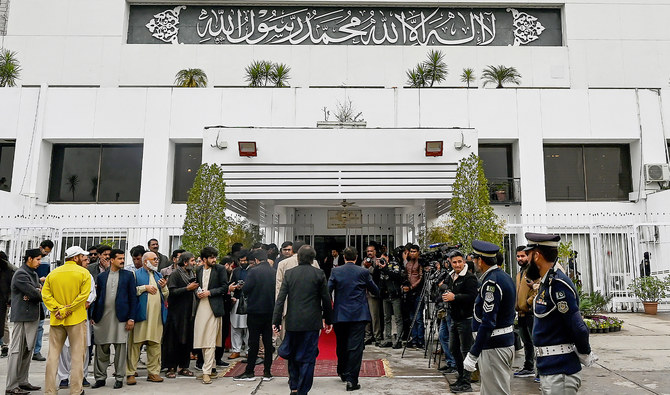
Lawmakers arrive at the Parliament House in Islamabad on March 3, 2024. (AFP/File)
Short Url
Updated 02 April 2024
Follow

Pakistan election regulator delays Senate polls in northwest province amid oath-taking controversy

  • The decision was taken after the KP speaker refused to administer oath to opposition members on reserved seats
  • With the postponement of polling process in KP, the electoral contest is now taking place on 19 Senate seats

ISLAMABAD: Pakistan’s election regulatory body on Tuesday postponed Senate elections in the northwestern Khyber Pakhtunkhwa (KP) province, responding to a plea by the opposition which called for a postponement because nearly two dozen provincial lawmakers on reserved seats had not been administered the oath despite a court order.

Polling to elect members on 30 vacant seats in the upper house of the country’s bicameral parliament was scheduled to be held today, with the Election Commission of Pakistan (ECP) staff ready to hold the voting process in the KP assembly.

However, the Pakistan Peoples Party’s Ahmad Karim Kundi objected to it, saying in the plea to the ECP that 25 lawmakers belonging to his party on the reserved seats had not been sworn in by the assembly speaker despite a Peshawar High Court ruling last month. The opposition members in KP previously protested the speaker’s decision to ignore the court ruling, saying it was to prevent the lawmakers on the reserved seats from participating in the Senate elections.

After evaluating the opposition’s plea, the ECP decided to postpone the polling process.

“The Commission in exercise of powers under Article 218(3) of the Constitution read with Section 4(1), Section 8(c) and Section 128 of the Election Act, 2017 and all other enabling provisions of the Constitution and law in this behalf, postpones the poll to the Senate Election to the extent of Khyber Pakhtunkhwa till the administration of oath to the elected members against the reserved seats,” it said in its order.

The ECP had already notified unopposed candidates as winners on 18 seats, including seven each from Punjab and Balochistan on general seats, two on women seats, and two on seats reserved for scholars or technocrats.

With the postponement of election on 11 Senate seats from KP due to the incomplete electoral college, the polling process is now only taking place on 19 seats.

Pakistani senators are elected for a term of six years. They are responsible to discuss laws, provide their technical input and vote on legislations like other public representatives. Half of these senators retire every three years and new ones are elected to replace them.

The Senate consists of 100 members, of which 52 recently retired, necessitating polls on 48 vacant seats as four seats from the erstwhile Federally Administered Tribal Areas (FATA) have already been abolished due to their merger with the Khyber Pakhtunkhwa province.

The ECP printed ballot papers in four different colors for polling today, including white papers for general seats, green for technocrat seats, pink for women and yellow for minority seats.

A total of 59 candidates were prepared to contest the polls on 30 vacant seats before the postponement of voting in KP.

Senator elections in Pakistan usually take place days before the senators’ terms end, but they were delayed this time due to the ECP’s failure to hold timely general election.

General elections scheduled for November last year were held on Feb. 8 this year.

The chief minister of KP, Ali Amin Gandapur, said his party would protest the postponement of the Senate polling process in response to the latest political development.

Gandapur belongs to former prime minister Imran Khan’s Pakistan Tehreek-e-Insaf that swept the last general elections in KP and formed the provincial administration.


Pakistan’s deputy PM says country will not send forces to Gaza to disarm Hamas

Updated 9 sec ago
Follow

Pakistan’s deputy PM says country will not send forces to Gaza to disarm Hamas

  • Ishaq Dar says Pakistan open to peacekeeping but Gaza’s internal security is Palestinian responsibility
  • Pakistan’s top religious clerics from different schools have warned against sending forces to Palestine

ISLAMABAD: Deputy Prime Minister Ishaq Dar said on Saturday Pakistan was willing to contribute to an international peacekeeping force in Gaza, though it would not deploy troops to disarm or de-weaponize Hamas.

The statement follows media reports saying Washington views Pakistan as a potentially significant contributor given its battle-hardened military and wants it to be part of International Stabilization Force (ISF), which is part of United States President Donald Trump’s 20-point framework for a Gaza peace plan.

The plan announced by Trump at the White House on September 29 was formally adopted at the Sharm El-Sheikh Peace Summit in October. Co-chaired by Trump and Egyptian President Abdel Fattah El-Sisi, the summit brought together leaders from 27 countries to sign the “Trump Declaration for Enduring Peace and Prosperity.”

Deployment of troops from Muslim-majority countries during a transitional stabilization phase is a key part of the plan before the war-ravaged Palestinian territory moves toward reconstruction and a longer-term political settlement.

“If they say that we should go and start fighting, disarm Hamas, de-weaponize them, and go and destroy the tunnels that Hamas has built until now, that is not our job,” Dar, who is also the country’s foreign minister, told reporters during a year-end briefing in Islamabad.

He emphasized there was clarity between Pakistan’s civil and military leadership over the matter.

“We have a very complete understanding on this matter that we cannot do that kind of work,” he added.

The deputy prime minister said Pakistan had been using the term “peacekeeping” and had never used the phrase “peace enforcement” while discussing the force.

“I have been very clear: Pakistan will be happy to join if the mandate is not peace enforcement and disarming and de-weaponizing Hamas.”

The government’s stance comes amid growing domestic pressure over the issue.

On Monday, a group of Pakistan’s top religious leaders, chaired by prominent scholar Mufti Taqi Usmani, warned the government against yielding to what they described as international pressure to send forces to Gaza.

In a joint statement from Karachi, the clerics — representing Deobandi, Barelvi, Ahl-e-Hadees and Shia schools of thought — said that Washington wanted Muslim countries to send their forces to Gaza to disarm Hamas.

“Several Muslim governments have already refused this, and pressure is being increased on Pakistan,” it added.

Addressing such concerns, Dar said Pakistan would not land its forces in Palestine to “fight Muslims.”

Israel has repeatedly called for the disarmament of Hamas as a precondition for any long-term settlement, and the United Nations Security Council has also endorsed the ISF framework in November.

However, Dar maintained during the media briefing the internal security of Gaza was the Palestinian responsibility.

“The Palestinian Authority, their government, it is their job, it is the job of their law enforcement agency,” he said

The deputy prime minister also highlighted Pakistan’s involvement in the “Arab Islamic Group of Eight,” including Saudi Arabia, Jordan, Egypt, the United Arab Emirates, Qatar, Turkiye and Indonesia, which has been coordinating on the crisis.

He said the efforts of these countries had brought some peace to Palestine and reduced bloodshed.

“Our declared policy is that there should be an independent two-state solution,” he continued while calling for pre-1967 borders.