

Islamic Development Bank, Pakistan sign $603 million loan deals to fund development projects

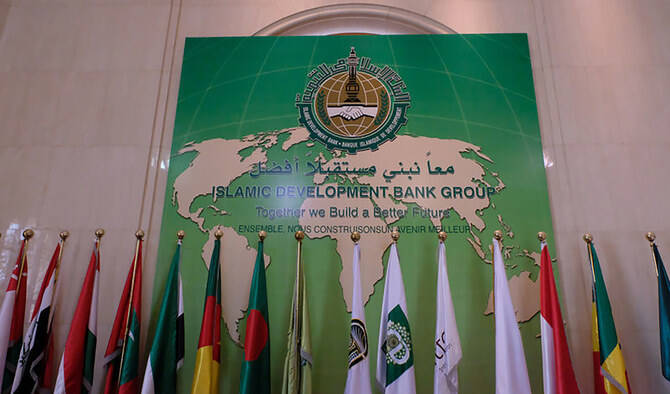
A banner with the flags of Arab countries seen at the entrance of the Islamic Development Bank headquarters in Jeddah, Saudi Arabia on May 31, 2018. (REUTERS/File)
Short Url
Updated 20 January 2026
Follow

Islamic Development Bank, Pakistan sign $603 million loan deals to fund development projects

  • The projects concern Sukkur-Hyderabad motorway, poverty graduation of flood-affectees and out-of-school children
  • The poverty graduation project will be implemented in 25 districts, including five districts most affected by floods

ISLAMABAD: Pakistan and the Islamic Development Bank (IsDB) have signed three loan agreements worth about $603 million to finance multiple development projects, the Pakistani information ministry said on Tuesday.

The agreements relating to M-6 Sukkur-Hyderabad Motorway Project, Poverty Graduation of Extremely Poor and Flood Affected Households Project (PGEP), and the Out-of-School Children project in Azad Jammu and Kashmir were formalized in Islamabad, following talks between Pakistan’s Economic Affairs Minister Ahad Cheema and an IsDB delegation, led by Vice President Dr. Rami Ahmad.

Under the agreements, IsDB will provide financing of $475 million for the M-6 Sukkur–Hyderabad Motorway, a key link to the proposed Peshawar-Karachi Motorway. Pakistan signed the second agreement with IsDB to launch the Poverty Graduation of Extremely Poor and Flood

Affected Households (PGEP) project, aimed at transitioning ultra-poor households from dependency on cash assistance to sustainable livelihoods, resilience and economic self-reliance.

“PGEP has a total outlay of $134.2 million, of which IsDB will contribute USD 118.4 million. The Project will be implemented in 25 districts (20 districts selected based on Multidimensional Poverty Index (MPI 2024) and 5 most flood-affected districts of the 2022 and 2025 floods,” the information ministry said.

“The project aims to reach 160,866 households and create 100,000 employment opportunities through integrated asset transfers, interest-free loans, skills development, rainwater harvesting, climate-smart agriculture, and business service providers’ interventions. The PGEP reflects the Government’s commitment to shifting from consumption-based safety nets to graduation-focused, resilience-driven development, aligned with national priorities and the Sustainable Development Goals (SDGs).”

IsDB will provide another $10 million for the Out-of-School Children project in Azad Jammu and Kashmir, which would help bring about 60,000 children back into classrooms and support training for 4,000 teachers.

“The minister for economic affairs acknowledged and appreciated the continued IsDB support for Pakistan,” the information ministry said. “The IsDB vice president expressed that IsDB was keen on further expanding cooperation with Pakistan in the areas of mutual interest.”

In May last year, IsDB announced funding a Pakistani project to reactivate out-of-work women doctors, while the bank announced a $100 million loan to support Pakistan’s polio eradication efforts in Dec. 2023.

Tens of thousands flee northwest Pakistan over fears of military operation

Updated 28 January 2026
Follow

Tens of thousands flee northwest Pakistan over fears of military operation

  • More than 70,000 people, mostly women and children, have fled remote Tirah region bordering Afghanistan 
  • Government says no military operation underway or planned in Tirah, a town in Khyber Pakhtunkhwa province

BARA, Pakistan: More than 70,000 people, mostly women and children, have fled a remote region in northwestern Pakistan bordering Afghanistan over uncertainty of a military operation against the Pakistani Taliban, residents and officials said Tuesday.

Pakistan’s Defense Minister Khawaja Mohammad Asif has denied the claim by residents and provincial authorities. He said no military operation was underway or planned in Tirah, a town in Khyber Pakhtunkhwa province.

Speaking at a news conference in Islamabad, he said harsh weather, rather than military action, was driving the migration. His comments came weeks after residents started fleeing Tirah over fears of a possible army operation.

The exodus began a month after mosque loudspeakers urged residents to leave Tirah by Jan. 23 to avoid potential fighting. Last August, Pakistan launched a military operation against Pakistani Taliban in the Bajau r district in the northwest, displacing hundreds of thousands of people.

Shafi Jan, a spokesman for the provincial government in Khyber Pakhtunkhwa, posted on X that he held the federal government responsible for the ordeal of the displaced people, saying authorities in Islamabad were retracting their earlier position about the military operation.

Khyber Pakhtunkhwa Chief Minister Suhail Afridi, whose party is led by imprisoned former Prime Minister Imran Khan, has criticized the military and said his government will not allow troops to launch a full-scale operation in Tirah.

The military says it will continue intelligence-based operations against Pakistani Taliban, who are known as Tehrik-e-Taliban Pakistan, or TTP. Though a separate group, it has been emboldened since the Afghan

Taliban returned to power in 2021. Authorities say many TTP leaders and fighters have found sanctuary in Afghanistan and that hundreds of them have crossed into Tirah, often using residents as human shields when militant hideouts are raided.

Caught in the middle are the residents of Tirah, who continued arriving in Bara.

So far, local authorities have registered roughly 10,000 families — about 70,000 people — from Tirah, which has a population of around 150,000, said Talha Rafiq Alam, a local government administrator overseeing the relief effort. He said the registration deadline, originally set for Jan. 23, has been extended to Feb. 5.

He said the displaced would be able to return once the law-and-order situation improves.

Among those arriving in Bara and nearby towns was 35-year-old Zar Badshah, who said he left with his wife and four children after the authorities ordered an evacuation. He said mortar shells had exploded in villages in recent weeks, killing a woman and wounding four children in his village. “Community elders told us to leave. They instructed us to evacuate to safer places,” he said.

At a government school in Bara, hundreds of displaced lined up outside registration centers, waiting to be enrolled to receive government assistance. Many complained the process was slow.

Narendra Singh, 27, said members of the minority Sikh community also fled Tirah after food shortages worsened, exacerbated by heavy snowfall and uncertain security.

“There was a severe shortage of food items in Tirah, and that forced us to leave,” he said.

Tirah gained national attention in September, after an explosion at a compound allegedly used to store bomb-making materials killed at least 24 people. Authorities said most of the dead were militants linked to the TTP, though local leaders disputed that account, saying civilians, including women and children, were among the dead.