

Islamic Development Bank, Pakistan sign $603 million loan deals to fund development projects

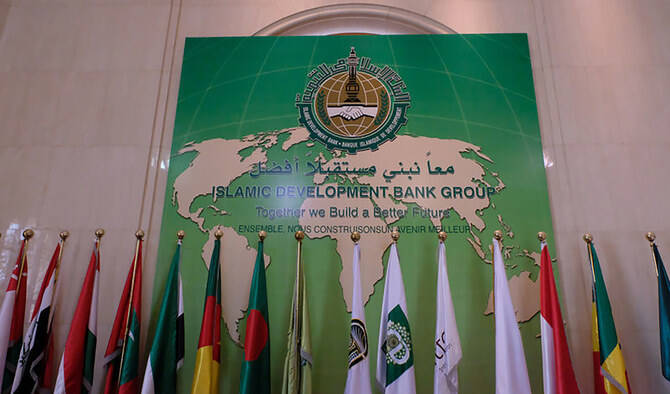
A banner with the flags of Arab countries seen at the entrance of the Islamic Development Bank headquarters in Jeddah, Saudi Arabia on May 31, 2018. (REUTERS/File)
Short Url
Updated 20 January 2026
Follow

Islamic Development Bank, Pakistan sign $603 million loan deals to fund development projects

  • The projects concern Sukkur-Hyderabad motorway, poverty graduation of flood-affectees and out-of-school children
  • The poverty graduation project will be implemented in 25 districts, including five districts most affected by floods

ISLAMABAD: Pakistan and the Islamic Development Bank (IsDB) have signed three loan agreements worth about $603 million to finance multiple development projects, the Pakistani information ministry said on Tuesday.

The agreements relating to M-6 Sukkur-Hyderabad Motorway Project, Poverty Graduation of Extremely Poor and Flood Affected Households Project (PGEP), and the Out-of-School Children project in Azad Jammu and Kashmir were formalized in Islamabad, following talks between Pakistan’s Economic Affairs Minister Ahad Cheema and an IsDB delegation, led by Vice President Dr. Rami Ahmad.

Under the agreements, IsDB will provide financing of $475 million for the M-6 Sukkur–Hyderabad Motorway, a key link to the proposed Peshawar-Karachi Motorway. Pakistan signed the second agreement with IsDB to launch the Poverty Graduation of Extremely Poor and Flood

Affected Households (PGEP) project, aimed at transitioning ultra-poor households from dependency on cash assistance to sustainable livelihoods, resilience and economic self-reliance.

“PGEP has a total outlay of $134.2 million, of which IsDB will contribute USD 118.4 million. The Project will be implemented in 25 districts (20 districts selected based on Multidimensional Poverty Index (MPI 2024) and 5 most flood-affected districts of the 2022 and 2025 floods,” the information ministry said.

“The project aims to reach 160,866 households and create 100,000 employment opportunities through integrated asset transfers, interest-free loans, skills development, rainwater harvesting, climate-smart agriculture, and business service providers’ interventions. The PGEP reflects the Government’s commitment to shifting from consumption-based safety nets to graduation-focused, resilience-driven development, aligned with national priorities and the Sustainable Development Goals (SDGs).”

IsDB will provide another $10 million for the Out-of-School Children project in Azad Jammu and Kashmir, which would help bring about 60,000 children back into classrooms and support training for 4,000 teachers.

“The minister for economic affairs acknowledged and appreciated the continued IsDB support for Pakistan,” the information ministry said. “The IsDB vice president expressed that IsDB was keen on further expanding cooperation with Pakistan in the areas of mutual interest.”

In May last year, IsDB announced funding a Pakistani project to reactivate out-of-work women doctors, while the bank announced a $100 million loan to support Pakistan’s polio eradication efforts in Dec. 2023.

Pakistan army hits Afghan Taliban drone storage facility, ammunition depot in Jalalabad

Updated 5 sec ago
Follow

Pakistan army hits Afghan Taliban drone storage facility, ammunition depot in Jalalabad

  • Around 435 Afghan Taliban fighters killed, over 630 injured in Pakistani military offensive, minister says
  • Several countries, global bodies have urged both sides to exercise restraint since the conflict began last week

ISLAMABAD: Pakistan’s army struck a drone storage facility and ammunition depot of Afghan Taliban in Jalalabad, a Pakistani security official said on Monday, following Pakistani strikes on more than 50 locations in Afghanistan amid ongoing hostilities between the neighbors.

Pakistan launched Operation ‘Ghazb lil Haq’ against Afghanistan on the night of Feb. 26 following an attack by Afghanistan on Pakistani military installations along their shared border.

The worst fighting between the two neighbors in years erupted after Pakistani airstrikes targeted what Islamabad called militant hideouts inside Afghanistan on Feb. 21-22, accusing Kabul of harboring Tehreek-e-Taliban Pakistan (TTP) militants behind the attacks on its soil. Afghanistan denies the charge.

A Pakistani security official, who requested anonymity, said the army was continuing “strong retaliatory action” against the Afghan Taliban and blew up multiple border posts, forcing them to abandon their positions.

“Pakistan forces are effectively targeting the bases and military installations of the Fitna Al-Khawarij and the Afghan Taliban,” he said.

“During the effective counter-operation of the Pakistani forces, the ammunition depot and drone storage site of Fitna Al-Khawarij (TTP) and the Afghan Taliban in Jalalabad was destroyed.”

Separately, Pakistan’s Information Minister Attaullah Tarar said more than 400 Afghan Taliban fighters had been killed and over 630 wounded in the Pakistani military offensive so far.

Pakistan destroyed around 188 check posts and captured 31, according to a post on X by Tarar. Over 180 tanks, armored vehicles and artillery guns were also destroyed in Pakistani air raids at 51 locations across Afghanistan.

On Sunday, Pakistani state media shared a video of what it said were Pakistani soldiers crossing into Afghanistan in the northwest to capture an Afghan post. Pakistan has seized a 32-square-kilometer area of Afghanistan, another Pakistani security official said.

Afghan officials earlier said that dozens of Pakistani soldiers had been killed and several Pakistan posts had been captured by their forces. None of the casualty figures or battlefield claims from either side could be independently verified.

Since the conflict began last week, diplomatic efforts have intensified, with several countries and international bodies calling on both sides to exercise restraint.

The United Nations, along with China and Russia, has called for calm, while US President Donald Trump said Pakistan has the right to defend itself against cross-border militancy.