

Israel orders Gaza families to move in first forced evacuation since ceasefire

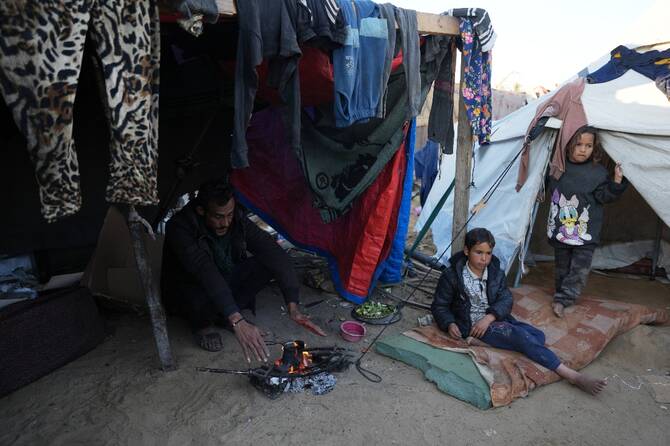
Displaced Palestinian Amr Al-Manaya, 35, sits by the fire with his children, Muhammad and Hala, next to their tent in Deir al-Balah, Gaza Strip. (AP)
Short Url
Updated 20 January 2026
Follow

Israel orders Gaza families to move in first forced evacuation since ceasefire

  • Residents of Bani Suhaila, east of Khan Younis, said the leaflets were dropped on Monday on families living in tent encampments in the Al-Reqeb neighborhood

CAIRO: Israeli forces have ordered dozens of Palestinian families in the southern Gaza Strip to leave their homes in the first forced evacuation since October’s ceasefire, as residents and Hamas said on Tuesday the military was ​expanding the area under its control.
Residents of Bani Suhaila, east of Khan Younis, said the leaflets were dropped on Monday on families living in tent encampments in the Al-Reqeb neighborhood.
“Urgent message. The area is under IDF control. You must evacuate immediately,” said the leaflets, written in Arabic, Hebrew, and English, which the army dropped over the Al-Reqeb neighborhood in the town of Bani Suhaila.
In the two-year war before the US brokered ceasefire was signed in October, Israel dropped leaflets over areas that were subsequently raided or bombarded, forcing some families to move several times.
Residents and a source from the Hamas militant group said this was the first time they had been ‌dropped since then. ‌The Israeli military did not immediately respond to a request for comment.

SIDES FAR ‌APART ⁠ON ​NEXT PHASES
The ‌ceasefire has not progressed beyond its first phase, under which major fighting has stopped, Israel withdrew from less than half of Gaza, and Hamas released hostages in return for Palestinian detainees and prisoners.
Virtually the entire population of more than 2 million people are confined to around a third of Gaza’s territory, mostly in makeshift tents and damaged buildings, where life has resumed under control of an administration led by Hamas.
Israel and Hamas have accused each other of major breaches of the ceasefire and remain far apart on the more difficult steps planned for the next phase.
Mahmoud, a resident from the ⁠Bani Suhaila area, who asked not to give his family name, said the evacuation orders impacted at least 70 families, living in tents and homes, ‌some of which were partially damaged, in the area.
“We have fled ‍the area and relocated westward. It is maybe the ‍fourth or fifth time the occupation expanded the yellow line since last month,” he told Reuters by phone ‍from Khan Younis, referring to the line behind which Israel has withdrawn.
“Each time they move it around 120 to 150 meters (yards) inside the Palestinian-controlled territory, swallowing more land,” the father-of-three said.

HAMAS CITES STATE OF HUMANITARIAN DISRUPTION
Ismail Al-Thawabta, director of the Hamas-run Gaza government media office, said the Israeli military had expanded the area under its control in eastern Khan Younis five times since ​the ceasefire, forcing the displacement of at least 9,000 people.
“On Monday, 19 January 2026, the Israeli occupation forces dropped warning leaflets demanding the forced evacuation of the Bani Suhaila area in eastern ⁠Khan Younis Governorate, in a measure that falls within a policy of intimidation and pressure on civilians,” Thawabta told Reuters.
He said the new evacuation orders affected approximately 3,000 people.
“The move created a state of humanitarian disruption, increased pressure on the already limited shelter areas, and further deepened the internal displacement crisis in the governorate,” Thawabta added.
Israel’s military has previously said it has opened fire after identifying what it called “terrorists” crossing the yellow line and approaching its troops, posing an immediate threat to them.
It has continued to conduct air strikes and targeted operations across Gaza. The Israeli military has said it views “with utmost severity” any attempts by militant groups in Gaza to attack Israel.
Under future phases of the ceasefire that have yet to be hammered out, US President Donald Trump’s plan envisages Hamas disarming, Israel pulling out further, and an internationally backed administration rebuilding Gaza.
More than 460 Palestinians and three Israeli soldiers have been reported killed since the ceasefire took ‌effect.
Israel launched its operations in Gaza in the wake of an attack by Hamas-led fighters in October 2023 which killed 1,200 people, according to Israeli tallies. Israel’s assault has killed 71,000 people, according to health authorities in the enclave.


Sudan defense minister dismisses ‘intelligence document’ as fabrication after convoy strike

Updated 12 February 2026
Follow

Sudan defense minister dismisses ‘intelligence document’ as fabrication after convoy strike

  • Gen. Hassan Kabroun tells Arab News claims that army hid weapons in aid convoy are “completely false”

RIYADH: Sudan’s defense minister has firmly denied reports attributed to Sudanese intelligence alleging that a convoy targeted in North Kordofan was secretly transporting weapons under the cover of humanitarian aid.

Gen. Hassan Kabroun described the claims as “false” and an attempt to distract from what he called a militia crime.

The controversy erupted after news reports emerged that a document attributed to Sudan’s General Intelligence Service claimed the convoy struck in Al-Rahad on Friday was not a purely humanitarian mission, but was instead carrying “high-quality weapons and ammunition” destined for Sudanese Armed Forces units operating in the state.

The report further alleged that the convoy had been outwardly classified as humanitarian in order to secure safe passage through conflict zones, and that the Rapid Support Forces had destroyed it after gathering intelligence on its route and cargo.

Kabroun categorically rejected the narrative.

“First of all, we would like to stress the fact that this news is false,” he told Arab News. “Even the headline that talks about the security of the regions, such as Al-Dabbah, is not a headline the army would use.”

He described the document as fabricated and politically motivated, saying it was designed to “cover up the heinous crime they committed.”

The minister affirmed that the area targeted by drones is under full control of the Sudanese Armed Forces and does not require any covert military transport.

“Second, we confirm that the region that was targeted by drones is controlled by the army and very safe,” Kabroun said. “It does not require transporting any military equipment using aid convoys as decoys because it is a safe area controlled by the army, which has significant capabilities to transport humanitarian aid.”

According to the minister, the Sudanese military has both the logistical capacity and secure routes necessary to move equipment openly when needed.

“The army is professional and does not need to deliver anything to Kadugli or Dalang on board aid convoys,” he said. “The road between Dalang and Kadugli is open. The Sudanese forces used that road to enter and take control of the region. The road is open and whenever military trucks need to deliver anything, they can do so without resorting to any form of camouflage.”

Kabroun further rejected any suggestion that the military uses humanitarian operations as cover.

“Aid is transported by dedicated relief vehicles to the areas in need of this assistance,” he said. “Aid is not transported by the army. The army and security apparatus do not interfere with relief efforts at all, and do not even accompany the convoys.”

He stressed that the Sudanese Armed Forces maintains a clear institutional separation between military operations and humanitarian work, particularly amid the country’s crisis.

“These are false claims,” he said. “This fake news wanted to cover up the heinous crime they committed.”

Sudan has been gripped by conflict since April 2023, when fighting broke out between the Sudanese Armed Forces and the Rapid Support Forces, plunging the country into what the United Nations has described as one of the world’s worst humanitarian disasters.

The latest dispute over the convoy comes amid intensified fighting in South Kordofan, a strategically sensitive region linking central Sudan with the contested areas of Darfur and Blue Nile.

The false report suggested that intelligence monitoring had enabled the RSF to strike what it described as a military convoy disguised as humanitarian aid. But Kabroun dismissed that version outright.

“The intelligence agency is well aware of its duties,” he said. “The Sudanese Army has enough weapons and equipment to use in the areas of operations. These claims are completely false.”

He argued that the narrative being circulated seeks to shift blame for attacks on civilian infrastructure and humanitarian movements.

“This shows that they are trying to cover up the atrocities,” he added, referring to the militia.

Kabroun maintained that the army has regained momentum on multiple fronts and remains fully capable of sustaining its operations without resorting to deception.

“The region is secure, the roads are open, and the army does not need camouflage,” he said. “We are operating professionally and transparently.”

“These claims are completely false,” Kabroun said. “The Sudanese Army does not use humanitarian convoys for military purposes.”