

Amnesty International urges Pakistan government to respect freedom of peaceful assembly

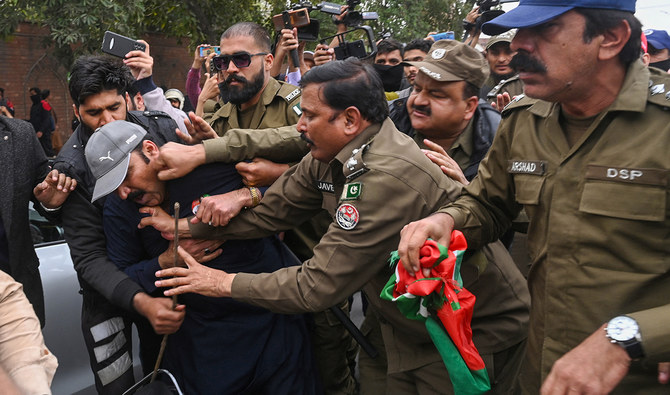
Police detain a supporter of former prime minister Imran Khan's Pakistan Tehreek-e-Insaf (PTI) party, at a protest against the alleged skewing in Pakistan's national election, in Lahore on March 10, 2024. (AFP/File)
Short Url
Updated 26 March 2024
Follow

Amnesty International urges Pakistan government to respect freedom of peaceful assembly

  • The development comes amid restrictions on political protests over February 8 election results and social media disruptions
  • Amnesty International urges government to end excessive use of force against assemblies and protests, adoption global norms

ISLAMABAD: Amnesty International, a global human rights watchdog, on Tuesday urged the new Pakistani government to respect and ensure the right to freedom of peaceful assembly and to place the country’s international human rights commitments at the forefront of its policies and decisions.

The development comes amid restrictions on demonstrations by political parties to protest results of Feb. 8 national election, arrests and trials of political workers and leaders, and social media disruptions.

In its statement, Amnesty International urged the government of Prime Minister Shehbaz Sharif to take concrete steps to address these concerns and to ensure its policies are in line with international norms.

“Unconditionally release all peaceful protesters under detention and ensure those under trial are given access to a fair trial as per international human rights standards,” it urged the Pakistani government.

“End excessive use of force against assemblies and protests through the adoption and implementation of international human rights standards, such as UN Basic Principles on the Use of Force and Firearms by Law Enforcement Officials, for law enforcement agencies when dealing with protesters.”

Pakistan’s national election last month was marred by a nationwide mobile network outage and delays in the release of constituency results, which led to widespread allegations of vote-rigging.

Several political parties, particularly the Pakistan Tehreek-e-Insaf (PTI) of jailed former premier Imran Khan, have since staged several demonstrations in the country to protest alleged rigging of polls.

While authorities deny any systematic rigging of polls, law enforcement agencies have cracked down on a number of these protests and briefly arrested several demonstrators.

In its statement, Amnesty International urged Islamabad to amend laws “criminalizing” the right to freedom of peaceful assembly.

“Repeal laws allowing blanket bans on assemblies, such as section 144 of the Code of Criminal Procedure, and other laws imposing authorization regimes requiring permits for assemblies and protests,” it added.


Islamabad hospital says Imran Khan’s vision shows ‘remarkable’ improvement

Updated 4 sec ago
Follow

Islamabad hospital says Imran Khan’s vision shows ‘remarkable’ improvement

  • Doctors from Al-Shifa Trust Eye Hospital and PIMS examine Khan at Adiala Jail amid his declining eyesight
  • Khan’s health has become a sensitive issue, with supporters questioning the transparency of his treatment

ISLAMABAD: Jailed former prime minister Imran Khan’s vision has “improved remarkably,” the Pakistan Institute of Medical Sciences (PIMS) said on Tuesday, following an examination after he received an intravitreal injection amid concerns related to his eyesight.

Khan, 74, has been held at Adiala jail since August 2023 in cases that he and his Pakistan Tehreek-e-Insaf (PTI) party say are politically motivated. His health has become an increasingly sensitive political issue in recent weeks, particularly after a lawyer informed Pakistan’s Supreme Court that his vision in one eye had significantly deteriorated while in custody.

The ex-premier has reportedly been receiving treatment for retinal vein occlusion, a condition caused by blocked veins draining blood from the retina that can lead to vision loss.

In a statement issued last night, PIMS said Khan had been examined at Adiala Prison on Mar. 3 by a medical board comprising two senior doctors, one of them heading its ophthalmology department and the other heading the vitreoretinal department at Al-Shifa Trust Eye Hospital.

“This examination was performed as a follow-up of his second dose of intravitreal injection of anti VEGF,” it added. “The board concluded that his vision has improved remarkably which is substantially good vision at this stage.”

Anti-VEGF injections are commonly used to treat retinal vein occlusion and other retinal vascular disorders by reducing swelling and abnormal blood vessel growth inside the eye.

The statement highlighted that both Khan’s eyes were examined for “visual acuity, fundoscopy, slit lamp examination and Optical coherence tomography” during the examination.

It added that the board recommended continuing care and treatment as previously advised.

Last month, Khan was taken to PIMS for a second eye injection and was discharged in stable condition, while his party questioned the transparency of the medical update and demanded independent access to his care.

Khan was removed from office in April 2022 through a parliamentary vote of no confidence that he says was orchestrated at the behest of the former administration in Washington by his political rivals with backing from the military. His allegation is denied by all parties involved.

Since his imprisonment, Khan has faced multiple convictions and ongoing legal proceedings that authorities say follow due process, while his party describes them as efforts to sideline him from politics.