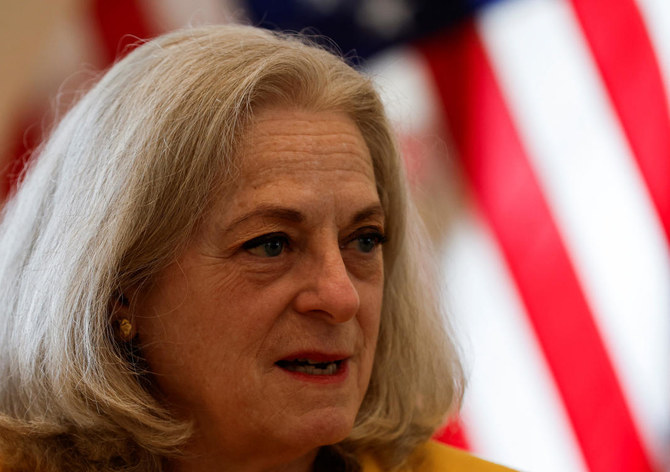
BAGHDAD: Daesh still poses a threat in Iraq and the US-led military coalition’s work with Iraq to fully defeat the group is not done, United States Ambassador to Iraq Alina Romanowski told Reuters in an interview.
Senior Iraqi politicians, including Prime Minister Mohammed Shia Al-Sudani, have repeatedly said that the group no longer posed a threat in Iraq and the coalition was not needed, even as its affiliates continued to carry out attacks elsewhere.
“We both assess Daesh is still a threat here, much, much diminished, but nevertheless our work is essentially not done and we want to ensure that Iraqi forces can continue the enduring defeat of Daesh,” Romanowski said at the US embassy in Baghdad.
She was speaking after Daesh’s Afghan branch, IS-K, claimed responsibility for Friday’s attack at a rock concert near Moscow, in which 137 people were killed.
“As this event reminds us, Daesh is a common terrorist enemy that must be defeated everywhere,” she said in an additional comment after the interview.
“That’s why the United States and Iraq share a commitment to ensure the enduring defeat of Daesh, including by working together to shape the future of a strong bilateral US-Iraq security partnership.”
Last week, at least three people died in a suicide bombing carried out by IS-K in Afghanistan and in January it claimed responsibility for a twin suicide bombing in Iran, which shares a 1,600 km (994 mile) border with Iraq.
Iraq’s prime minister is due to meet US President Joe Biden in Washington on April 15 to discuss the future of the coalition, as well as Iraqi financial reforms and a US push to wean Iraq — a rare ally of both Washington and Tehran — off Iranian power and gas.
While the coalition’s mission is to advise and assist Iraqi forces in the fight against the Daesh, Western officials say the US and its allies also see its presence in Iraq as a check on Iranian influence.
“It’s going to take some time,” to wind down the coalition’s work, Romanowski said, referring to talks between Washington and Baghdad initiated in January amid tit-for-tat attacks between Iran-backed Shia Muslim armed groups and US forces.
US-led forces invaded Iraq and toppled former leader Saddam Hussein in 2003, withdrawing in 2011 but then returning in 2014 to fight Daesh as part of an international coalition. The US currently has some 2,500 troops in the country.
‘ORDERLY FASHION’
Daesh was declared territorially defeated in 2017 and Baghdad has argued the coalition’s mission has therefore ended.
“In the past we have left quickly only to come back, or only to need to continue, so this time I would argue we need to do this in an orderly fashion,” Romanowski said.
The mission’s end would depend on the capabilities of Iraqi security forces, the operational environment, and the threat posed by the IS, she said.
Beyond security, US efforts in Iraq are centered on reducing its dependence on Iranian energy and pushing its banking sector toward global standards, she said.
“Many Iraqis don’t really trust the banking system here and they have good reason not to,” Romanowski said, though noting that a 40 percent increase in total deposits in the last two years signalled improvement.
“That’s one area where, with the prime minister’s support ... we’re going to do what we can... and yes, it will be painful.”
Iraqi financial institutions have come under close scrutiny from Washington amid concerns about the flow of oil revenues to Iran and affiliated groups in violation of US sanctions.


![]()

Daesh still a threat in Iraq, US ambassador says
Short Url
https://arab.news/vrfjc
Daesh still a threat in Iraq, US ambassador says
- Senior Iraqi politicians, including PM Al-Sudani, have repeatedly said group no longer posed threat


Latest updates


© 2026 SAUDI RESEARCH & PUBLISHING COMPANY, All Rights Reserved And subject to Terms of Use Agreement.