

Aid reaches Gaza as Israel and Hamas consider truce talks

The hunger crisis has piled international pressure on Israel more than five months into its ground and air campaign in Gaza, triggered by the Oct. 7 Hamas attack. (AFP)
Short Url
Updated 17 March 2024
Follow

Aid reaches Gaza as Israel and Hamas consider truce talks

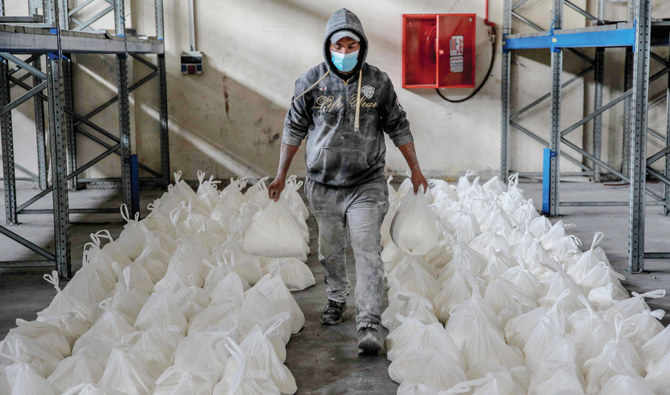
CAIRO: Trucks of flour have reached northern Gaza for distribution to areas that have had no aid in four months, Palestinian media reported on Sunday, with famine looming in the enclave and truce talks between Israel and Hamas due to resume in Qatar.

A convoy of 12 trucks arrived in the north on Saturday — six in Gaza City and six in the Jabalia refugee camp — carrying supplies to also be distributed to the northernmost areas of Beit Lahiya and Beit Hanoun, the media and residents said.

The Hamas-linked Home Front media outlet reported that the aid was distributed by the “Popular Committees,” a group that includes leaders of powerful clans in Gaza. A Hamas source said the route was secured by Hamas security personnel.

Aid agencies have warned that pockets of Gaza already face famine, with hospitals in the north reporting children dying of malnutrition and dehydration.

The hunger crisis has piled international pressure on Israel more than five months into its ground and air campaign in Gaza, triggered by the Oct. 7 Hamas attack, with more talks for a ceasefire and hostage exchange expected in the coming days.

Israel’s military campaign in Gaza has now killed more than 31,500 Palestinians, according to health authorities in Hamas-run Gaza.

An Israeli strike overnight killed 12 people in one house in Deir Al-Balah in the center of the tiny, crowded Gaza Strip, the Health Ministry said, among 92 people it said had been killed.

German Chancellor Olaf Scholz said on Sunday after talks with Jordanian King Abdullah in Jordan that the large number of civilian casualties that would result from such an assault would make regional peace “very difficult.”

A source familiar with the truce talks in Qatar said the head of Israel’s Mossad intelligence agency would join the delegation attending the negotiations with Qatari, Egyptian and US mediators and was expected in Doha on Sunday.

Hamas presented a new ceasefire proposal last week including an exchange of Israeli hostages and Palestinian prisoners. Israel’s security Cabinet is to meet to discuss it before the delegation leaves.

Netanyahu has already said the proposal was based on “unrealistic demands,” but a Palestinian official familiar with mediation efforts said chances for a deal looked better with Hamas having given more details on the proposed prisoner swap.

“The mediators felt positive about Hamas’ new proposal. Some in Israel felt the group made some improvement on its previous position and it is now in the hands of Netanyahu alone to say whether an agreement is imminent,” said the official, who asked not to be named.

With the situation increasingly dire, donors have turned to deliveries by air or sea.

Multiple governments have begun daily aid airdrops over Gaza, while the new maritime corridor is to be complemented by a US-military-built temporary pier.

But air and sea missions are no alternative to land deliveries, UN agencies say. Humanitarians have cited Israeli restrictions as among the obstacles they face.


Syrian government and SDF agree to de-escalate after Aleppo violence

Updated 37 min 40 sec ago
Follow

Syrian government and SDF agree to de-escalate after Aleppo violence

  • Turkiye views the US-backed SDF, which controls swathes of northeastern Syria, as a ⁠terrorist organization and has warned of military action if the group does not honor the agreement

DAMASCUS: Syrian government forces and the Kurdish-led Syrian Democratic Forces agreed to de-escalate on Monday evening in the northern city of Aleppo, after a wave of attacks that both sides blamed on each other left at least two civilians dead and several wounded.
Syria’s state news agency SANA, citing the defense ministry, said the army’s general command issued an order to stop targeting the SDF’s fire sources. The SDF said in a statement later that it had issued instructions to stop responding ‌to attacks ‌by Syrian government forces following de-escalation contacts.

HIGHLIGHTS

• SDF and Syrian government forces blame each other for Aleppo violence

• Turkiye threatens military action if SDF fails integration deadline

• Aleppo schools and offices closed on Tuesday following the violence

The Syrian health ministry ‌said ⁠two ​people ‌were killed and several were wounded in shelling by the SDF on residential neighborhoods in the city. The injuries included two children and two civil defense workers. The violence erupted hours after Turkish Foreign Minister Hakan Fidan said during a visit to Damascus that the SDF appeared to have no intention of honoring a commitment to integrate into the state’s armed forces by an agreed year-end deadline.
Turkiye views the US-backed SDF, which controls swathes of northeastern Syria, as a ⁠terrorist organization and has warned of military action if the group does not honor the agreement.
Integrating the SDF would ‌mend Syria’s deepest remaining fracture, but failing to do ‍so risks an armed clash that ‍could derail the country’s emergence from 14 years of war and potentially draw in Turkiye, ‍which has threatened an incursion against Kurdish fighters it views as terrorists.
Both sides have accused the other of stalling and acting in bad faith. The SDF is reluctant to give up autonomy it won as the main US ally during the war, which left it with control of Islamic ​State prisons and rich oil resources.
SANA, citing the defense ministry, reported earlier that the SDF had launched a sudden attack on security forces ⁠and the army in the Sheikh Maqsoud and Ashrafiyah neighborhoods of Aleppo, resulting in injuries.
The SDF denied this and said the attack was carried out by factions affiliated with the Syrian government. It said those factions were using tanks and artillery against residential neighborhoods in the city.
The defense ministry denied the SDF’s statements, saying the army was responding to sources of fire from Kurdish forces. “We’re hearing the sounds of artillery and mortar shells, and there is a heavy army presence in most areas of Aleppo,” an eyewitness in Aleppo told Reuters earlier on Monday. Another eyewitness said the sound of strikes had been very strong and described the situation as “terrifying.”
Aleppo’s governor announced a temporary suspension of attendance in all public and private schools ‌and universities on Tuesday, as well as government offices within the city center.