

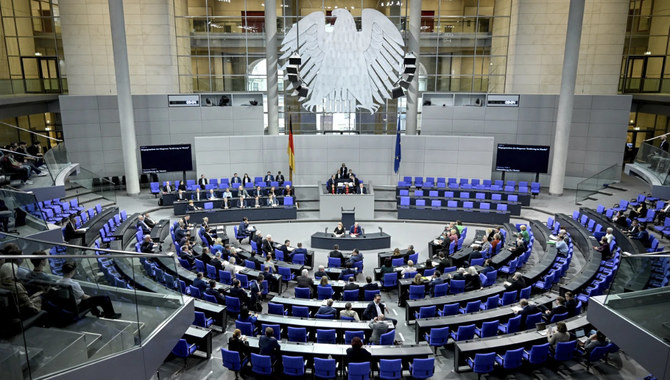
Germany’s parliament rejects new opposition call to send Taurus missiles to Ukraine

Members of the Bundestag debate in Berlin during over whether to send Taurus long-range cruise missiles to Ukraine to boost its fight against Russian invasion. (AP)
Short Url
Updated 15 March 2024
Follow

Germany’s parliament rejects new opposition call to send Taurus missiles to Ukraine

  • Germany has become the second-biggest supplier of military aid to Ukraine after the United States, but Scholz has stalled for months on Ukraine’s desire for Taurus missiles
  • Chancellor Olaf Scholz defended his refusal to supply the weapons on Wednesday, telling lawmakers that prudence is a virtue and rejected suggestions that he doesn’t trust Kyiv

BERLIN: German lawmakers on Thursday rejected a new call by the opposition for the government to send Taurus long-range cruise missiles to Ukraine, a day after Chancellor Olaf Scholz defended his refusal to supply the weapons.

The main center-right opposition bloc has sought to keep up pressure on the issue and exploit divisions in Scholz’s unpopular three-party coalition, even as the German leader tries to put a lid on the debate. On Wednesday, he told lawmakers that prudence is a virtue and rejected suggestions that he doesn’t trust Kyiv.

Parliament’s lower house, or Bundestag, rejected the opposition Union bloc’s motion by 495 votes to 190, with five abstentions.

Germany has become the second-biggest supplier of military aid to Ukraine after the United States, but Scholz has stalled for months on Ukraine’s desire for Taurus missiles, which have a range of up to 500 kilometers (310 miles) and could in theory be used against targets far into Russian territory.

His position has frustrated the conservative opposition and parts of Scholz’s own coalition. The criticism didn’t diminish after Scholz finally offered a detailed explanation last month, pointing to his insistence that Germany must not become directly involved in the war.

Lawmakers last month urged the government to deliver further long-range weapons to Ukraine but voted down a previous opposition call explicitly urging it to send Taurus missiles.

Critics reject Scholz’s argument that Taurus missiles could only be used responsibly with the involvement of German soldiers, whether inside or outside Ukraine. That, he said Wednesday, is “a line that I as chancellor do not want to cross.”

The “supposed prudence has always only fueled Mr. (Russian President Vladimir) Putin in his aggression against Ukraine — that is the result,” opposition lawmaker Johann Wadephul told lawmakers. “He will only retreat if he is only forced to. Either we enable Ukraine to win the war or we will lose with it. There is no third way.”

Rolf Mützenich, who leads the parliamentary group of Scholz’s Social Democrats, suggested that the debate was being driven by domestic political motives.

“Germany is the country that, after the United States, does most for Ukraine,” he said.

A senior lawmaker with the Greens, one of Scholz’s junior coalition partners, made clear that her party continues to back sending Taurus missiles but rejected what she called “shop-window motions” by the opposition. Agnieszka Brugger noted that any decision can only be made by senior ministers.

But she said that “hesitation and procrastination also can ultimately contribute to escalation” and rejected Scholz’s attempts to shut down the debate. She said that France and Britain have sent similar missiles and that hasn’t meant a further escalation.


Danish intelligence report warns of US military threat under Trump

Updated 5 sec ago
Follow

Danish intelligence report warns of US military threat under Trump

  • “The strategic importance of the Arctic is rising as the conflict between Russia and the West intensifies,” said the report
  • The findings and analyzes in the report echo a string of recent concerns, notably in Western Europe

COPENHAGEN: The United States is using its economic power to “assert its will” and threaten military force against friend and foe alike, a Danish intelligence agency said in a new report.
The Danish Defense Intelligence Service, in its latest annual assessment, said Washington’s greater assertiveness under the Trump administration also comes as China and Russia seek to diminish Western, especially American, influence.
Perhaps most sensitive to Denmark — a NATO and European Union member country, and a US ally — is growing competition between those great powers in the Arctic. US President Donald Trump has expressed a desire to see Greenland, a semiautonomous and mineral-rich territory of Denmark, become part of the United States, a move opposed by Russia and much of Europe.
“The strategic importance of the Arctic is rising as the conflict between Russia and the West intensifies, and the growing security and strategic focus on the Arctic by the United States will further accelerate these developments,” said the report, published Wednesday.
Russian President Vladimir Putin has said Russia is worried about NATO’s activities in the Arctic and will respond by strengthening its military capability in the polar region.
The findings and analyzes in the report echo a string of recent concerns, notably in Western Europe, about an increasingly go-it-alone approach by the United States, which under Trump’s second term has favored bilateral deals and partnerships at the expense of multilateral alliances like NATO.
“For many countries outside the West, it has become a viable option to forge strategic agreements with China rather than the United States,” read the report, which was written in Danish. “China and Russia, together with other like-minded states, are seeking to reduce Western – and particularly US – global influence.”
“At the same time, uncertainty has grown over how the United States will prioritize its resources in the future,” it added. “This gives regional powers greater room for maneuver, enabling them to choose between the United States and China or to strike a balance between the two.”
The Trump administration has raised concerns about respect for international law with its series of deadly strikes on alleged drug-smuggling boats in the Caribbean Sea and eastern Pacific Ocean — part of a stepped-up pressure campaign against President Nicolás Maduro of Venezuela.
Trump has also refused to rule out military force in Greenland, where the United States already has a military base.
“The United States is leveraging economic power, including threats of high tariffs, to assert its will, and the possibility of employing military force – even against allies – is no longer ruled out,” the report said.