BAMIYAN, Afghanistan: Sitting in his modest home beneath snow-dusted hills in Afghanistan’s Bamiyan province, Nimatullah Rahesh expressed relief to have found somewhere to “live peacefully” after months of uncertainty.
Rahesh is one of millions of Afghans pushed out of Iran and Pakistan, but despite being given a brand new home in his native country, he and many of his recently returned compatriots are lacking even basic services.
“We no longer have the end-of-month stress about the rent,” he said after getting his house, which was financed by the UN refugee agency on land provided by the Taliban authorities.
Originally from a poor and mountainous district of Bamiyan, Rahesh worked for five years in construction in Iran, where his wife Marzia was a seamstress.
“The Iranians forced us to leave” in 2024 by “refusing to admit our son to school and asking us to pay an impossible sum to extend our documents,” he said.
More than five million Afghans have returned home since September 2023, according to the International Organization for Migration (IOM), as neighboring Iran and Pakistan stepped up deportations.
The Rahesh family is among 30 to be given a 50-square-meter (540-square-foot) home in Bamiyan, with each household in the nascent community participating in the construction and being paid by UNHCR for their work.
The families, most of whom had lived in Iran, own the building and the land.
“That was crucial for us, because property rights give these people security,” said the UNHCR’s Amaia Lezertua.
Waiting for water
Despite the homes lacking running water and being far from shops, schools or hospitals, new resident Arefa Ibrahimi said she was happy “because this house is mine, even if all the basic facilities aren’t there.”
Ibrahimi, whose four children huddled around the stove in her spartan living room, is one of 10 single mothers living in the new community.
The 45-year-old said she feared ending up on the street after her husband left her.
She showed AFP journalists her two just-finished rooms and an empty hallway with a counter intended to serve as a kitchen.
“But there’s no bathroom,” she said. These new houses have only basic outdoor toilets, too small to add even a simple shower.
Ajay Singh, the UNHCR project manager, said the home design came from the local authorities, and families could build a bathroom themselves.
There is currently no piped water nor wells in the area, which is dubbed “the dry slope” (Jar-e-Khushk).
Ten liters of drinking water bought when a tanker truck passes every three days costs more than in the capital Kabul, residents said.
Fazil Omar Rahmani, the provincial head of the Ministry of Refugees and Repatriation Affairs, said there were plans to expand the water supply network.
“But for now these families must secure their own supply,” he said.
Two hours on foot
The plots allocated by the government for the new neighborhood lie far from Bamiyan city, which is home to more than 70,000 people.
The city grabbed international attention in 2001, when the Sunni Pashtun Taliban authorities destroyed two large Buddha statues cherished by the predominantly Shia Hazara community in the region.
Since the Taliban government came back to power in 2021, around 7,000 Afghans have returned to Bamiyan according to Rahmani.
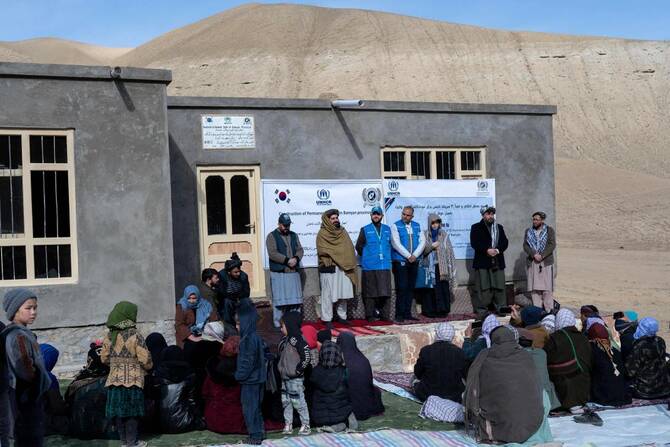
The new project provides housing for 174 of them. At its inauguration, resident Rahesh stood before his new neighbors and addressed their supporters.
“Thank you for the homes, we are grateful, but please don’t forget us for water, a school, clinics, the mobile network,” which is currently nonexistent, he said.
Rahmani, the ministry official, insisted there were plans to build schools and clinics.
“There is a direct order from our supreme leader,” Hibatullah Akhundzada, he said, without specifying when these projects will start.
In the meantime, to get to work at the market, Rahesh must walk for two hours along a rutted dirt road between barren mountains before he can catch a ride.
Only 11 percent of adults found full-time work after returning to Afghanistan, according to an IOM survey.
Ibrahimi, meanwhile, is contending with a four-kilometer (2.5-mile) walk to the nearest school when the winter break ends.
“I will have to wake my children very early, in the cold. I am worried,” she said.


Afghan returnees in Bamiyan struggle despite new homes
https://arab.news/6z5j7
Afghan returnees in Bamiyan struggle despite new homes

- More than five million Afghans have returned home since September 2023, according to the International Organization for Migration


Afghanistan says it thwarted Pakistani airstrike on Bagram Air Base as fighting enters fourth day
- The fighting has been the most severe between the neighbors for years
- Pakistan accuses Taliban government of harboring militant groups that stage attacks against it
KABUL: Afghanistan thwarted attempted airstrikes on Bagram Air Base, the former US military base north of Kabul, authorities said Sunday, while cross-border fighting between Pakistan and Afghanistan stretched into a fourth day.
The fighting has been the most severe between the neighbors for years, with Pakistan declaring that it’s in “open war” with Afghanistan.
The conflict has alarmed the international community, particularly as the area is one where other militant organizations, including Al-Qaeda and the Daesh group, still have a presence and have been trying to resurface.
Pakistan accuses Afghanistan’s Taliban government of harboring militant groups that stage attacks against it and also of allying with its archrival India.
Border clashes in October killed dozens of soldiers, civilians and suspected militants until a Qatari-mediated ceasefire ended the intense fighting. But several rounds of peace talks in Turkiye in November failed to produce a lasting agreement, and the two sides have occasionally traded fire since then.
On Sunday, the police headquarters of Parwan province, where Bagram is located, said in a statement that several Pakistani military jets had entered Afghan airspace “and attempted to bomb Bagram Air Base” at around 5 a.m.
The statement said Afghan forces responded with “anti-aircraft and missile defense systems” and had managed to thwart the attack.
There was no immediate response from Pakistan’s military or government regarding Kabul’s claim of attempted airstrikes on Bagram or the ongoing fighting.
Bagram was the United States’ largest military base in Afghanistan. It was taken over by the Taliban as they swept across the country and took control in the wake of the chaotic US withdrawal from the country in 2021. Last year, US President Donald Trump suggested he wanted to reestablish a US presence at the base.
The current fighting began when Afghanistan launched a broad cross-border attack on Thursday night, saying it was in retaliation for Pakistani airstrikes the previous Sunday.
Pakistan had said its airstrike had targeted the outlawed Pakistani Taliban, also known as Tehreek-e-Taliban Pakistan, or TTP. Afghanistan had said only civilians were killed.
The TTP militant group, which is separate but closely allied with Afghanistan’s ruling Taliban, operates inside Pakistan, where it has been blamed for hundreds of deaths in bombings and other attacks over the years.
Pakistan accuses Afghanistan’s Taliban government of providing a safe haven within Afghanistan for the TTP, an accusation that Afghanistan denies.
After Thursday’s Afghan attack, Pakistani Defense Minister Khawaja Mohammad Asif declared that “our patience has now run out. Now it is open war between us.”
In the ongoing fighting, each side claims to have killed hundreds of the other side’s forces — and both governments put their own casualties at drastically lower numbers.
Two Pakistani security officials said that Pakistani ground forces were still in control on Sunday of a key Afghan post and a 32-square-kilometer area in the southern Zhob sector near Kandahar province, after having seized it during fighting Friday. The captured post and surrounding area remain under Pakistani control, they added. The officials spoke on condition of anonymity, because they weren’t authorized to speak publicly.
In Kabul, the Afghan government rejected Pakistan’s claims. Deputy government spokesman Hamdullah Fitrat called the reports “baseless.”
Afghan officials said that fighting had continued overnight and into Sunday in the border areas.
The police command spokesman for Nangarhar province, Said Tayyeb Hammad, said that anti-aircraft missiles were used from the provincial capital, Jalalabad, and surrounding areas on Pakistani fighter jets flying overhead Sunday morning.
Defense Ministry spokesman Enayatulah Khowarazmi said that Afghan forces had launched counterattacks with snipers across the border from Nangarhar, Paktia, Khost and Kandahar provinces overnight. He said that two Pakistani drones had been shot down and dozens of Pakistani soldiers had been killed.
Fitrat said that Pakistani drone attacks hit civilian homes in Nangarhar province late Saturday, killing a woman and a child, while mortar fire killed another civilian when it hit a home in Paktia province.
There was no immediate response to the claims from Pakistani officials.


